A Historic View of Australia: Endeavour River, New Holland, 1773
€ 350
One of a kind: this is the sheet in the photographs. Ships from Langweer, the Netherlands.
Date
1773
Technique
Engraved
Sheet size
25 × 38.5 cm (9.8 × 15.2 in)
Condition
Good
Reference
BG-13059-23
Condition
In very good condition, with some visible fold lines, which is common for antique prints of this age.
About this sheet
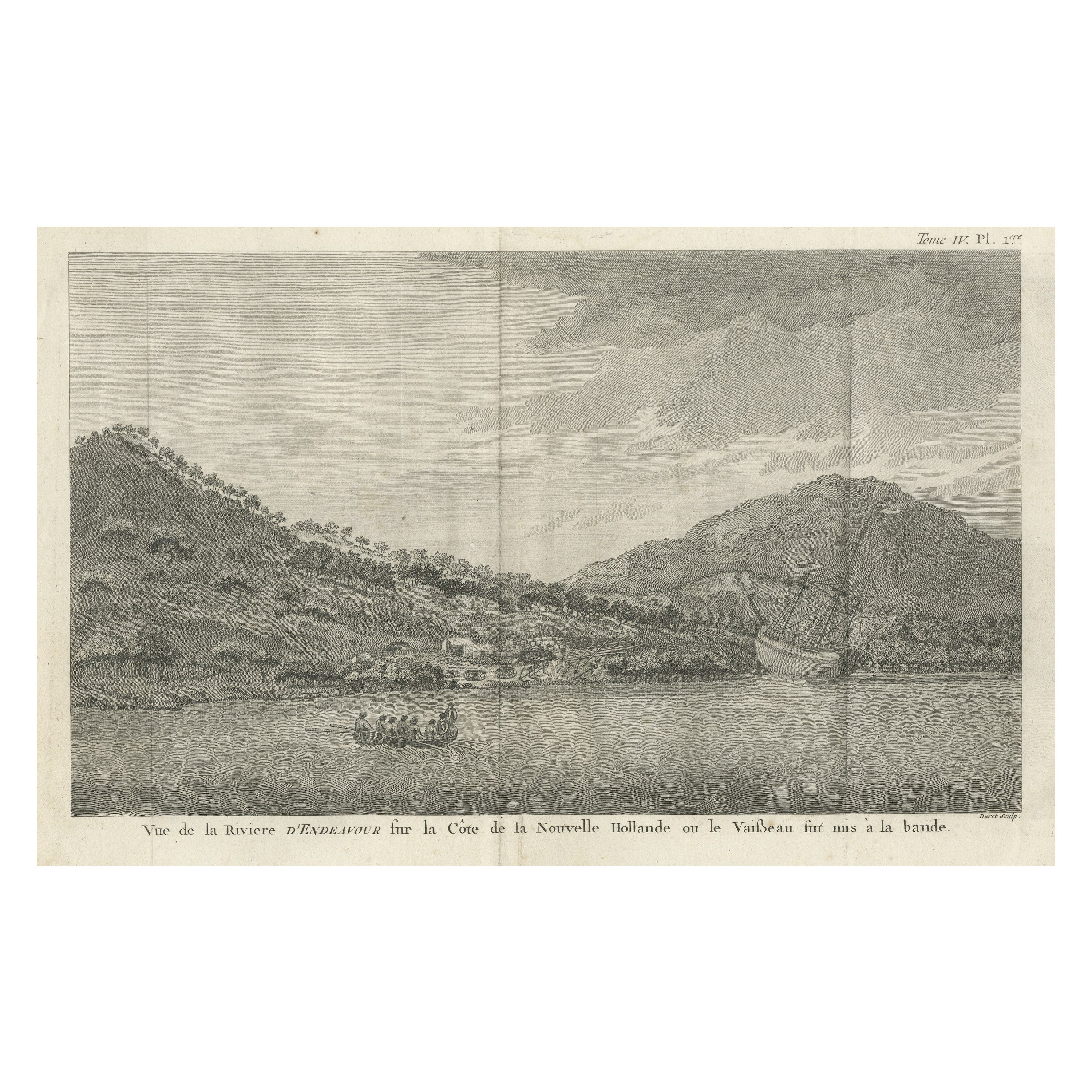
This historical print, titled "Vue de la Rivière d'Endeavour sur la Côte de la Nouvelle Hollande ou le Vaisseau fut mis à la bande," is a significant representation of the east coast of Australia during the late 18th century. Here's a description of this remarkable artwork:
- Title: Vue de la Rivière d'Endeavour sur la Côte de la Nouvelle Hollande ou le Vaisseau fut mis à la bande. [Tome IV Pl. 1ère.]
- Publisher: Captain James Cook, with publication in Paris in 1773.
- Coloring: Uncolored.
- Size: Approximately 200 x 340 mm (7.9 x 13.4 inches).
- Condition: In very good condition, with some visible fold lines, which is common for antique prints of this age.
- Description: This print is historically significant as it represents the first known landscape drawing of the east coast of Australia. It depicts a view of the Endeavour River on the coast of New Holland (now Australia), where Captain James Cook's ship, the Endeavour, was intentionally grounded to undergo repairs after sustaining damage on a reef. The print provides a glimpse into the early exploration and navigation of this region.
- Artist: The engraving is drawn after Sydney Parkinson, a Scottish Quaker, botanical illustrator, and natural history artist. Parkinson accompanied Joseph Banks on James Cook's first voyage to the Pacific in 1768. During the voyage, he created numerous drawings of plants and animals collected by Banks and Daniel Solander. Parkinson's work was essential in documenting the flora and fauna of the newly discovered lands.
- Engraver: The engraving was executed by Duret.
This print offers a historical perspective on the exploration of Australia during the age of discovery and serves as a testament to the challenges and accomplishments of early explorers and naturalists like Sydney Parkinson. It provides a valuable glimpse into the landscapes and experiences of the time.