About this sheet
Antique South American Horned Frog Engraving – Bertuch, c. 1807
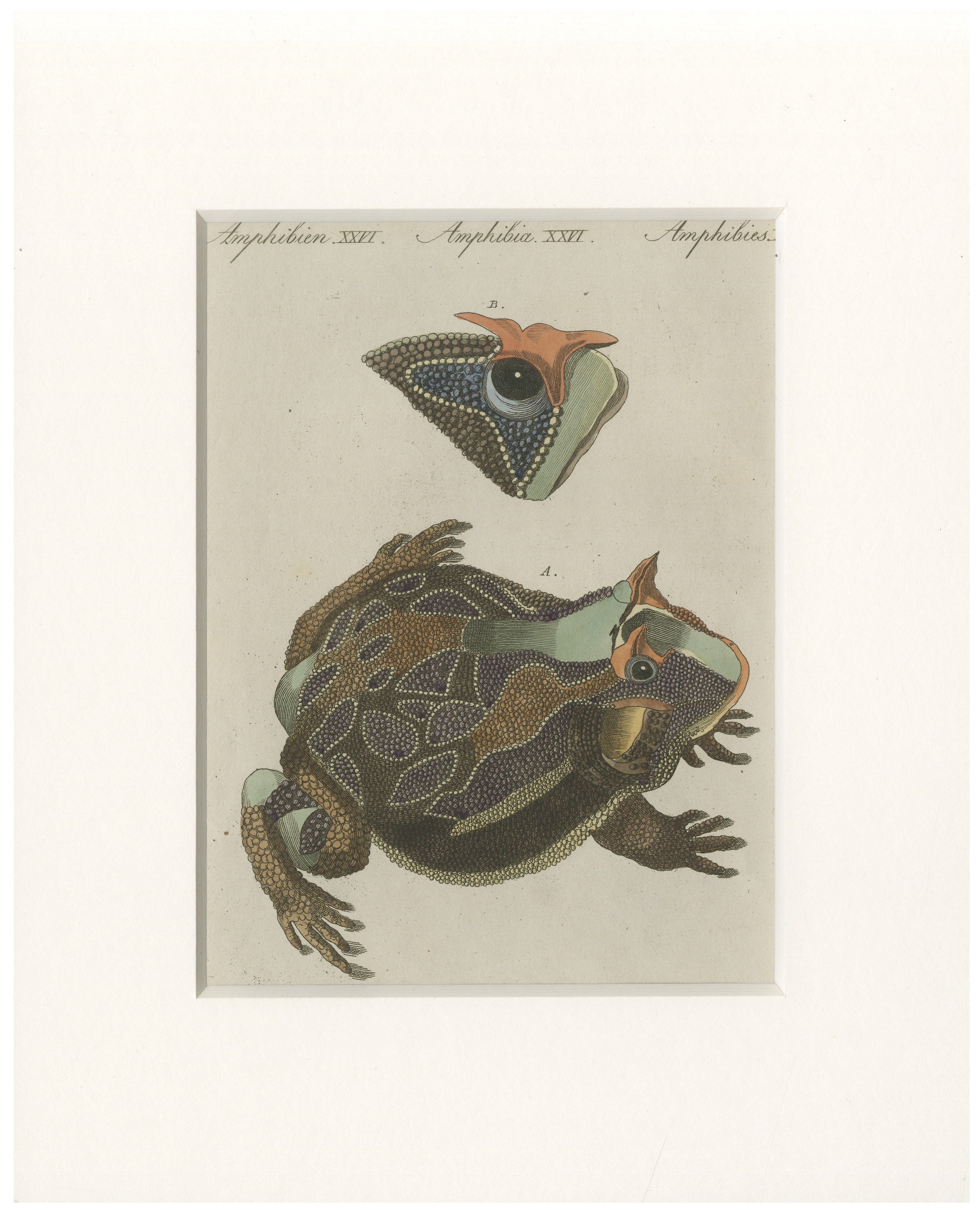
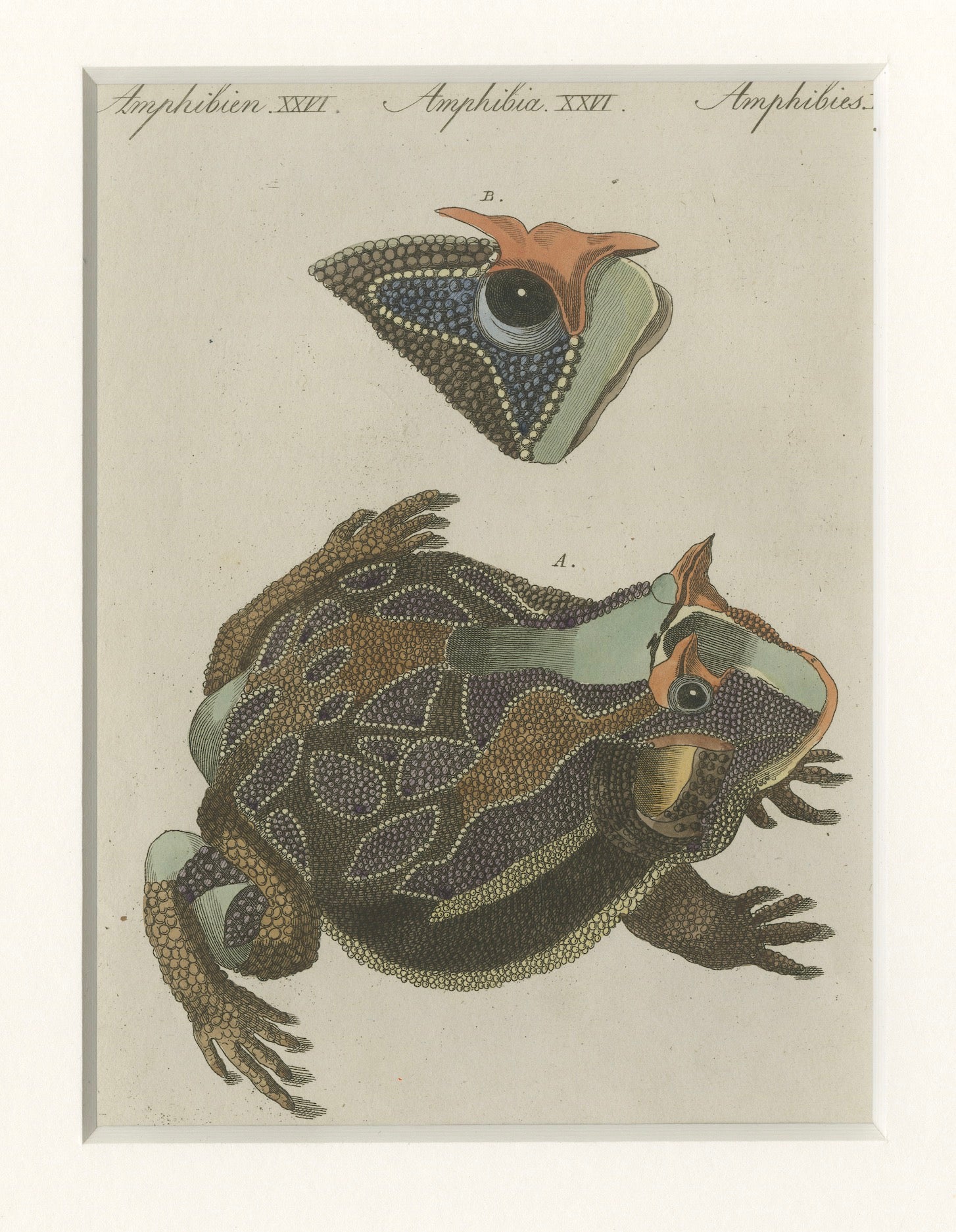
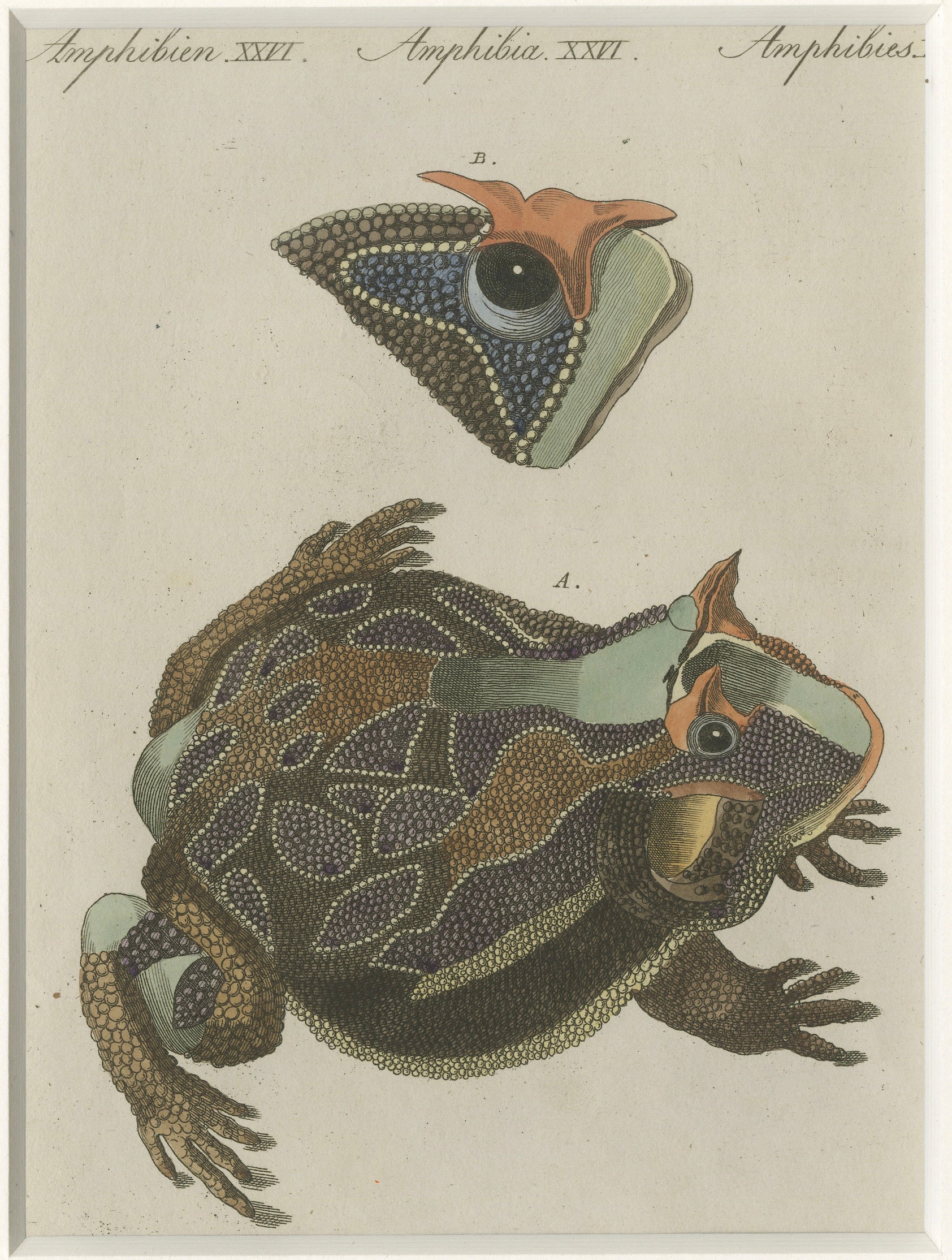
Original antique hand-colored copper engraving depicting an extraordinary South American horned frog, published in Friedrich Justin Bertuch’s celebrated “Bilderbuch für Kinder” in Weimar in the early 19th century.
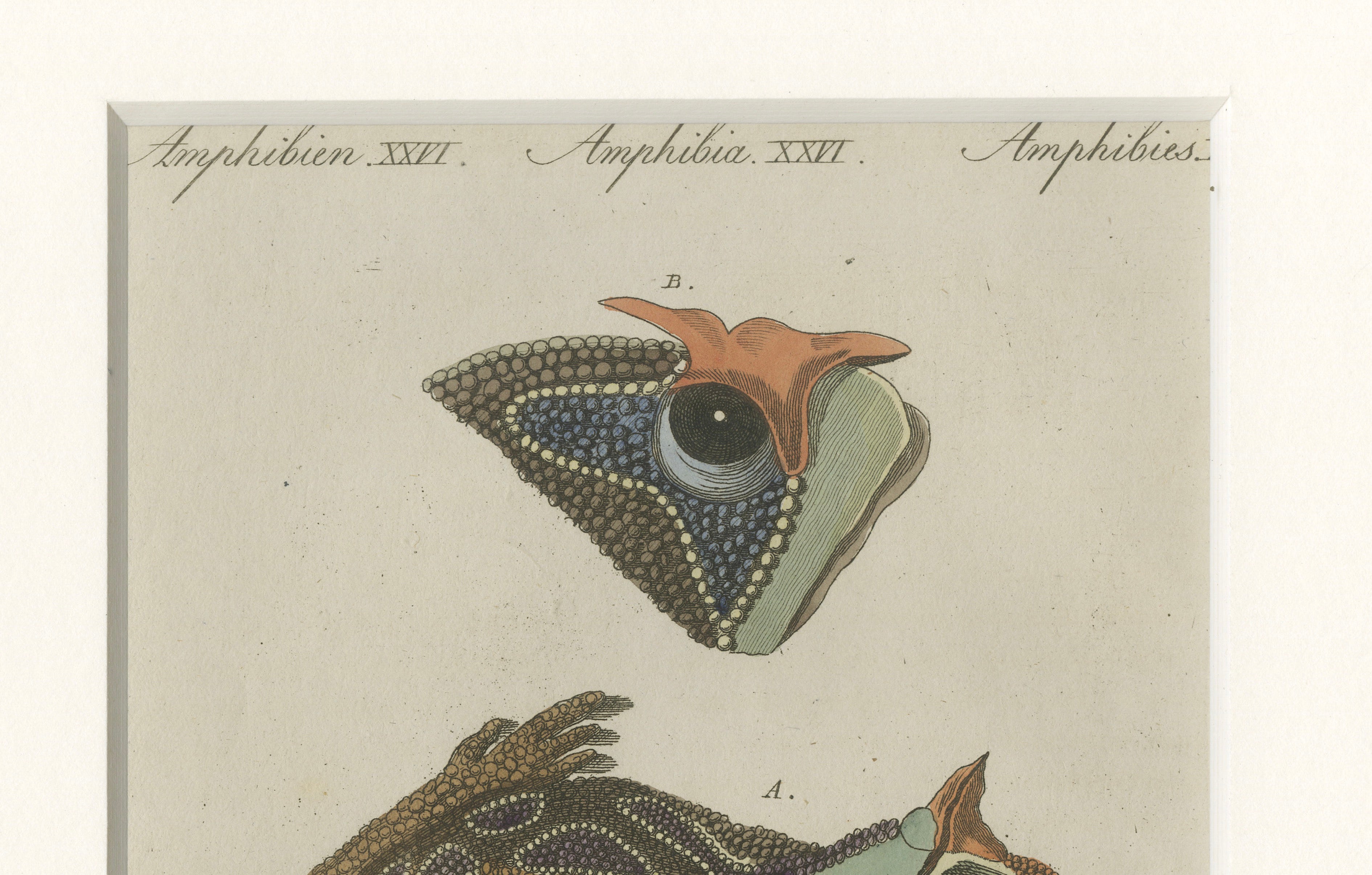
The plate is headed “Amphibien XXVI / Amphibia XXVI / Amphibies XXVI” and belongs to Bertuch’s series of remarkable amphibians.
The Horned Frog
Historical name: Rana cornuta
Common names: Horned Frog / South American Horned Frog / Horned Toad
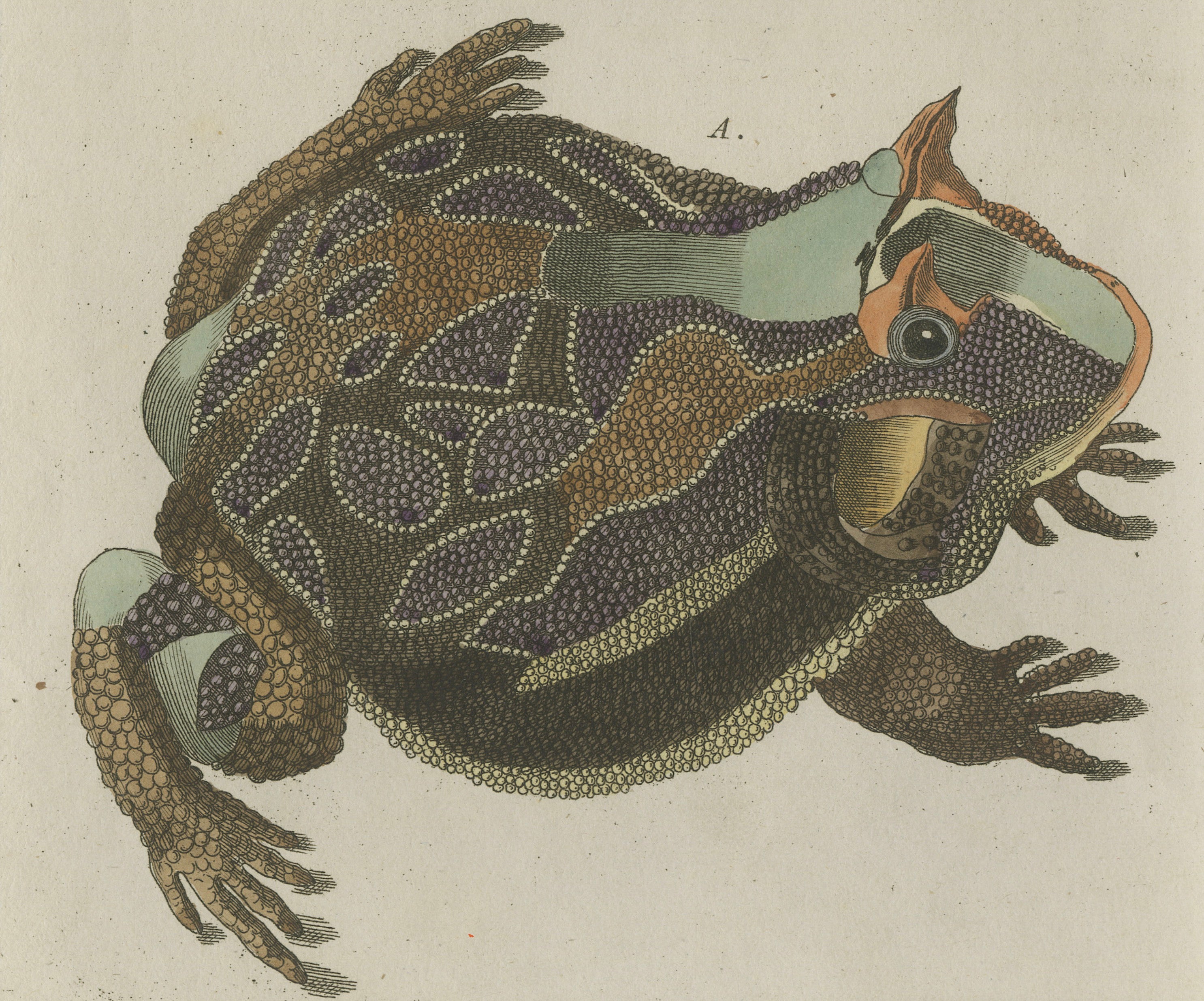
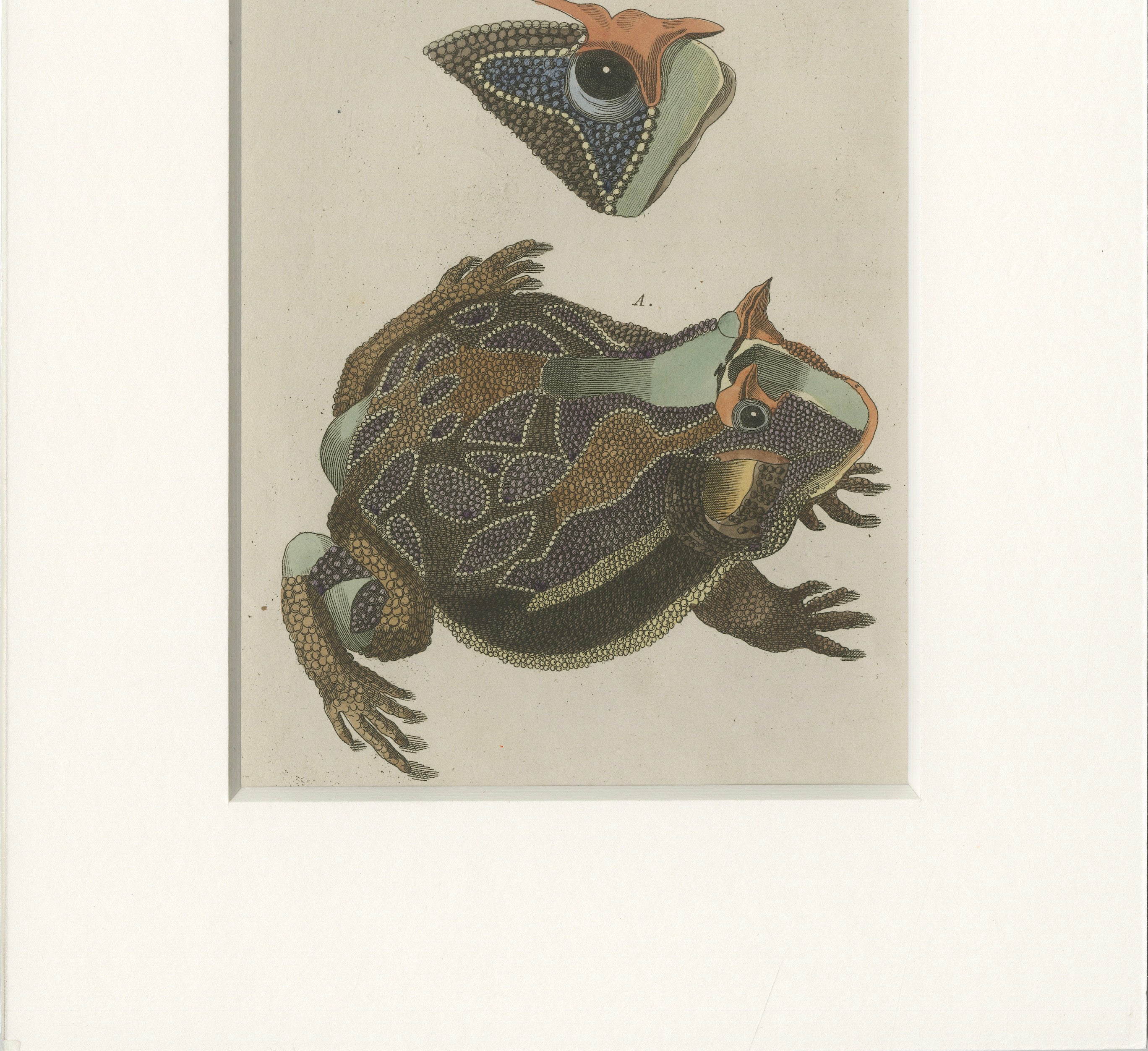
The plate shows the animal in a large three-quarter view, accompanied by a separate enlarged study of its remarkable head and eye.
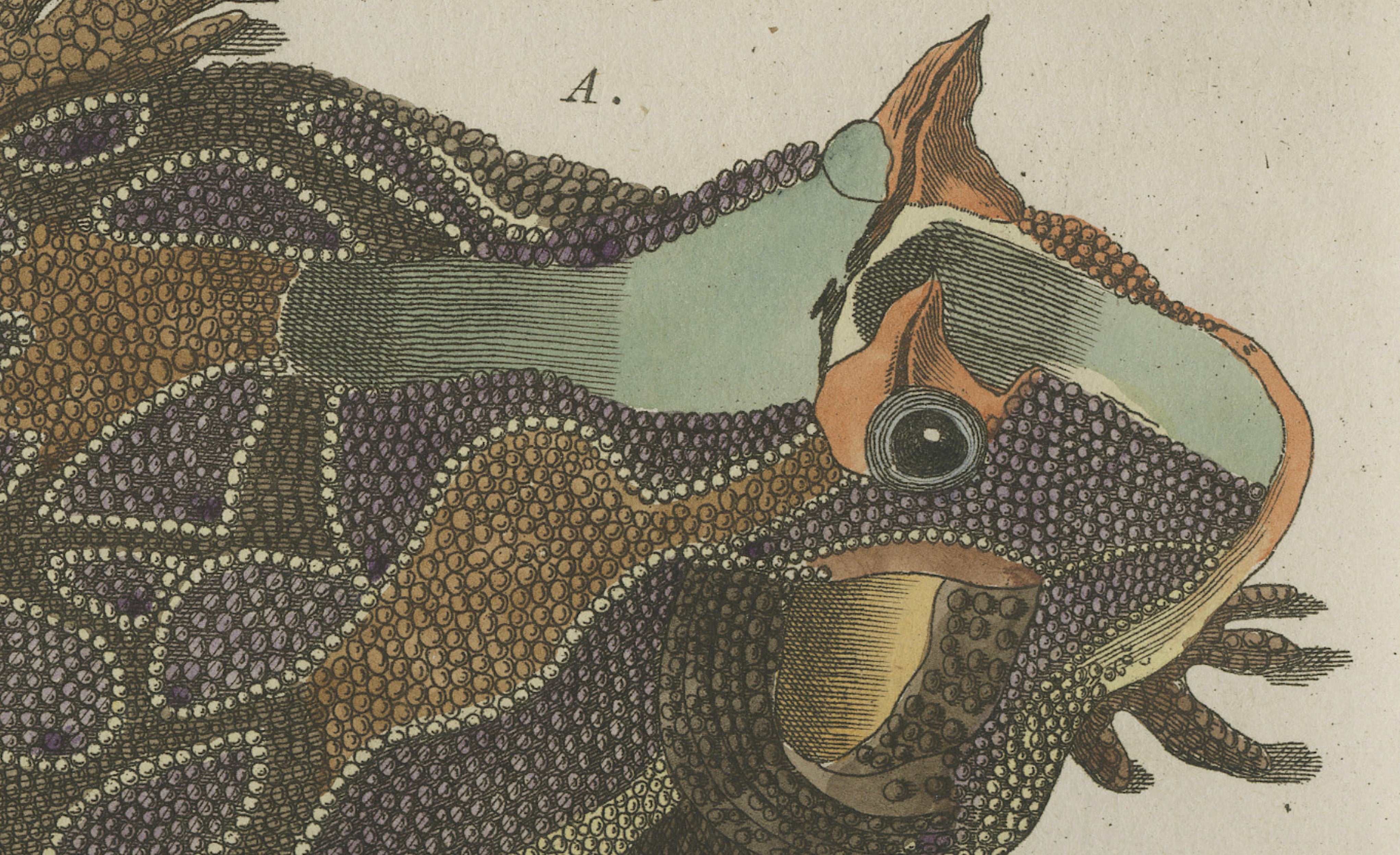
The frog takes its name from the conspicuous pointed projections above its eyes, which resemble small horns. Its broad head, enormous mouth and heavily patterned body give it an almost fantastical appearance.
Bertuch describes the animal as “Die gehörnte Kröte” – the Horned Toad – and records it from South America, including Brazil and the island of Santa Catarina.
Particularly interesting is Bertuch’s statement that earlier European illustrations of the animal had been based on faded specimens preserved in alcohol and were therefore inaccurate.
The present illustration was instead derived from a study made from life by the German naturalist and explorer Wilhelm Gottlieb Tilesius (1769–1857), allowing its remarkable coloration and physical characteristics to be represented much more accurately.
Bertuch specifically draws attention to the animal’s unusual coloration: a yellowish-brown body covered with pointed warts and decorated with violet-blue markings edged in white, together with areas of brilliant green and reddish-yellow horn-like eyelids.
The main figure, marked A, is shown reduced in size, while detail B illustrates the head at natural size. Bertuch even records an exceptionally large specimen weighing approximately four pounds.
Friedrich Justin Bertuch (1747–1822) was a German publisher, writer and patron of the arts. His monumental “Bilderbuch für Kinder” (Picture Book for Children), first published in Weimar in 1790, became one of the great illustrated educational encyclopedias of the late 18th and early 19th centuries.
Its hundreds of engraved and hand-colored plates introduced readers to animals, plants, geography, science, technology, antiquity and cultures from around the world.
This is an especially decorative and unusual natural-history plate. The monumental frog, intricate skin pattern and almost surreal horned head make it particularly striking compared with more conventional zoological illustrations from the series.
Technique: Original hand-colored copper engraving
Publisher: Friedrich Justin Bertuch / Industrie-Comptoir
Publication: Bilderbuch für Kinder
Place: Weimar, Germany
Date: early 19th century, circa 1807
Plate: Amphibien XXVI / Amphibia XXVI / Amphibies XXVI
Subject: Horned Frog / Horned Toad
Historical scientific name: Rana cornuta
After a life study by: Wilhelm Gottlieb Tilesius (1769–1857)
Origin of animal: South America, including Brazil
Condition:
Good antique condition with light overall age-related toning, scattered small spots and minor marks and imperfections consistent with its age. The original hand coloring remains particularly attractive, with green, violet, ochre and reddish tones. Please study the photographs carefully as they form part of the condition description.
The engraving is loosely inserted in an acid-free matting board.
Please note: This is an original antique hand-colored copper engraving from the early 19th century, not a modern reproduction. The print is sold unframed. Framed images or interior views, if shown, are for presentation and inspiration only.
Other companion animal, amphibian and natural-history plates from Bertuch’s “Bilderbuch für Kinder” are also available separately.
Keywords: Friedrich Justin Bertuch, Bilderbuch für Kinder, horned frog, horned toad, Rana cornuta, South American frog, Brazilian frog, Brazil natural history, Santa Catarina, amphibian engraving, antique frog print, frog illustration, toad engraving, Wilhelm Gottlieb Tilesius, Tilesius, antique zoology, antique natural history print, hand-colored copper engraving, amphibian print, herpetology, natural history illustration, Weimar, German engraving, early 19th century, original antique print