About this sheet
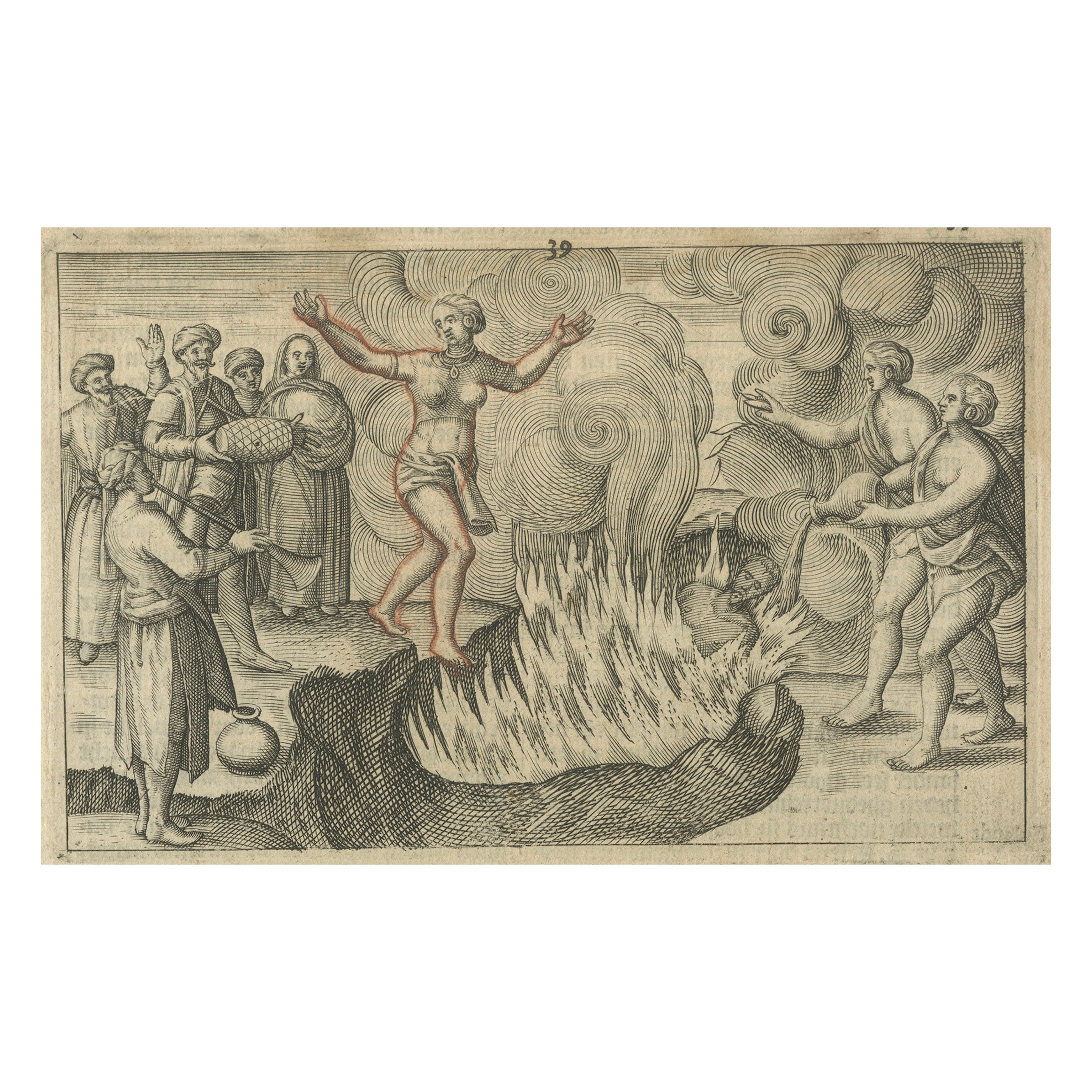
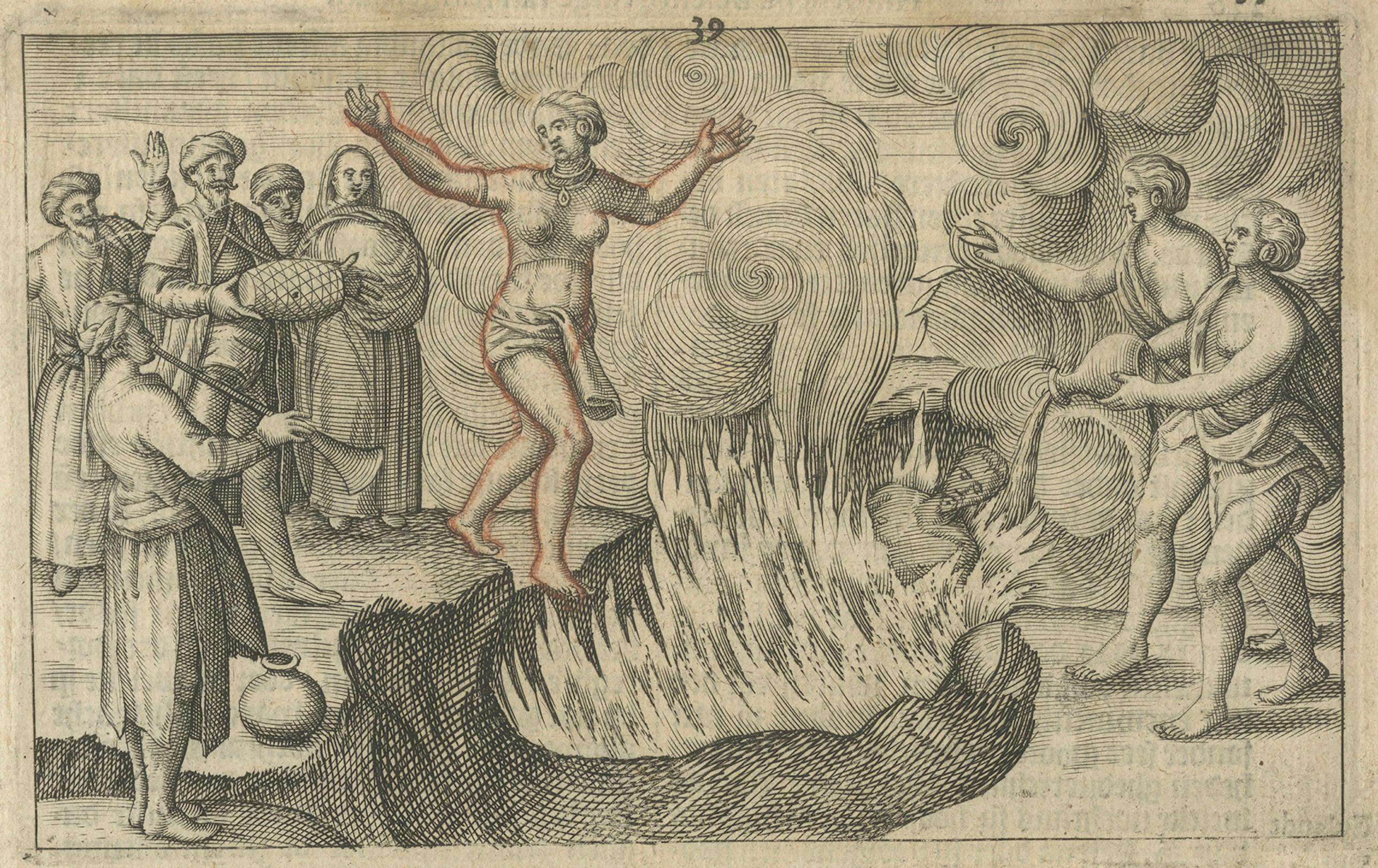
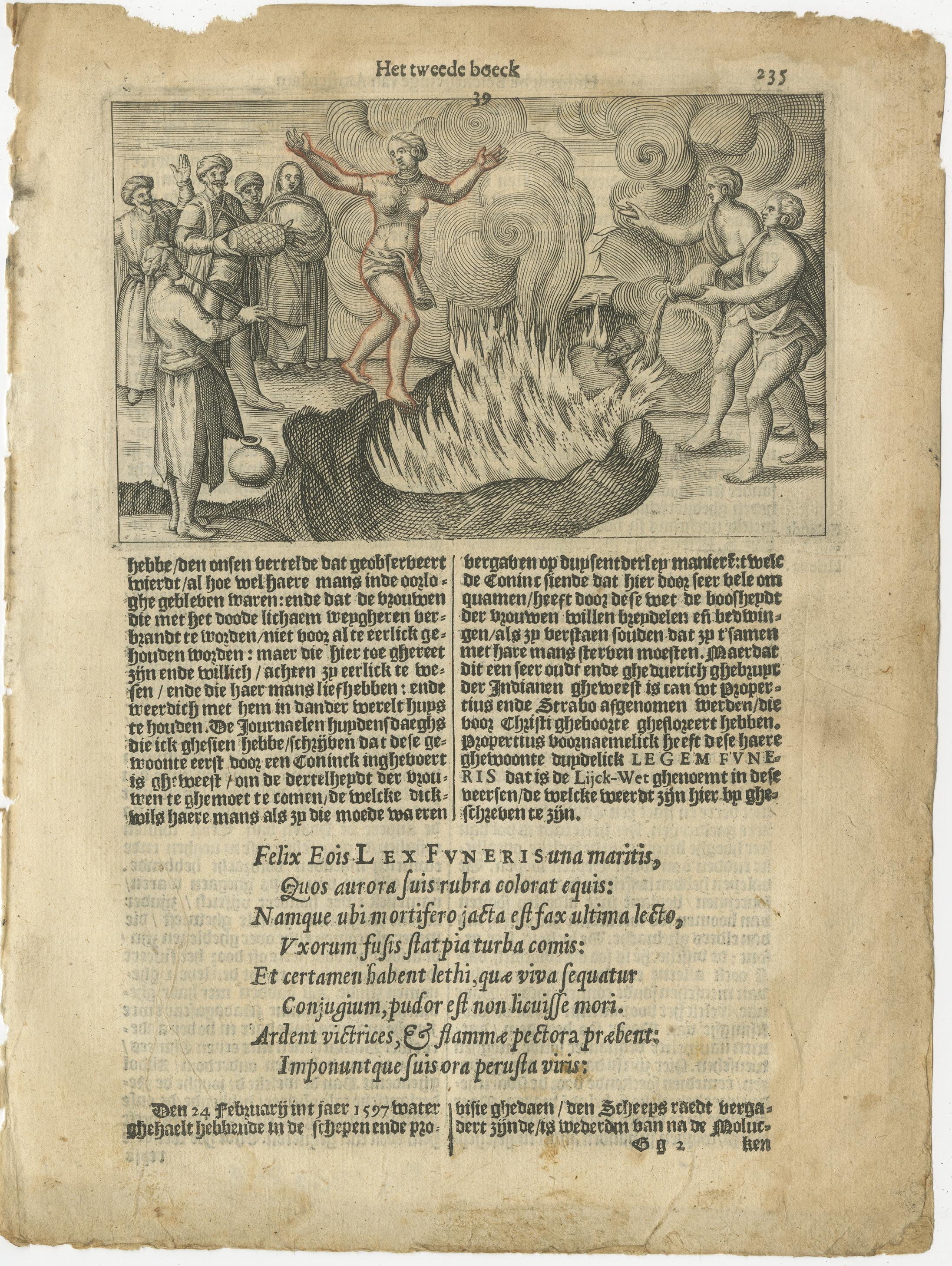
An exceptional early 17th-century Dutch engraving illustrating the Hindu ritual of sati, the self-immolation of a widow on her husband’s funeral pyre. The woman, shown stepping calmly into the flames with arms raised, is surrounded by musicians beating drums and blowing horns, while attendants pour offerings and gesture toward the fire. The composition conveys both ritual solemnity and the dramatic fascination with Eastern customs that captivated early European audiences.
This engraving appeared in *Itinerario, voyage ofte schipvaert van Jan Huygen van Linschoten naer Oost- ofte Portugaels Indien*, published in Amsterdam by Cornelis Claesz around 1598–1601. Linschoten’s work was the first comprehensive European account of the East Indies and India, describing their religions, customs, and commerce. The image is one of the earliest printed European representations of the sati ritual, based on descriptions circulating among Portuguese and Dutch observers in India at the end of the 16th century.
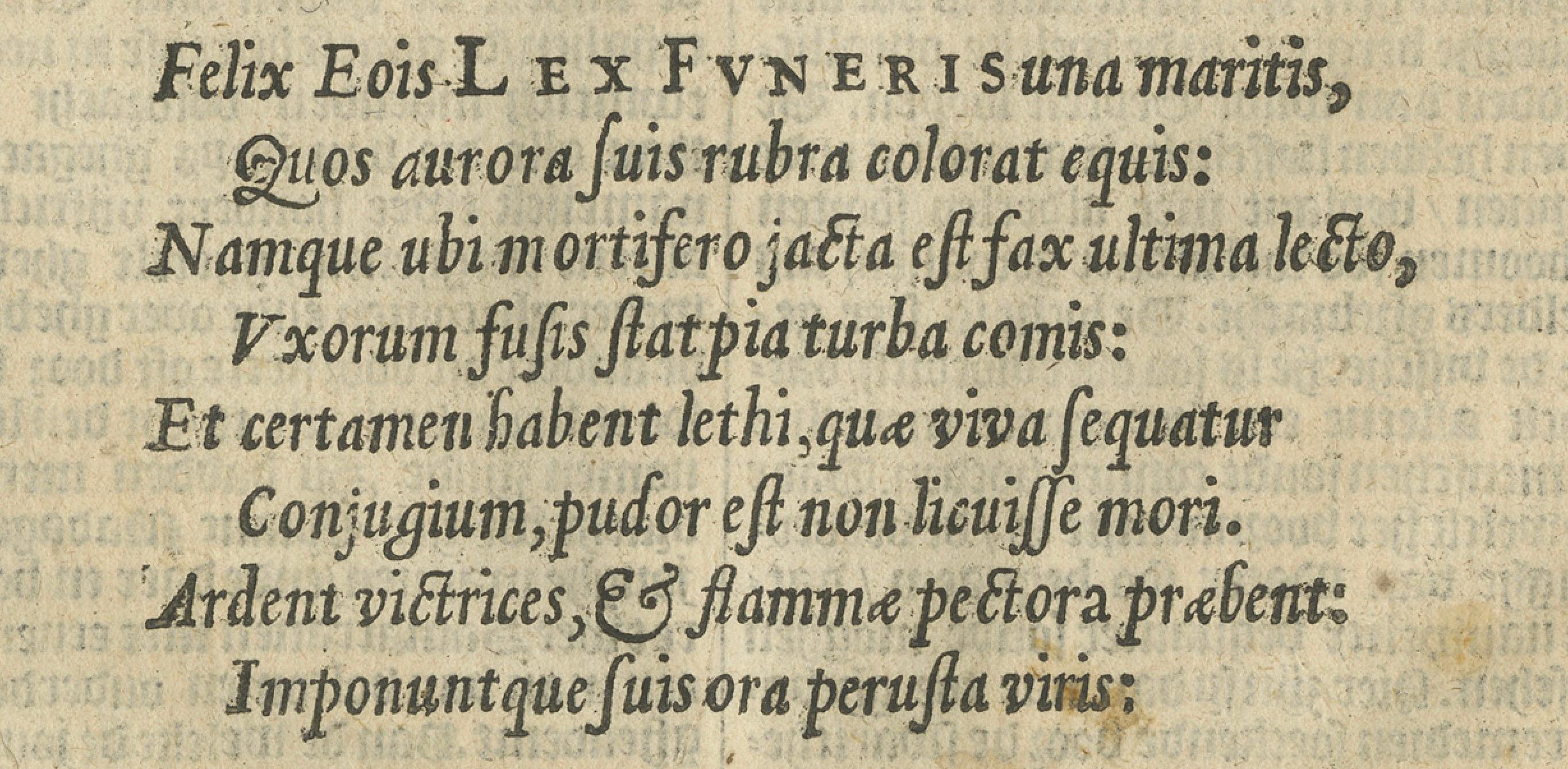
Below the image appears a Latin verse reflecting the European interpretation of the scene:
Felix Eois lex funeris una maritis,
Quos aurora suis rubra colorat equis:
Namque ubi mortifero jacta est fax ultima lecto,
Uxorum fusis stat pia turba comis:
Et certamen habent lethi, quae viva sequatur
Conjugium, pudor est non licuisse mori.
Ardent victrices, et flammae pectora praebent:
Imponuntque suis ora perusta viris.
Translation:
“Blessed is the Eastern law of funerals for husbands,
Whom the red dawn tints with its crimson steeds.
When the deadly torch is cast upon the pyre,
A devoted band of wives stands with loosened hair.
They compete in death, each striving to follow her spouse;
It is shameful not to die with one’s husband.
Victorious they burn, offering their hearts to the flames,
And press their scorched lips upon their husbands’ faces.”
The poem, while poetic, reveals the era’s romanticized misunderstanding of the practice, casting the widow’s sacrifice as noble devotion.
Condition:
Fair. Laid paper with age toning, small edge tears, and minor creasing; strong impression with visible plate mark. A colored line around the widow figure.
Framing tips:
Float-mount in a dark walnut or ebony frame with a warm off-white mat. A double-glass frame allows viewing of both sides of the original text leaf.
Technique: Copperplate engraving with letterpress text on laid paper
Maker: After Jan Huygen van Linschoten, Amsterdam, c.1601