About this sheet
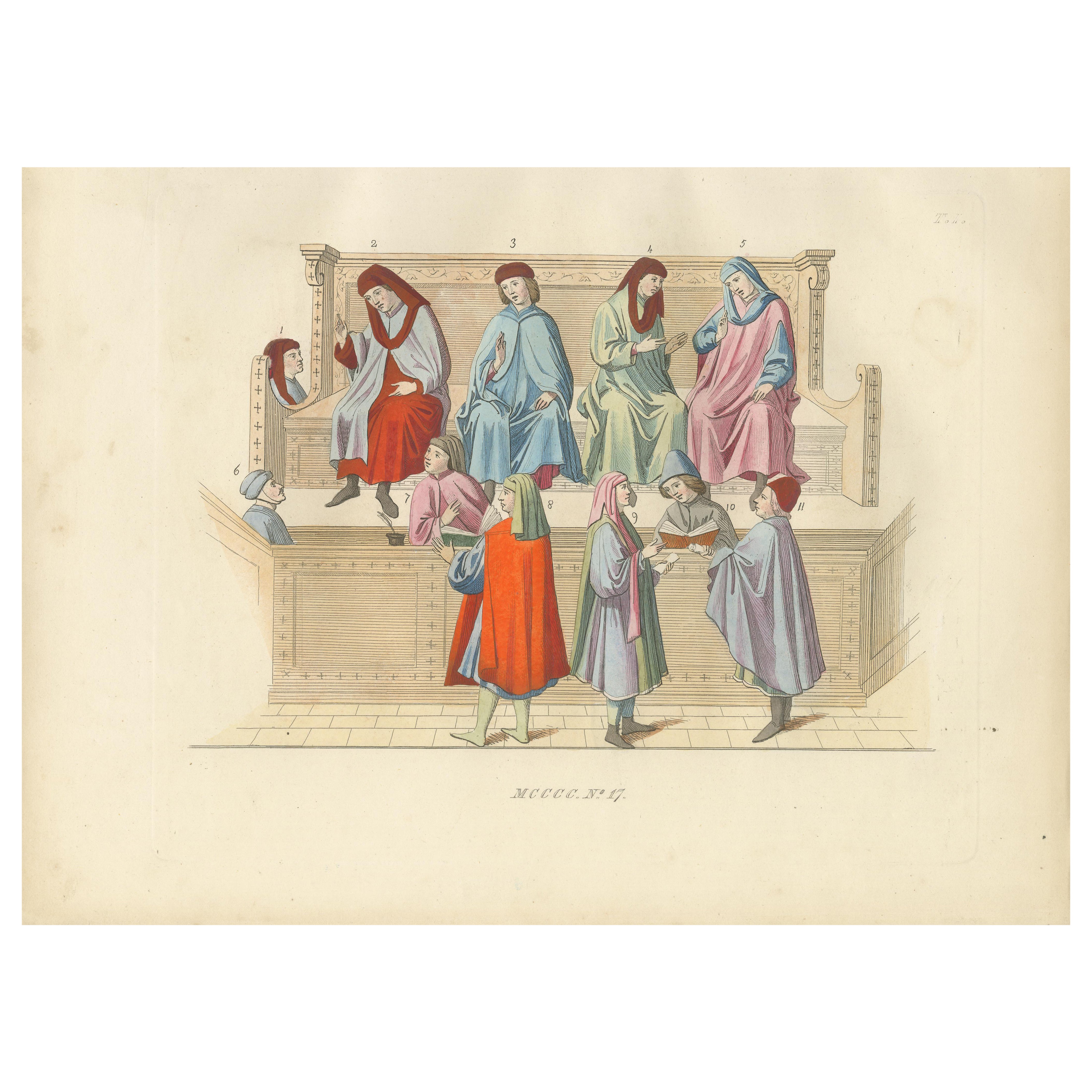
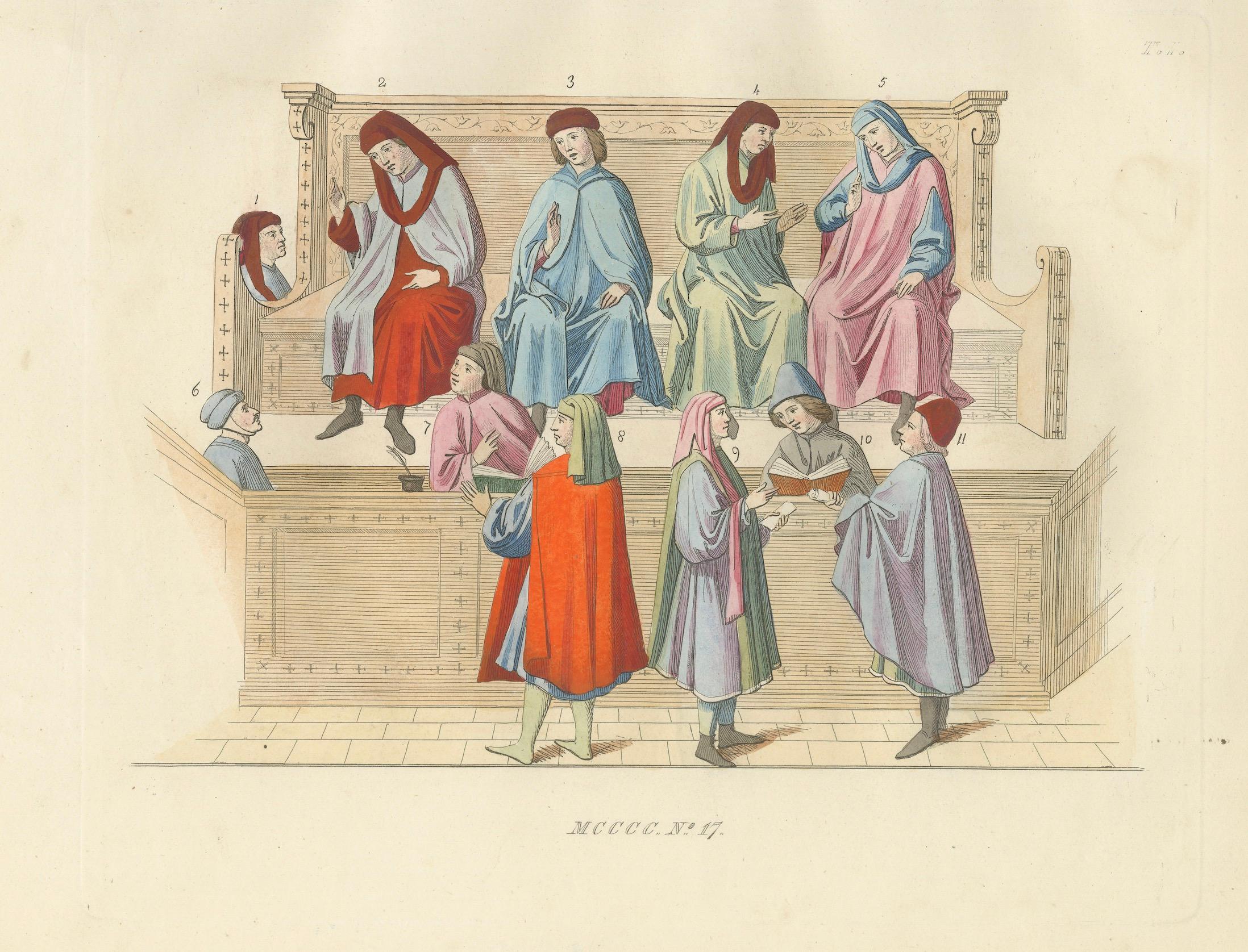
Merchant Courtroom Scene with Consuls and Petitioners in Medieval Italy
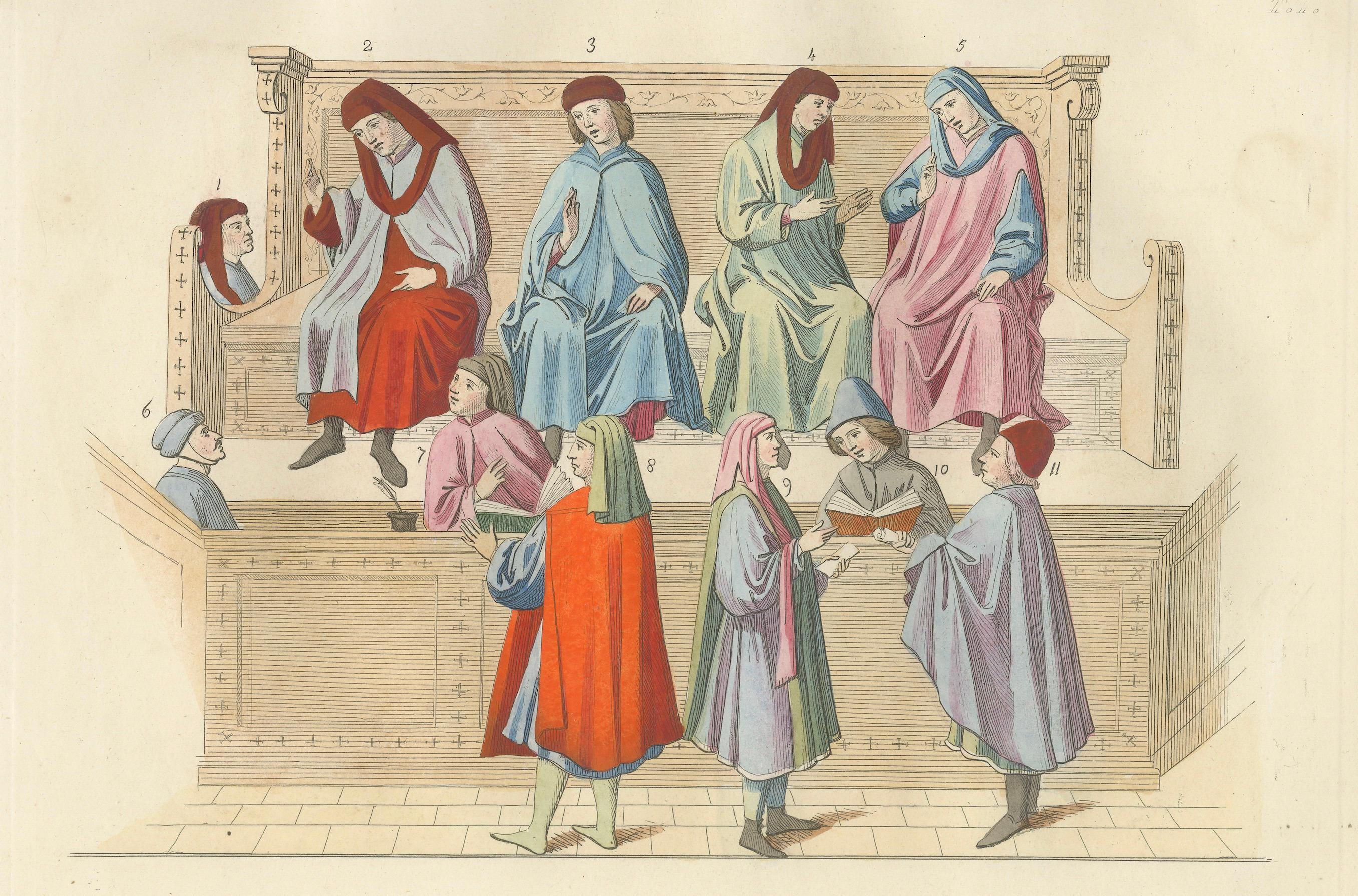
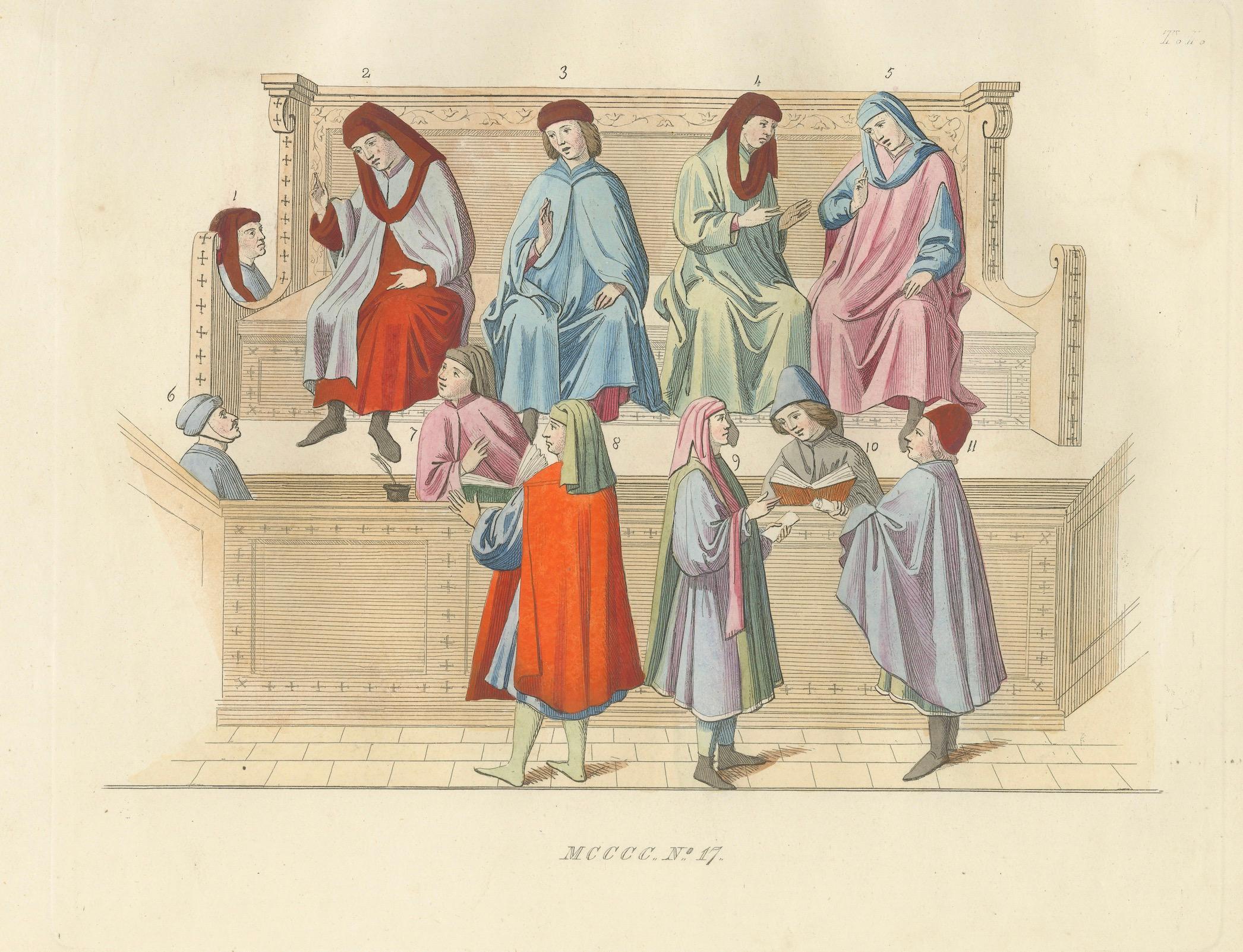
This elegant hand-colored lithograph titled “Tribunal des Marchands” (Merchant’s Court) is plate No. 47 from the 1845 edition of *Costumes Historiques des XIIIe, XIVe et XVe Siècles*. Designed by Paul Mercuri and historically annotated by Camille Bonnard, the image is a faithful reproduction of a miniature attributed to Sano di Pietro, taken from a manuscript of the *Statuts des marchands* preserved in the library of Siena. It offers a vivid reconstruction of the commercial justice system in place in the free trading cities of late medieval Italy.
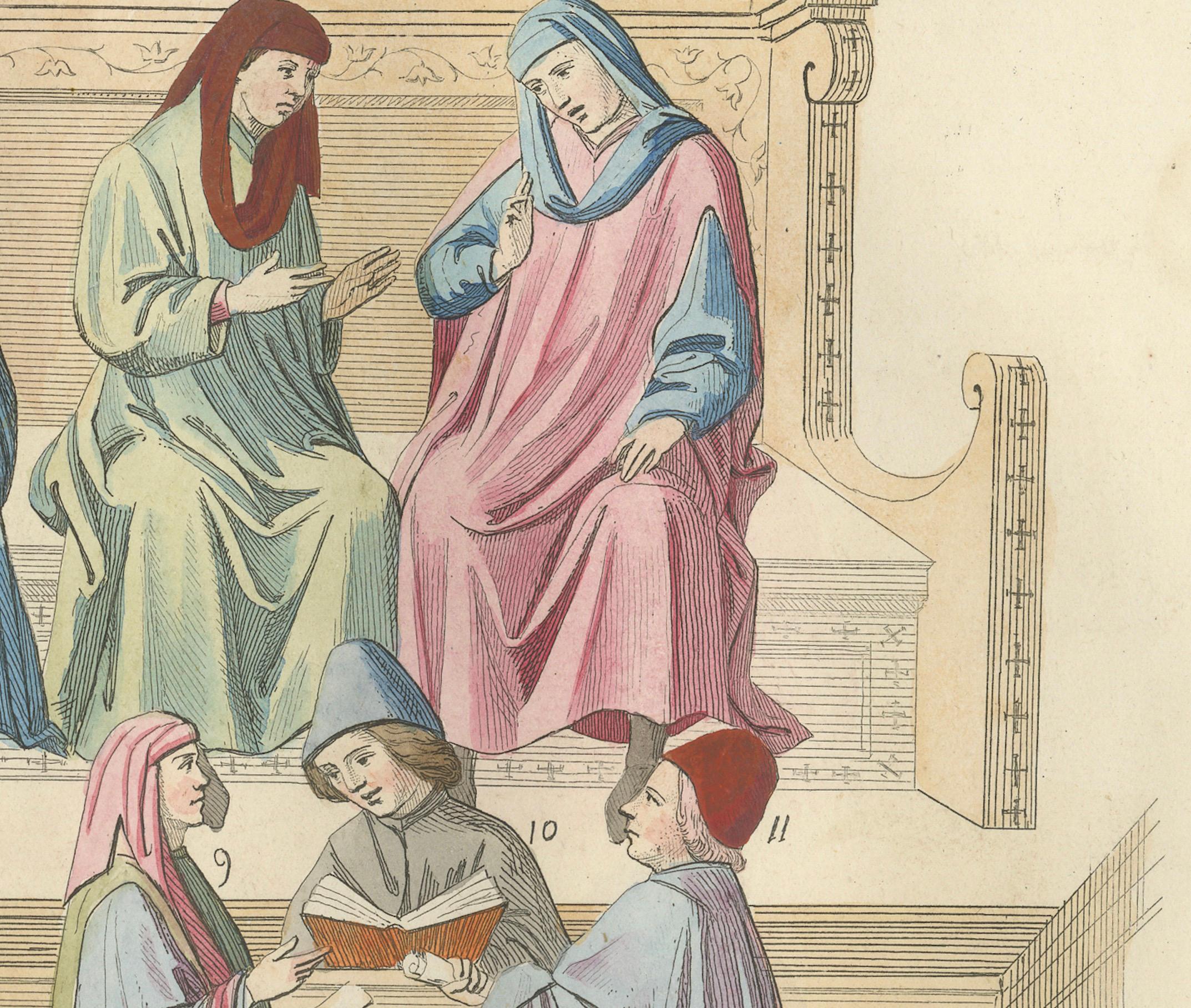
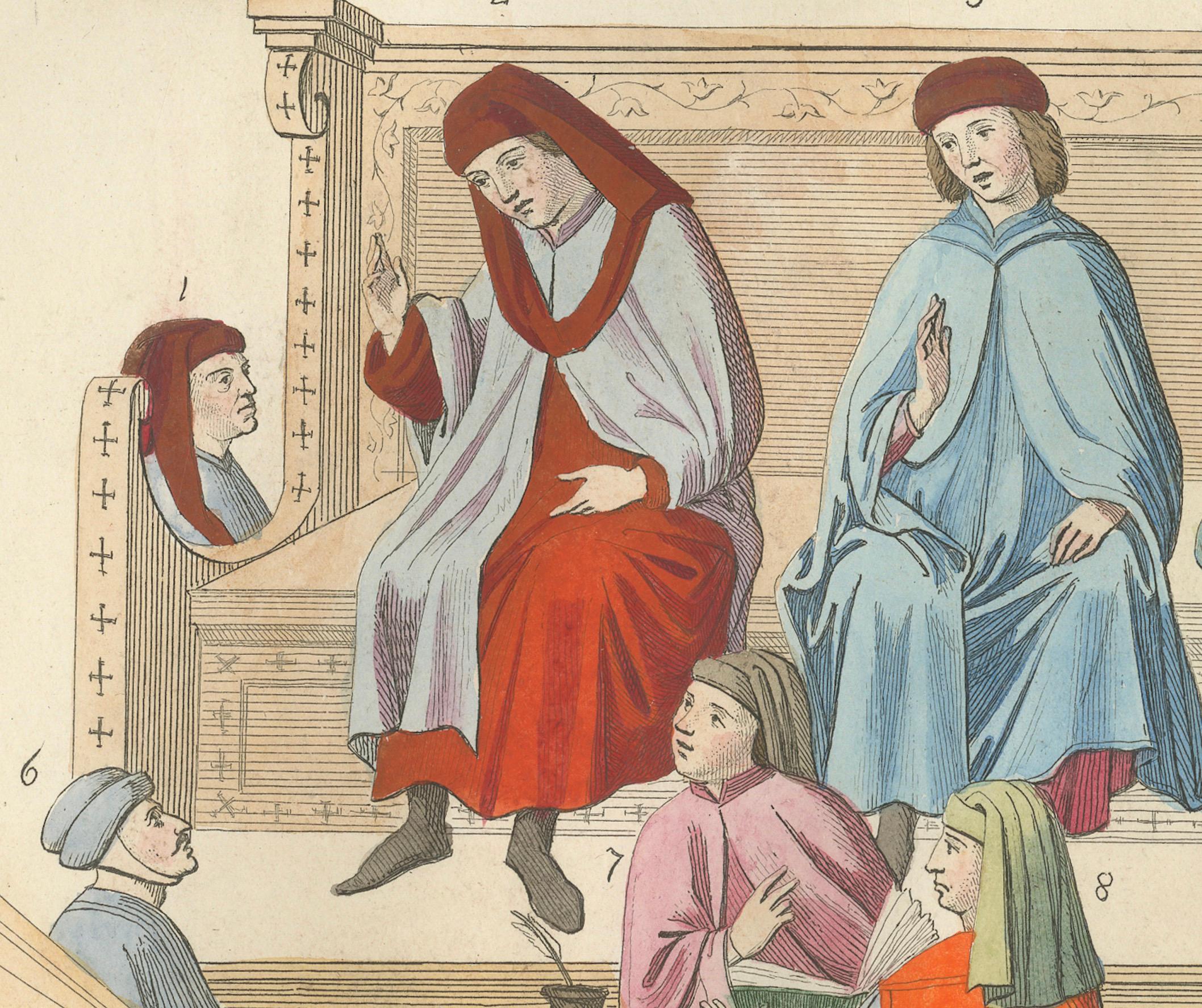
The illustration presents a structured, hierarchical courtroom scene in which merchant consuls preside from an elevated bench. Seated in solemn robes, the five judges are depicted with differing garments and headdresses, reflecting their status and individual identities. According to the original text, the consuls wear robes and hoods in a range of symbolic colors—red, blue, violet, and green—each combination carefully described in the original legend and visible in the detailed coloring of the print.
Beneath the consuls, the lower half of the tribunal shows scribes, petitioners, and merchants in active dialogue. They are depicted exchanging documents, consulting one another, or presenting their cases. Each figure’s attire is rendered with precision: from green tunics trimmed in white, to orange mantles, to scarlet hoods and black shoes. These details are historically accurate and serve not only to illustrate costume but to distinguish roles within the institutional structure of medieval commerce.
The accompanying commentary explains that such courts were essential to the governance of trade in free cities like Pisa, Genoa, Venice, and Amalfi. The consuls of merchants had far-reaching powers, judging disputes, enforcing contracts, and even negotiating with foreign powers. This print is more than a depiction of fashion—it is a window into the civic mechanisms that underpinned economic growth and legal order in the medieval Mediterranean world.
The numbered figures in the print "Tribunal des Marchands" (Plate No. 47 from *Costumes Historiques des XIIIe, XIVe et XVe Siècles*, 1845) correspond to the following individuals as described in the original text:
Fig. 1 – A merchant who has approached the consuls to speak. He wears a red chaperon (hood), and the visible part of his clothing is blue.
Fig. 2 – A consul or magistrate wearing a scarlet chaperon. His robe is the same color, his mantle is a changing blue with violet tones, and his shoes are black.
Fig. 3 – This figure wears a scarlet bonnet. Both the mantle and the robe are blue, with the robe bordered by a white trim. The undergarment is lacquer red, and the shoes are black.
Fig. 4 – This figure has a scarlet chaperon, a greenish robe, and black shoes.
Fig. 5 – The chaperon and sleeves are blue, the mantle is lacquer red, and the shoes are black.
Fig. 6 – This figure wears a blue veil, with a white band passing under the chin. It appears to represent a scribe or a person involved in documentation.
Fig. 7 – This figure has a black chaperon. The rest of the clothing is lacquer-colored, and the book binding is green.
Fig. 8 – The chaperon and the chausses (leggings) are greenish. The tunic is blue, and the mantle is orange.
Fig. 9 – The chaperon is lacquer red, the mantle and chausses are greenish, the tunic is light blue shifting into violet, and the boots are black.
Fig. 10 – The bonnet is blue, the tunic is lead-colored, and the book binding is red.
Fig. 11 – The bonnet is scarlet, the mantle is light blue shifting into violet, the tunic is greenish with white trim, and the shoes are black.
These descriptions correspond directly to the clothing details depicted in the image, offering a well-documented view of commercial, legal, and civic dress in late medieval Italy.
Condition:
Very good condition. The sheet is clean with only light age-related spots in the margins. Hand-coloring is fresh and well-preserved, with all details clearly visible. No tears or losses.
Framing Tips:
Use a medium to dark wooden frame—walnut or cherry—for a scholarly, classic presentation. A double mat in ivory and burgundy or slate blue would complement the color palette and enhance the historic feel. Ideal for display in a study, office, or library focused on legal, commercial, or medieval themes.