About this sheet
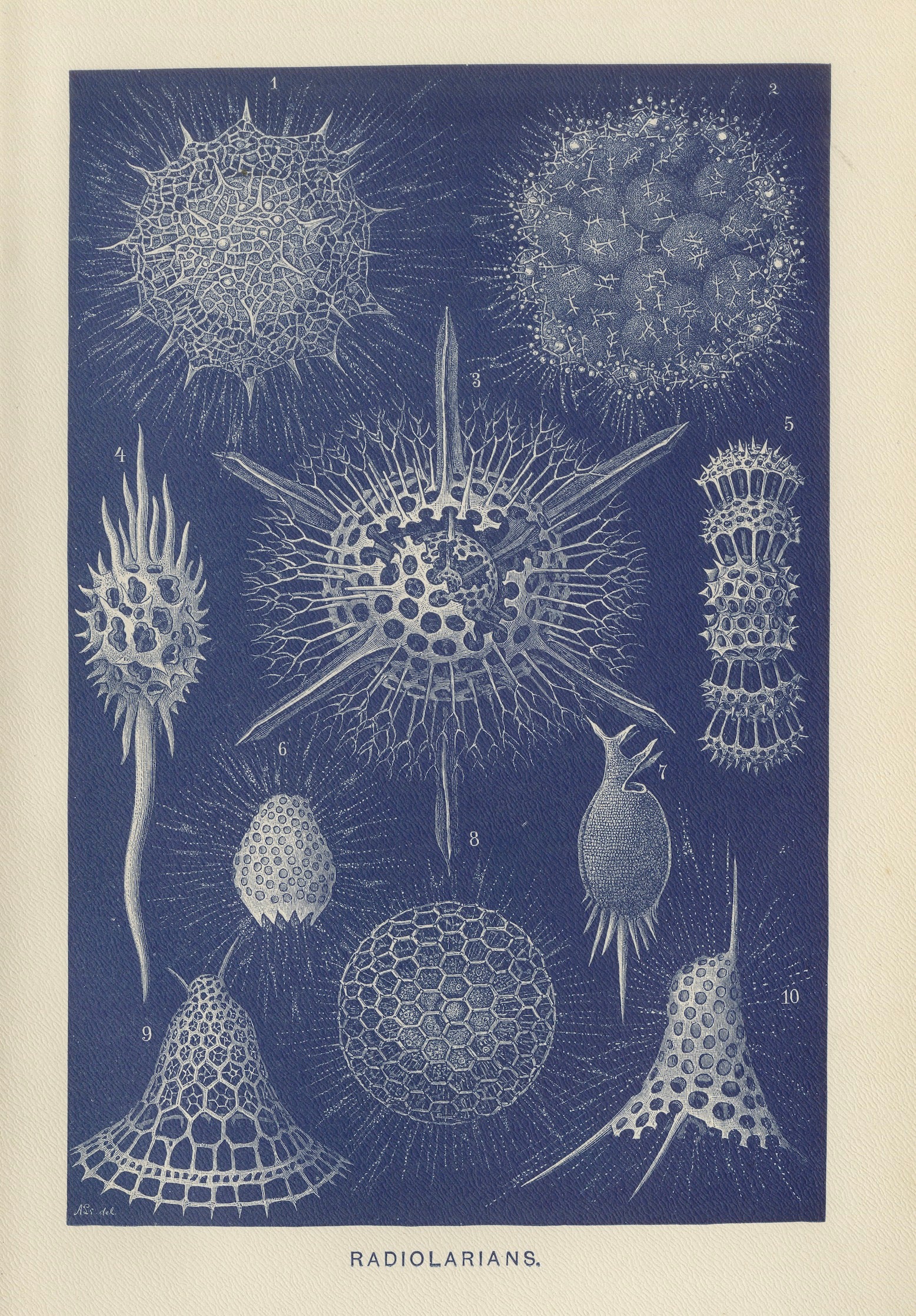
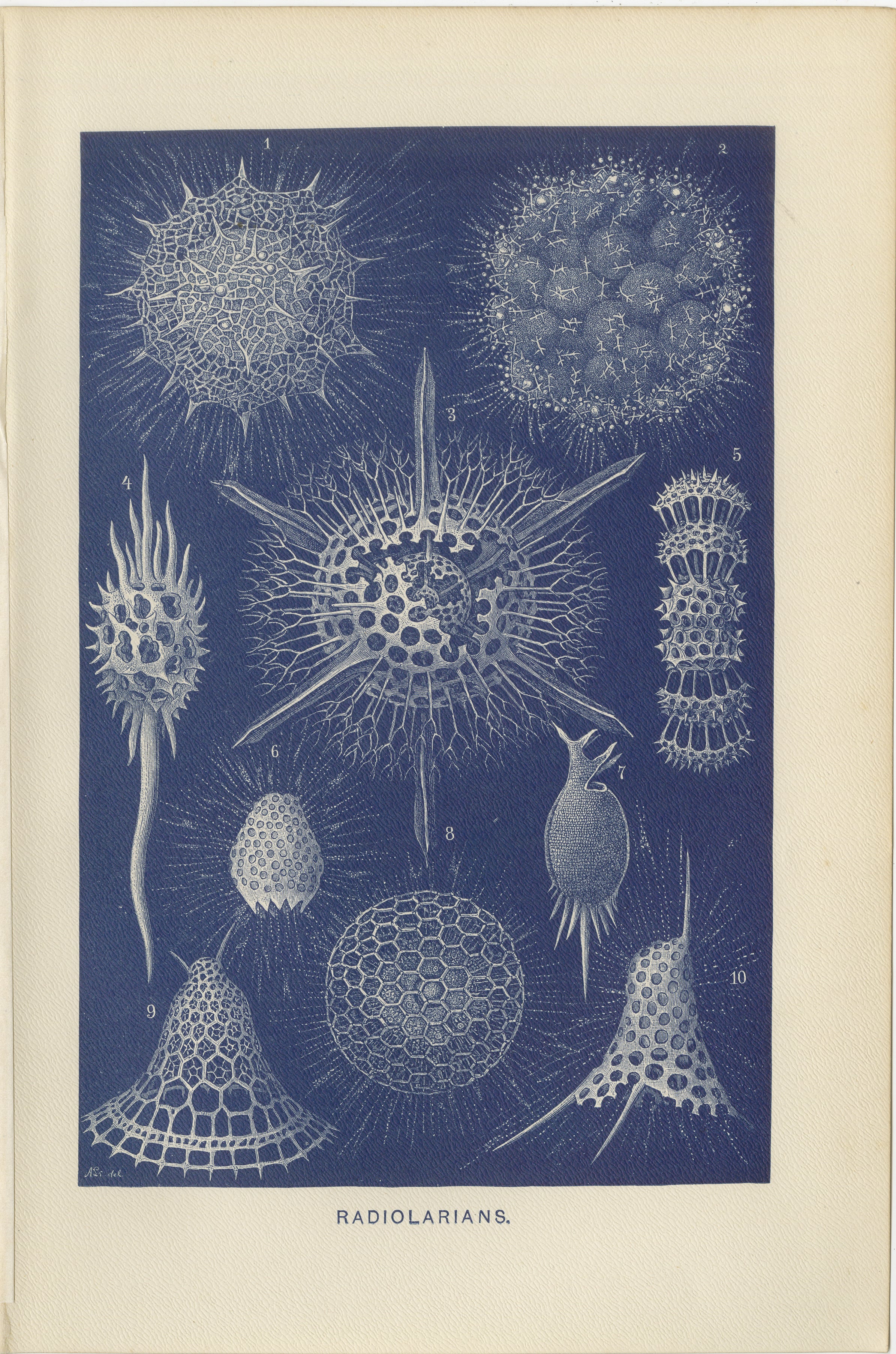
Radiolarians – Blue Scientific Natural History Plate from Lydekker, 1896
This striking original scientific illustration depicts a collection of radiolarians, microscopic marine organisms renowned for their extraordinarily intricate siliceous skeletons. Published in 1896 as part of The Royal Natural History, edited by the distinguished British naturalist Richard Lydekker, the plate exemplifies the marriage of scientific precision and decorative beauty that characterized the finest Victorian natural history publications.
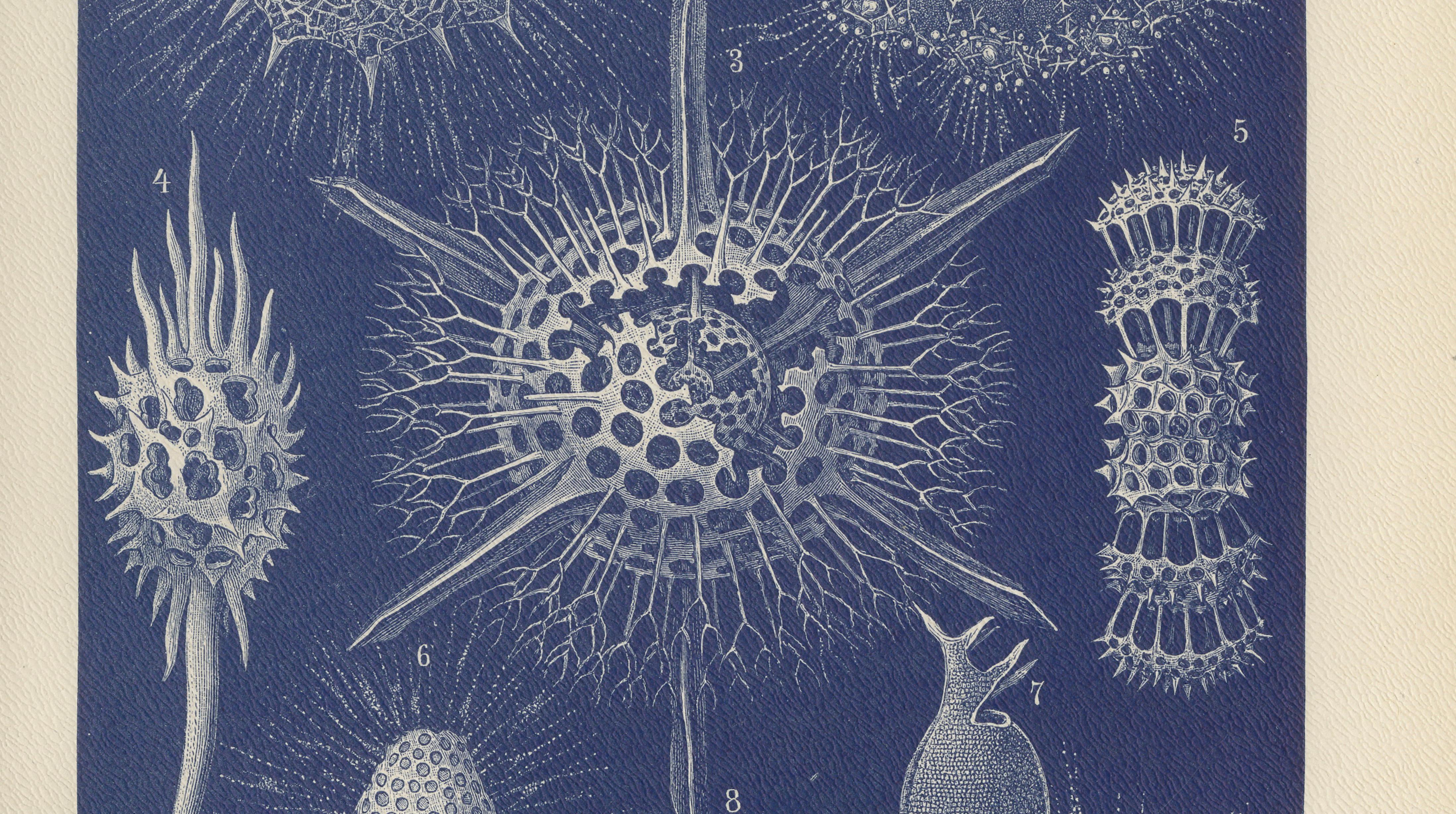
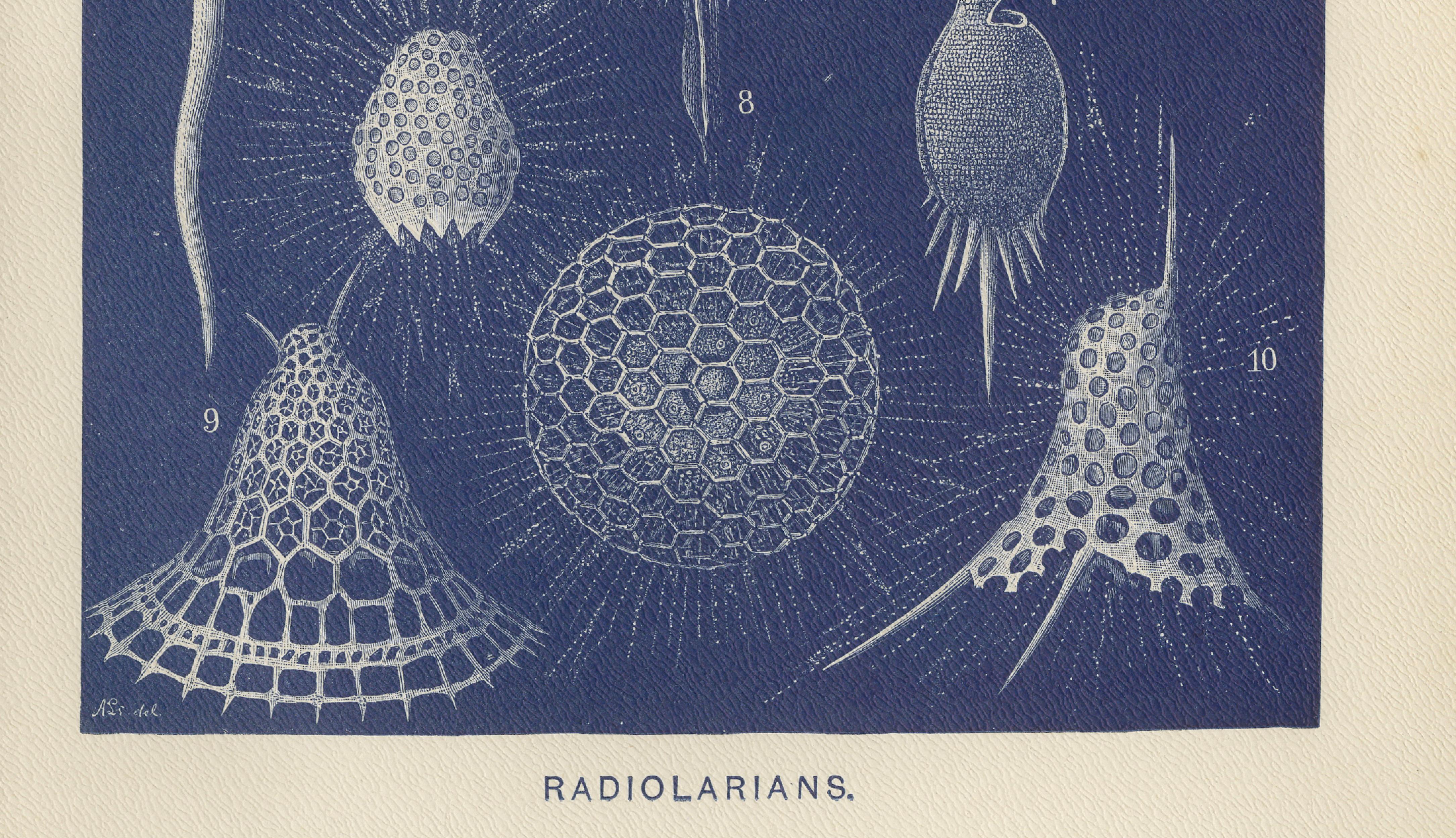
The composition presents ten distinct radiolarian forms arranged against a deep cobalt-blue ground, their delicate skeletal structures printed in white to dramatic effect. The extraordinary diversity of shapes is immediately apparent: spherical lattice forms, star-like organisms with radiating spines, honeycomb shells, bell-shaped structures, and architectural tower-like specimens. Though invisible to the naked eye, these marine protozoans were revealed through advances in microscopy during the nineteenth century, captivating both scientists and artists with their geometric perfection.
Richard Lydekker (1849–1915) was among Britain's foremost zoologists and natural historians. His monumental Royal Natural History, published simultaneously in London and New York, sought to present the wonders of the natural world to a broad audience through authoritative text and high-quality illustrations. Plates such as this introduced readers to previously unseen microscopic worlds, demonstrating that nature's most remarkable designs often existed on the smallest scales.
The visual appeal of radiolarians extends far beyond their scientific significance. Their mathematical symmetry and organic geometry later inspired artists, architects, and designers, particularly within the Art Nouveau movement. Today, such imagery remains surprisingly modern, making this print equally suitable for contemporary interiors, coastal residences, libraries, scientific collections, and design-focused spaces.
The rich blue-and-white palette gives the sheet a distinctive decorative quality uncommon among Victorian scientific illustrations. Whether appreciated as a study in marine biology, a historical document of scientific discovery, or simply a visually arresting work of graphic art, this plate remains one of the most appealing subjects from late nineteenth-century natural history publishing.
This is an original 1896 print from The Royal Natural History, not a modern reproduction.
Condition: Good antique condition with light age toning to the margins and minor handling wear consistent with age. The image remains strong and well-preserved. Please examine photographs carefully. Visible plate mark not applicable, as issued.
Framing tips: This print displays beautifully in a dark walnut, black, or white frame. A generous white museum mat enhances the dramatic contrast between the deep blue image area and the delicate white radiolarian structures. Particularly effective in modern, coastal, scientific, or minimalist interiors.