About this sheet
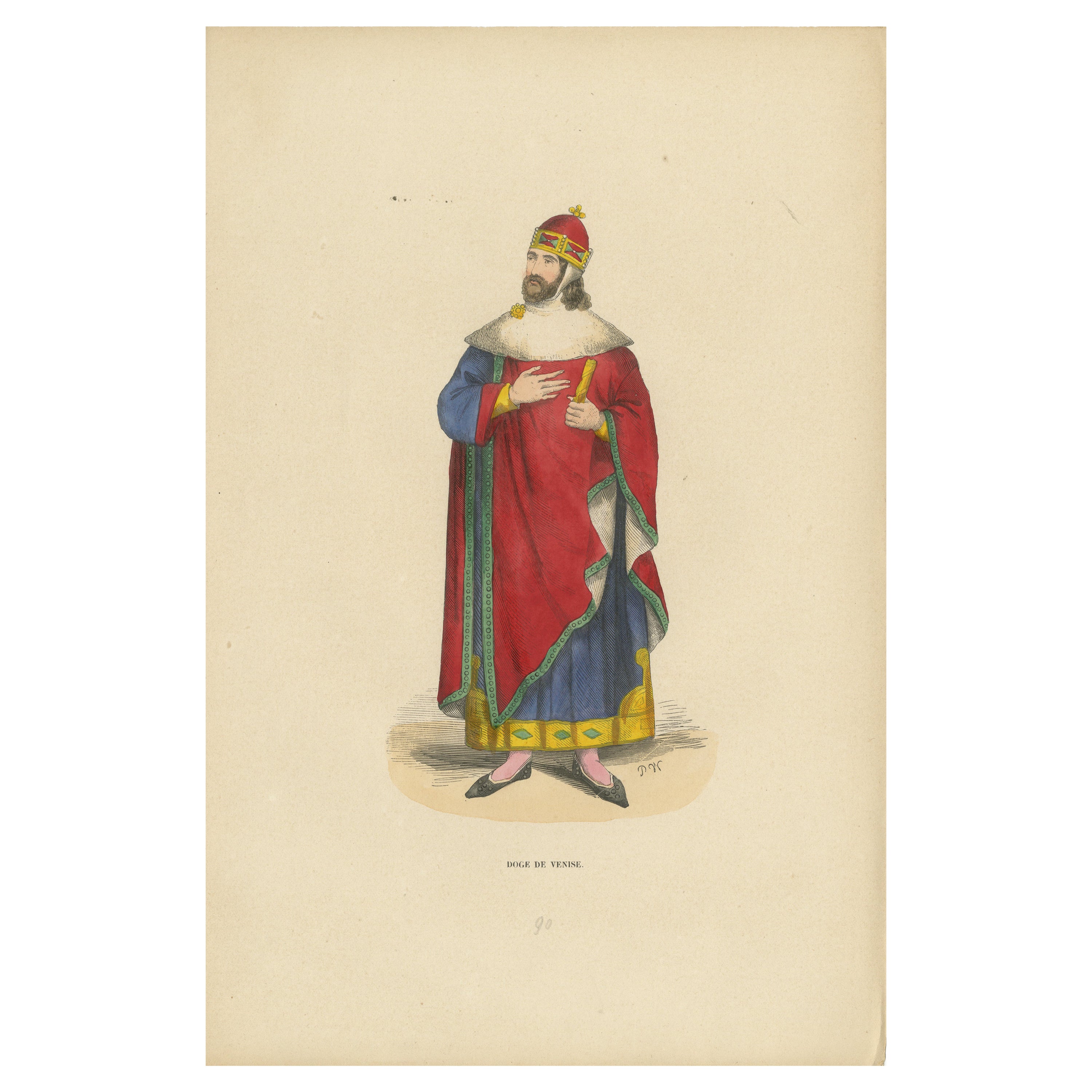
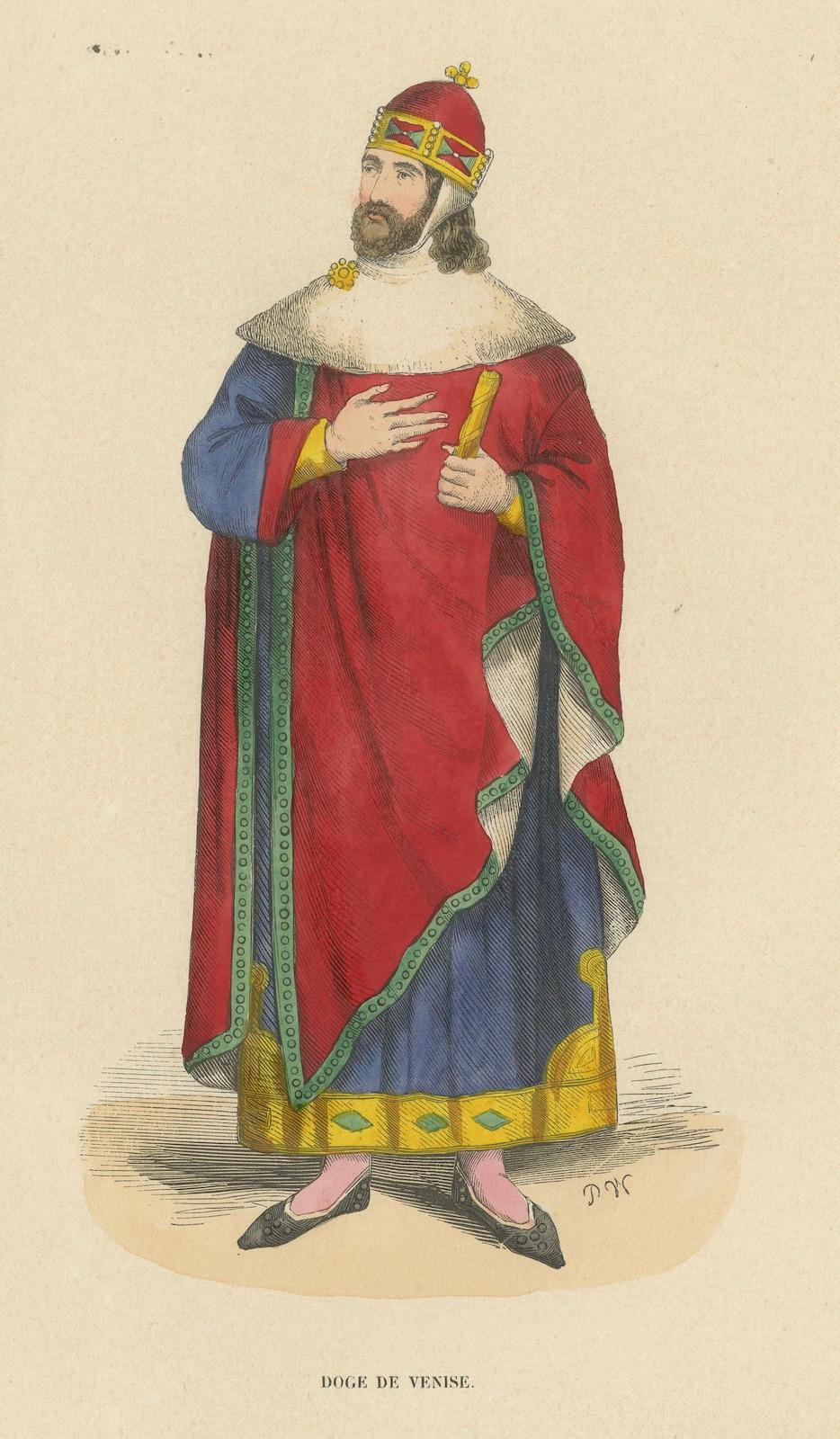
This handcolored historical print captures a Doge of Venice in a moment of solemn reflection. The Doge, as the chief magistrate and leader of the Republic of Venice, was a figure of significant authority and respect. His attire, rich in color and decoration, is befitting his high office.
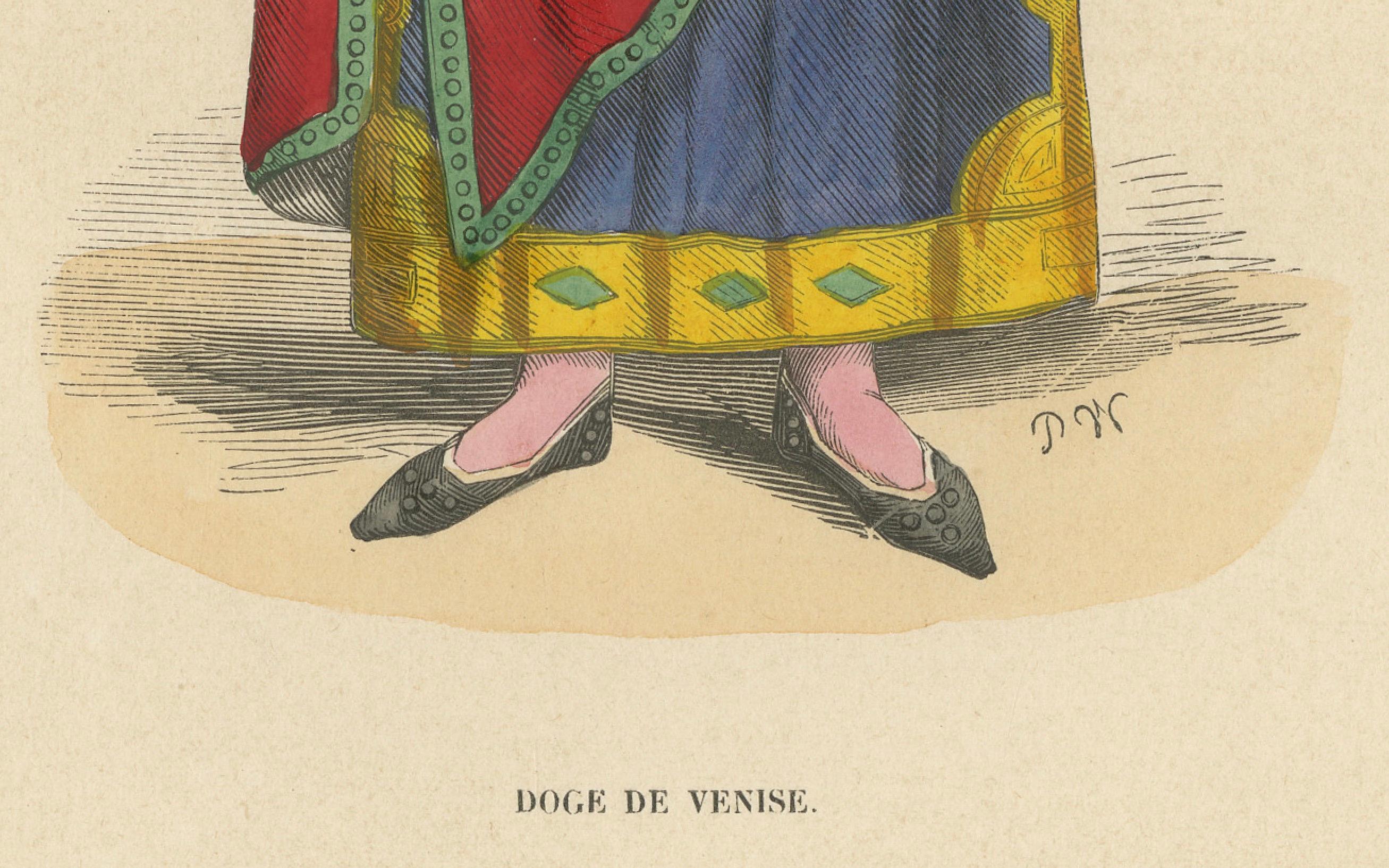
He stands draped in a luxurious robe of deep red, symbolizing power and prestige, edged with detailed trim that speaks to the wealth of the Venetian state. His undergarment is a contrasting blue, perhaps alluding to the maritime dominance of Venice, while the green sash may represent growth and prosperity. His footwear, adorned with golden motifs, complements the ornamental hem of his cloak.
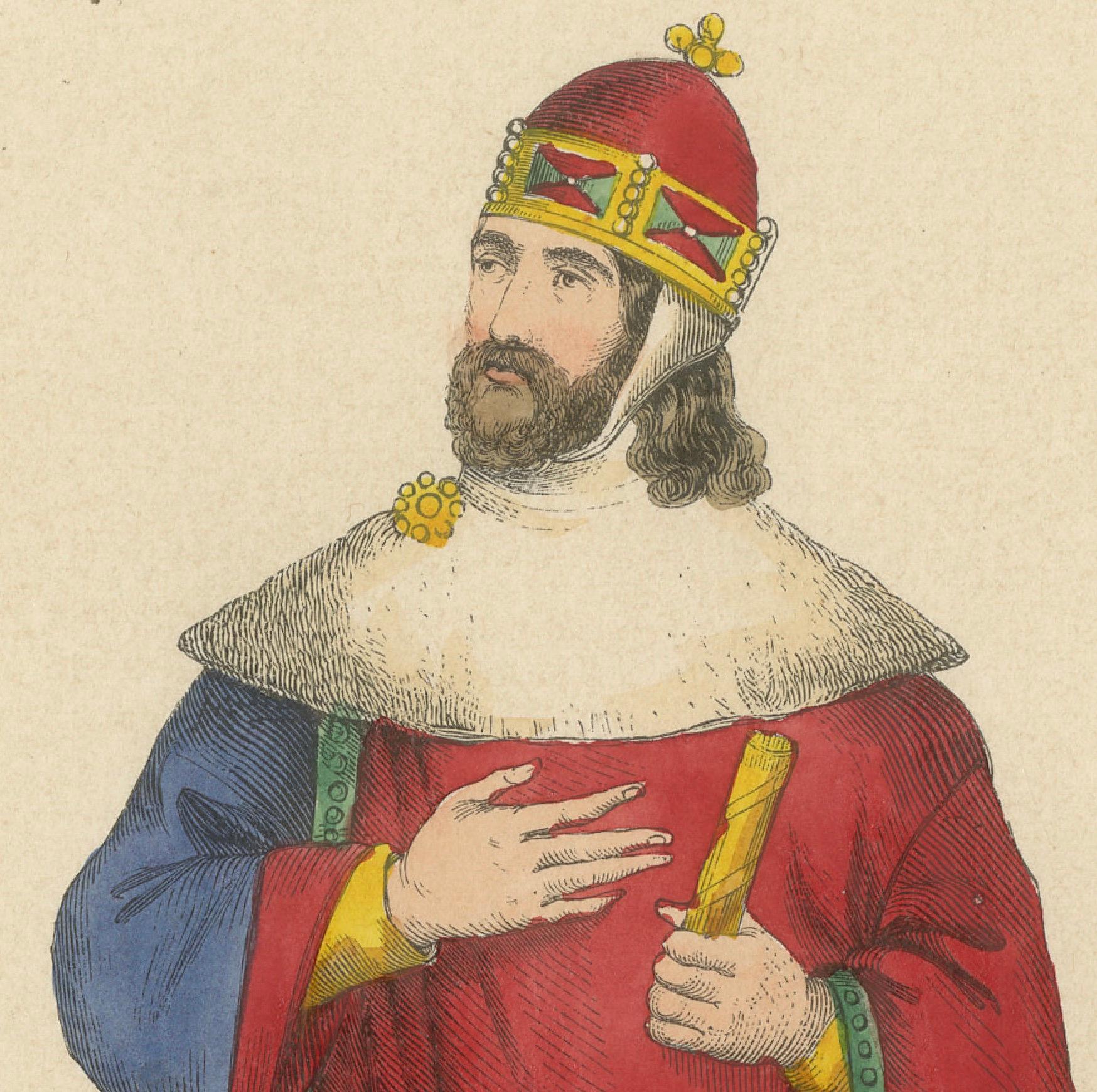
The Doge's cap, or corno ducale, is a distinctive feature, signifying his ruling status, with its elaborate design and regal embellishments. His beard, a sign of wisdom and maturity, frames his contemplative expression as his hand rests over his heart, a gesture that may denote his dedication and service to the city.
This portrayal not only serves as a historical record of the regalia and personage of a Doge but also evokes the gravity and introspection fitting for a leader of one of the most powerful maritime republics of the Renaissance era. It's a frozen narrative, one that allows us to infer the weight of responsibility borne by the Doges who helped shape Venice's storied past.
The colors have a nice glow over them. Historically, egg whites, known as glair, and sometimes egg yolk were indeed used in illumination and painting, particularly in manuscripts, to give colors a brighter appearance and to add a sheen or gloss to the work. This technique was quite common during the Middle Ages and into the Renaissance.
Egg whites can be applied as a varnish over pigments to enhance their brightness and to protect the colors. This application could make the colors appear more vivid and also add a slight glossy sheen to the surface of the image.
Egg yolk, on the other hand, was commonly used as a binding agent in paint. It forms the basis of tempera paint, a medium that was widely used before the advent of oil painting. Egg yolk helps to create a durable and long-lasting color that adheres well to various surfaces.
In the context of the print from 1847, it's less likely that egg whites or yolks were used directly on the print, as by that time, commercial printing processes would have been more advanced and less reliant on such manual methods. However, if this print is a representation of an earlier style or is meant to mimic the appearance of hand-painted manuscripts, the original artists might have employed techniques or materials that gave a similar effect to those achieved with egg-based binders and varnishes.