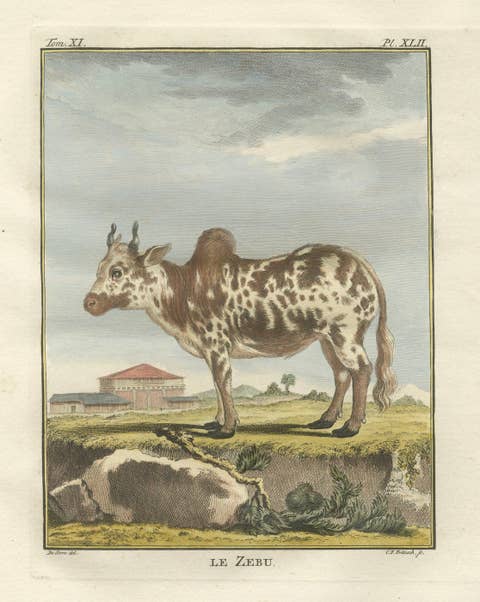
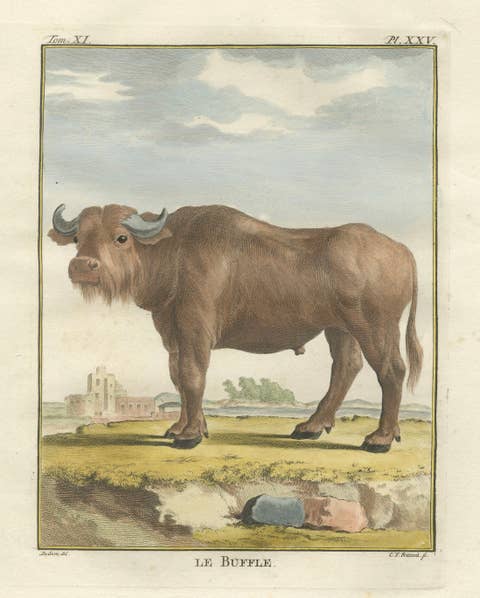
About this sheet
Complete Set of 10 Camel Anatomy Engravings, Buffon Scientific Plates 1769
This exceptional suite of ten original 18th-century anatomical engravings of the dromedary camel comes from the rare Dutch edition of Buffon’s monumental Histoire Naturelle, published in Amsterdam by J.H. Schneider in 1769. These plates appear in Tome XI and form one of the most extensive and detailed anatomical series produced for any species in the entire work. Drawn by Jacques de Sève, Buffon’s principal illustrator, and engraved with remarkable precision, the set documents the internal structure, digestive system, organs, hooves, musculature and full skeleton of the camel in a level of scientific detail that was groundbreaking for its time.
Each engraving focuses on a different anatomical component. Some plates show the complex multi-chambered stomach system, drawn with clarity and depth that reflect the Enlightenment fascination with comparative anatomy. Others depict the interior textures of the digestive tract, including close-up studies of the honeycomb-like stomach lining and finely rendered muscular folds. Several plates illustrate the camel’s hooves, both in isolation and paired, revealing their structural adaptation to desert terrain. One of the most striking sheets features a detailed arrangement of organs and reproductive structures, drawn with impressive accuracy and labeled according to Buffon and Daubenton’s taxonomic method. The suite concludes with the full skeletal plate, presenting the camel on a plinth in an elegant landscape, combining scientific precision with artistic composition.
Together, these ten engravings offer a rare and comprehensive view of the anatomy of the dromedary camel, representing one of the most ambitious anatomical sequences in 18th-century natural history publishing. The Dutch Schneider edition is especially prized for the crispness of its impressions, quality of paper, and refinement of engraving. Complete anatomical sets are increasingly difficult to assemble and are seldom available on the market as a coherent group. Their visual unity and refined copperplate workmanship make them highly suitable for framing as a large decorative installation, whether in a grid layout or grouped in smaller sets.
This suite is ideal for collectors of natural history, interior designers seeking authentic Enlightenment-period imagery, and anyone looking for a refined, scientific yet artistic wall statement. Over 250 years old, the engravings remain visually fresh, with sharp detail and strong plate marks.
Condition report:
Very good overall. Minor foxing and light toning mostly in margins, some faint handling marks typical of 18th-century sheets. Strong impressions throughout, with clearly defined plate marks. No tears, holes or repairs observed. Paper remains crisp and well preserved for age.
Framing tips:
These ten plates work beautifully in a 2x5 grid or as two separate groups of five. Use ivory or pale gray mats to highlight the engraving lines, paired with simple black, charcoal, or walnut frames for a museum-style presentation. Floating mounts in natural wood also work well, emphasizing the generous margins and plate marks. Identical framing is essential for a cohesive installation.