19th-Century Lithograph of the Black Wolf and Grey Wolf in Striking Detail
€ 290
Original antique · The actual sheet photographed · Certificate of authenticity on request · Sold unframed · Worldwide shipping from € 15 (rates)
Sheet size
32.2 × 26 cm (12.7 × 10.2 in)
Condition
Good
Reference
BG-13176-67
What the condition grades mean
Excellent
Bright and clean, with no faults worth mentioning.
Very good
Only light signs of age, such as faint toning.
Good
Normal signs of age for a sheet of this period: toning, some foxing, small marks or neat old repairs.
Fair
Clear faults such as staining, tears or repairs, priced to match.
Every fault we see is written in the condition note, and the whole sheet is shown uncropped in the photos.
Condition
Condition Summary: The print is in good condition, with mild age-related toning and scattered foxing visible mainly along the margins. The lithographic details remain sharp, preserving the intricate fur textures and anatomical accuracy.
About this sheet
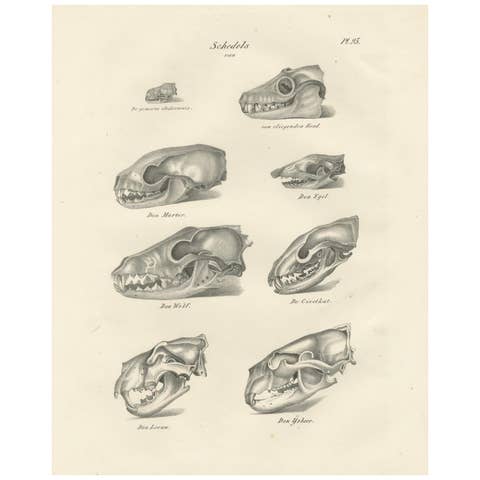
19th-Century Lithograph of the Black Wolf and Grey Wolf in Striking Detail This remarkable 19th-century lithograph presents two variations of the wolf species: the black wolf (De zwarte wolf) and the gray wolf (De wolf). Originally published in De Zoogdieren: afgebeeld en in hunne levenswijze geschetst, this print captures the powerful and majestic form of these apex predators with remarkable realism and anatomical accuracy.
The black wolf is a color variant of the gray wolf (Canis lupus), most commonly found in North America. Its dark fur results from genetic adaptation, likely influenced by historical interbreeding with domestic dogs. Black wolves have been observed in forests and mountainous regions, often in colder climates. The gray wolf, the most widespread subspecies, has historically ranged across Europe, Asia, and North America. It is known for its intelligence, strong social structure, and adaptability in various ecosystems, from tundra to grasslands.
Created by C.C. G. Zool. and printed by La Haye & J. L. G. V., this lithograph is an essential piece for collectors of antique zoological prints, wildlife illustrations, and those interested in early scientific depictions of predatory mammals.
Condition Summary: The print is in good condition, with mild age-related toning and scattered foxing visible mainly along the margins. The lithographic details remain sharp, preserving the intricate fur textures and anatomical accuracy. The edges show minor irregularities from past binding, but no major tears or folds are present. The overall integrity of the artwork remains well-preserved, making it a highly collectible piece.
Framing Tips: For the best presentation, use an acid-free mat in a soft neutral tone to enhance the contrast between the wolves' dark and light fur. A dark wooden or black frame will provide a striking effect, emphasizing the dramatic shading. UV-protective glass is recommended to prevent fading over time. If displayed with other zoological lithographs, matching frames will create a cohesive and sophisticated collection.