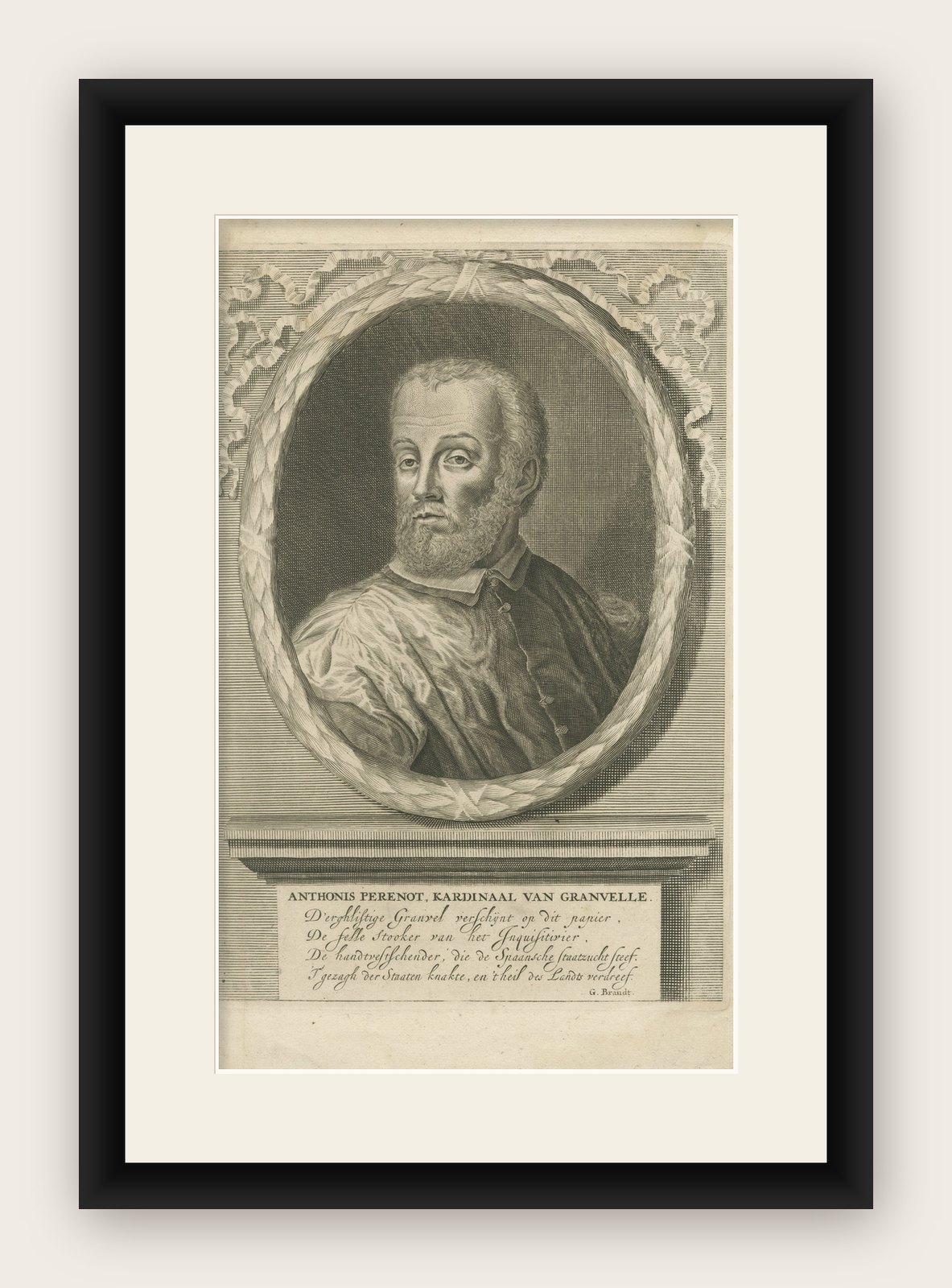
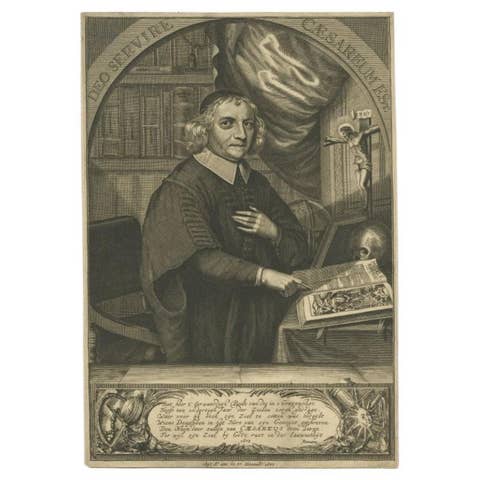
Portrait of Cardinal Granvelle – Dutch Engraving, circa 1681
€ 380
Original antique · The actual sheet photographed · Certificate of authenticity on request · Sold unframed · Worldwide shipping from € 15 (rates)
Date
1681
Mapmaker / artist
Anonymous, Netherlands, ca. 1681
Technique
Engraving on laid paper
Sheet size
31.5 × 20 cm (12.4 × 7.9 in)
Condition
Good
Reference
BG-13185-109
What the condition grades mean
Excellent
Bright and clean, with no faults worth mentioning.
Very good
Only light signs of age, such as faint toning.
Good
Normal signs of age for a sheet of this period: toning, some foxing, small marks or neat old repairs.
Fair
Clear faults such as staining, tears or repairs, priced to match.
Every fault we see is written in the condition note, and the whole sheet is shown uncropped in the photos.
Condition
Condition overall. Light age toning, ample margins. One vertical crease from lower margin to center, small margin stains. No tears or repairs. Watermark of a coat of arms with horn visible in the laid paper.
About this sheet
Portrait of Cardinal Granvelle – Dutch Engraving from de Groot's Jaerboeken, 1681
This antique 17th-century engraving presents a powerful image of Anthonis Perrenot de Granvelle (1517–1586), a key political and religious figure in Habsburg Europe. Granvelle was an influential advisor to Emperor Charles V and Philip II of Spain, later serving as Archbishop of Mechelen and chief minister of the Spanish Netherlands. He became a symbol of Catholic authoritarian rule and Spanish imperialism in the Low Countries during the turbulent decades leading up to the Dutch Revolt.
The portrait is framed within a laurel-embellished oval cartouche resting on a plinth, beneath which is a biting poetic caption by the Dutch writer G. Brandt. The verse condemns Granvelle’s role in enforcing the Inquisition and his suppression of Protestantism, casting him as a figure whose harsh policies ignited the resistance that ultimately led to Dutch independence.
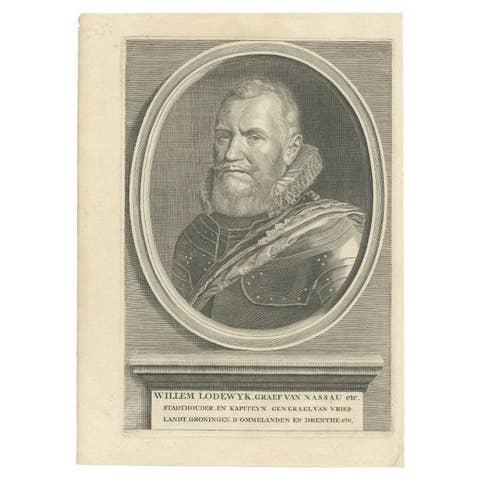
This engraving originally appeared in 'Hugo de Groot's Nederlandtsche Jaerboeken', published in 1681. Portraits of this type were also used in historical publications by P.C. Hooft, Bor, and Jean Le Clerc, circulating widely between 1670 and 1730. The artist remains anonymous, but the work reflects the refined portrait style of Dutch historical engraving in the late 17th century—clear, sober, and charged with political undertones.
Collectors of Reformation history, Habsburg portraiture, or Dutch independence literature will find this a compelling and historically resonant piece.
Framing tips: Ideal with a dark wood or black frame and ivory or parchment-colored mat. The contrast enhances both the solemnity of the portrait and the intensity of its historical message.