Interior of Winter House, Kamchatka – Cook Voyage Engraving c.1803
€ 420
Original antique · The actual sheet photographed · Certificate of authenticity on request · Sold unframed · Worldwide shipping from € 15 (rates)
Date
1803
Mapmaker / artist
Cook
Sheet size
28.5 × 41.5 cm (11.2 × 16.3 in)
Condition
Good
Reference
BG-11487-78
What the condition grades mean
Excellent
Bright and clean, with no faults worth mentioning.
Very good
Only light signs of age, such as faint toning.
Good
Normal signs of age for a sheet of this period: toning, some foxing, small marks or neat old repairs.
Fair
Clear faults such as staining, tears or repairs, priced to match.
Every fault we see is written in the condition note, and the whole sheet is shown uncropped in the photos.
Condition
Condition summary: Very good condition with strong impressions and clean paper. Minor age-toning and light foxing near the margins, but no repairs. Paper remains firm and well-preserved.
About this sheet
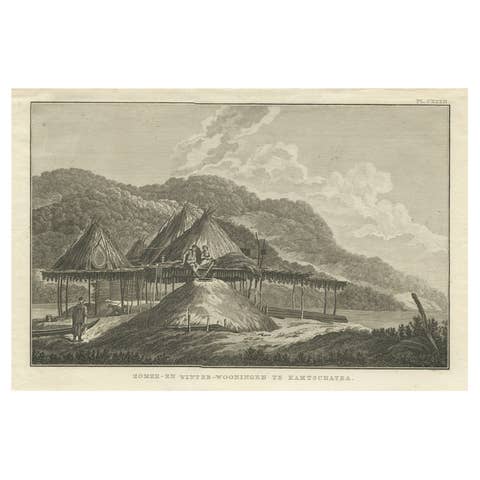
Winterwooning van Kamtschatka van binnen – Kamchatka Winter House Interior c.1795
This antique print depicts the interior of a traditional winter dwelling in Kamchatka, Russia. The engraving shows a spacious semi-subterranean hut with a rounded timber frame covered in earth and thatch for insulation against the extreme cold. Inside, a man stands in the central area wearing a heavy fur-lined coat, while to his left another figure tends a fire set in a pit, with cooking utensils and smoked fish hanging from beams above. On the right, two people rest on a raised wooden sleeping platform covered in furs, illustrating daily life and survival practices in the harsh Siberian climate.
This engraving originates from ‘Reizen Rondom de Waereld door James Cook,’ the Dutch translation of James Cook’s voyages, published circa 1795 by Honkoop, Allart en Van Cleef, and translated by J.D. Pasteur. Cook’s third voyage took him to Kamchatka in 1779, where he and his crew observed the lives of indigenous Siberian peoples, their architecture, and customs, which were recorded in both written descriptions and detailed engravings for European readers.
The technique used is engraving, involving careful incising of images onto metal plates to create prints with fine linear detail and tonal variation. These engravings served as early ethnographic records, capturing architecture, costume, and daily life before the era of photography.
Condition summary: Very good condition with strong impressions and clean paper. Minor age-toning and light foxing near the margins but no tears or repairs. Paper remains firm and well-preserved.
Framing tips: A warm cream or light taupe mount will complement the engraving’s muted tones. For framing, choose dark oak, walnut, or black with a slim silver or gold inner edge to enhance its classic presentation. UV-protective glass is recommended to preserve the fine detail and prevent fading..