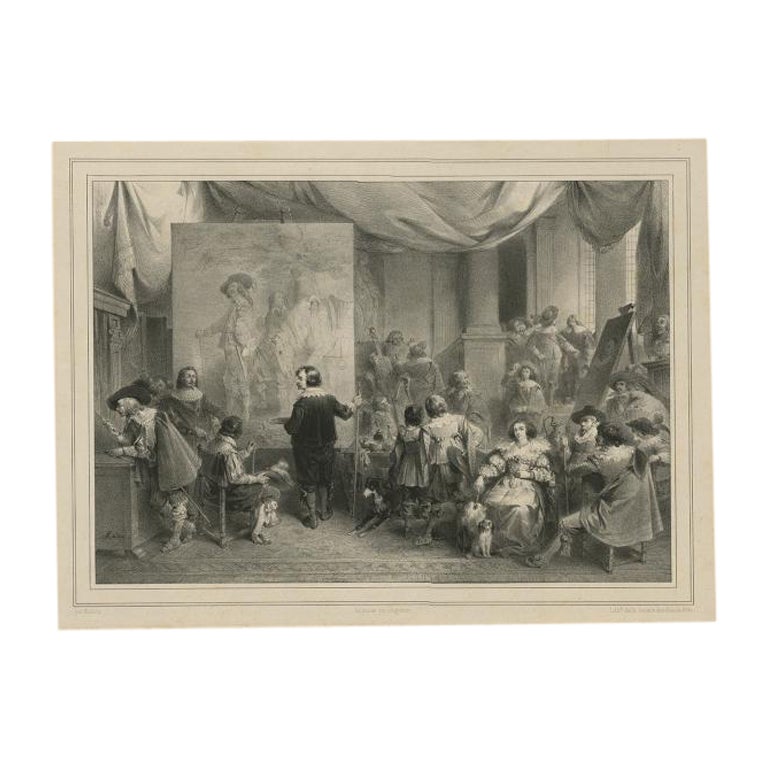
Antique Print Depicting the Famous Painter Van Dyck in London, 1842
€ 320
Original antique · The actual sheet photographed · Certificate of authenticity on request · Sold unframed · Worldwide shipping from € 15 (rates)
Date
1842
Sheet size
40.5 × 56.5 cm (15.9 × 22.2 in)
Condition
Good
Reference
BGI-00030
Condition
Some age-related toning and foxing. Including original text pages. Please review the images for further condition details.
About this sheet
Antique print titled 'A. van Dyck a Londres'. Antique print depicting A. van Dyck in London. This print originates from 'Scènes de la Vie des Peintres de l'école Flamande et hollandaise / par Madou', representing life scenes of famous artists.
Van Dyck was the most important Flemish painter of the 17th century after Rubens, whose works influenced the young Van Dyck. He also studied and was profoundly influenced by the work of Italian artists, above all, Titian.
Van Dyck was an extremely successful portraitist and painter of religious and mythological pictures in Antwerp and Italy. He was also an accomplished draughtsman and etcher. However, he is now best remembered for his elegant representations of Charles I and his court.
Van Dyck was born in Antwerp. A precocious artist, his first independent works date from 1615-16, when he would have been about 17. In 1621 he was in the service of James I of England, but left to visit Italy, where he remained until 1627. His aristocratic rendering of Genoese patricians, like the so-called 'Balbi Children', were very well received in that city. After a second period in the Netherlands, greater success awaited Van Dyck when he settled at the English court in 1632. His authoritative and flattering representations of Charles I and his family set a new standard for English portraiture to which members of the court were keen to aspire.
Artists and Engravers: Jean Baptiste Madou (1786-1877) was a Belgian painter, etcher and renowned pioneer lithographer.
We also offer thousands of antique prints covering fields of interest as diverse as architecture, natural history, religion, ethnology and many more.They were the product of engraved, etched or lithographed plates. These plates were handmade out of wood or metal, which required an incredible level of skill, patience and craftsmanship. Whether you have a house with Victorian furniture or more contemporary decor an old engraving can enhance your living space.