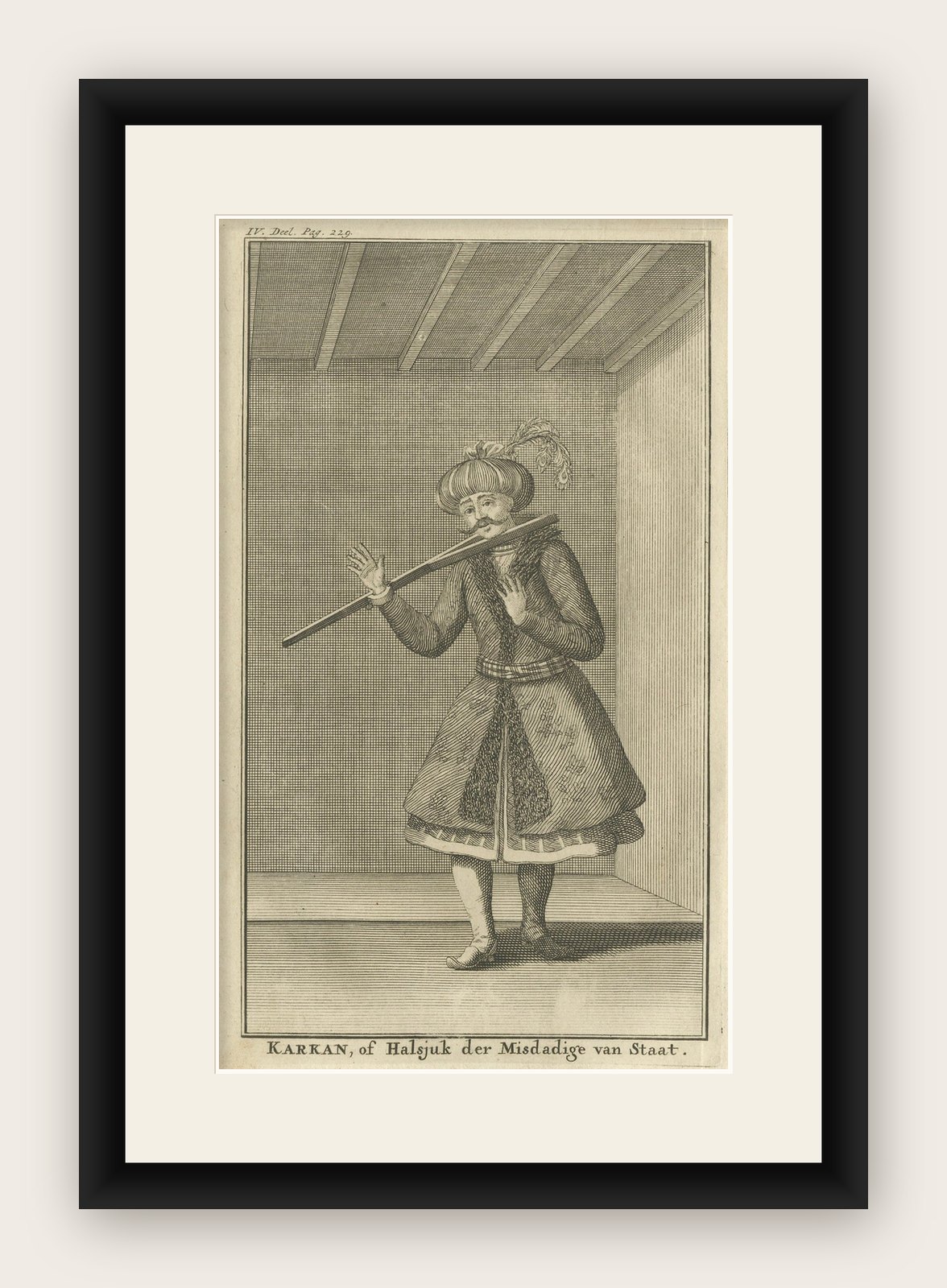
Karkan – 18th-Century Engraving of Ottoman State Punishment Collar, c.1730
€ 290
Original antique · The actual sheet photographed · Certificate of authenticity on request · Sold unframed · Worldwide shipping from € 15 (rates)
Date
1730
Mapmaker / artist
Anonymous Dutch engraver, Netherlands, circa 1730
Technique
Copperplate engraving
Sheet size
18.5 × 12 cm (7.3 × 4.7 in)
Condition
Good
Reference
BG-11491-3
What the condition grades mean
Excellent
Bright and clean, with no faults worth mentioning.
Very good
Only light signs of age, such as faint toning.
Good
Normal signs of age for a sheet of this period: toning, some foxing, small marks or neat old repairs.
Fair
Clear faults such as staining, tears or repairs, priced to match.
Every fault we see is written in the condition note, and the whole sheet is shown uncropped in the photos.
Condition
Condition overall. Crisp impression with minimal wear. Some faint age toning along the edges, and light crease in the upper right. No tears or repairs. The plate mark is strong and intact.
About this sheet
Karkan – 18th-Century Engraving of Ottoman State Punishment Collar, c.1730
This rare and unusual 18th-century copper engraving depicts a man restrained in a wooden punishment collar known as a “karkan,” used by Ottoman authorities as a form of public shaming or restraint for state criminals. The Dutch title beneath the image reads: “KARKAN, of Halsjuk der Misdadige van Staat” — translating roughly to “Karkan, or Neck Yoke for State Criminals.”
The restrained man is dressed in ornate Ottoman attire with a fur-trimmed kaftan and a plumed turban. The exaggerated wooden yoke (the karkan) is fitted around his neck and shoulders, rendering him helpless and publicly marked as a criminal. The image is set indoors, likely representing a holding chamber or administrative court. As noted at the top, this engraving appeared on page 229 of the fourth volume (“IV. Deel Pag. 229”) of a Dutch publication, most likely from a travelogue or ethnographic work describing the customs and punishments of foreign lands under Ottoman influence.
This print serves both as a visual record of foreign judicial customs and a moralizing curiosity for its European audience, reflecting how early modern Dutch society viewed law enforcement and “exotic” penal systems abroad. The karkan was a form of non-lethal punishment that caused discomfort and humiliation, and was sometimes used in the Middle East and parts of Asia for petty crimes or insubordination.
Framing tips: Due to its unique subject matter and tall vertical format, this print pairs well with a slender black or dark walnut frame. Use a soft ivory or light beige mat to highlight the detailing of the engraving, and consider museum glass for preservation.