About this sheet
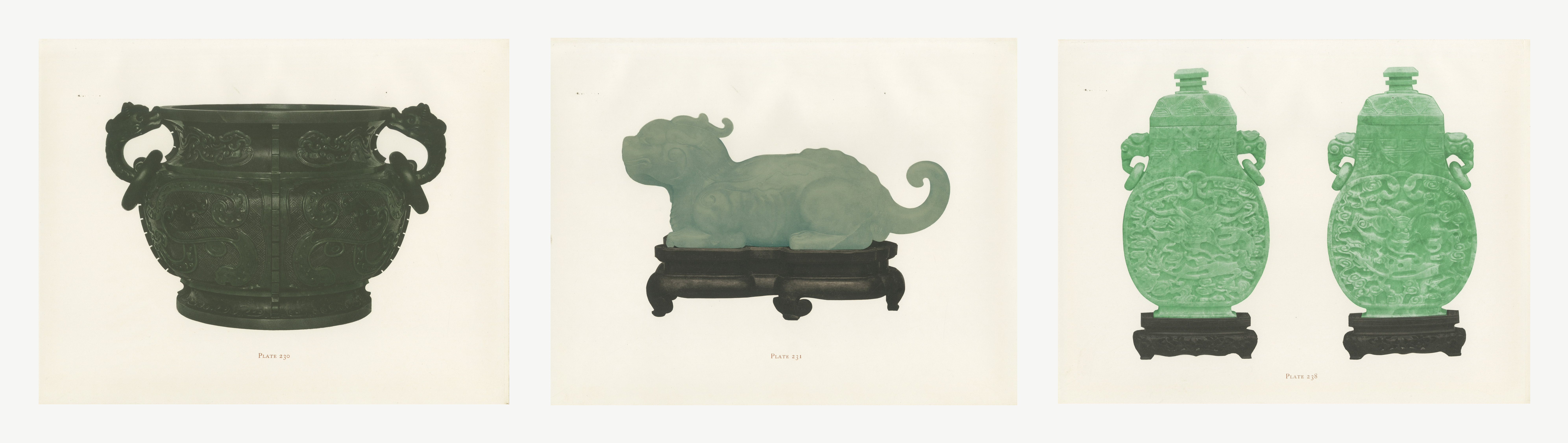
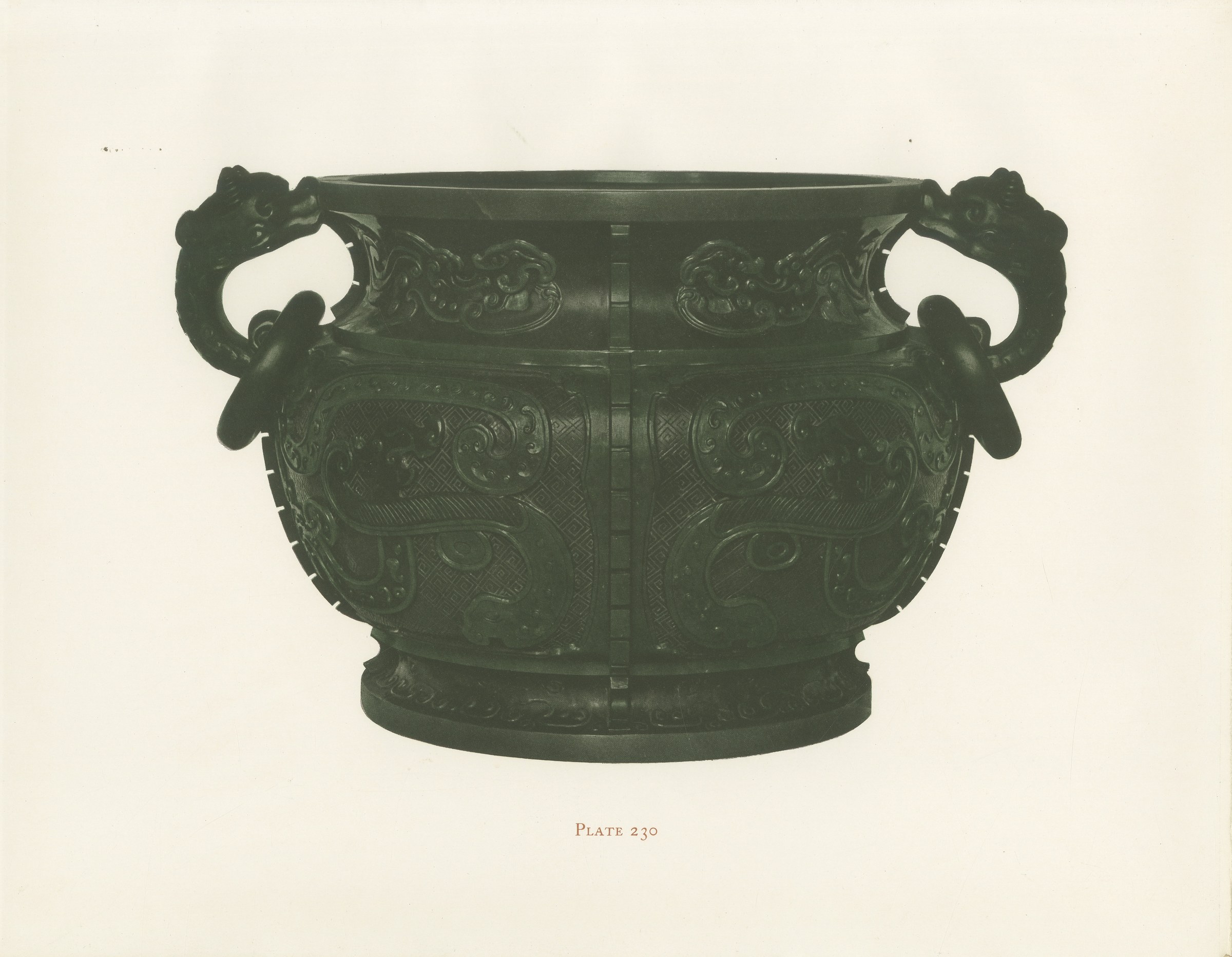
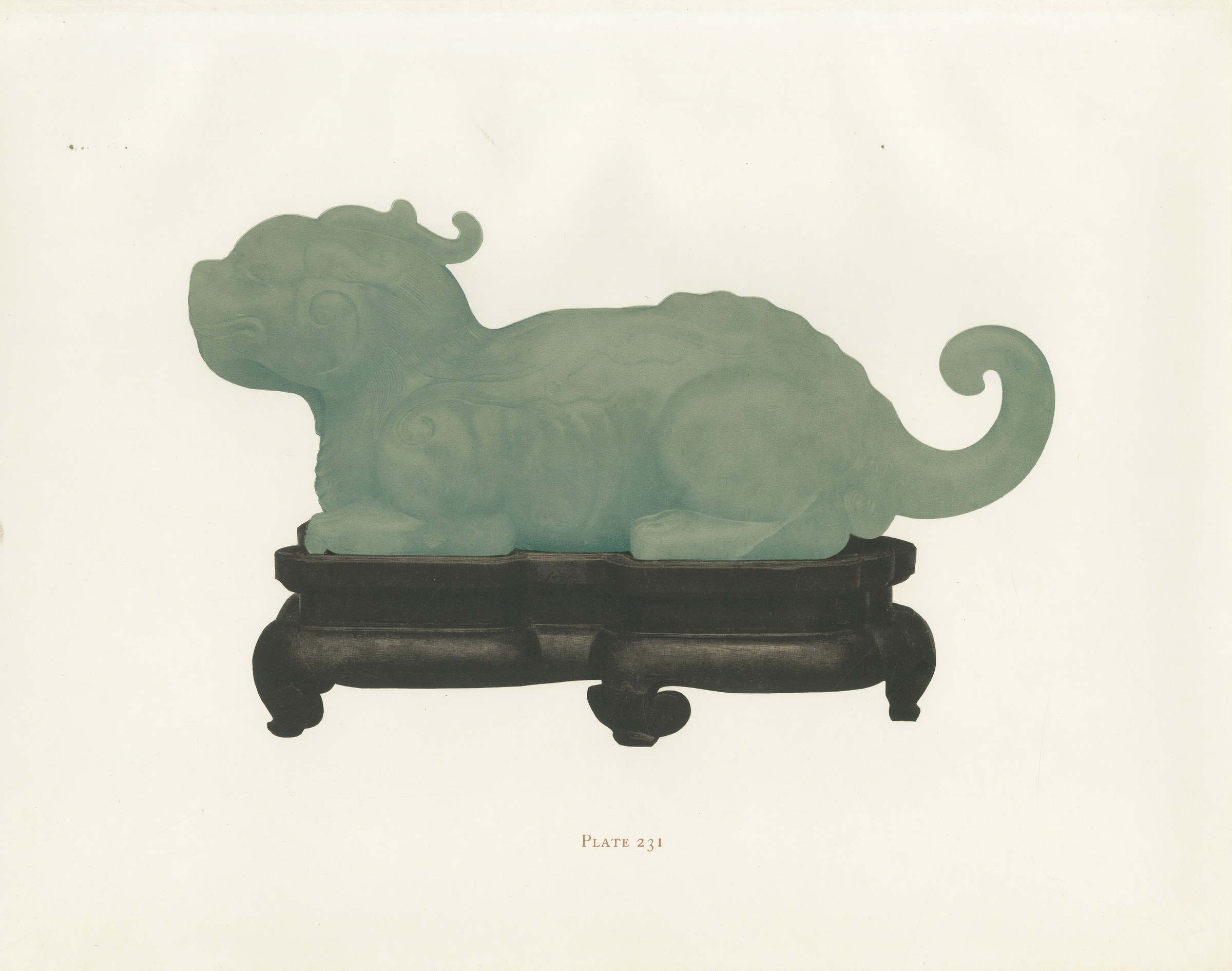
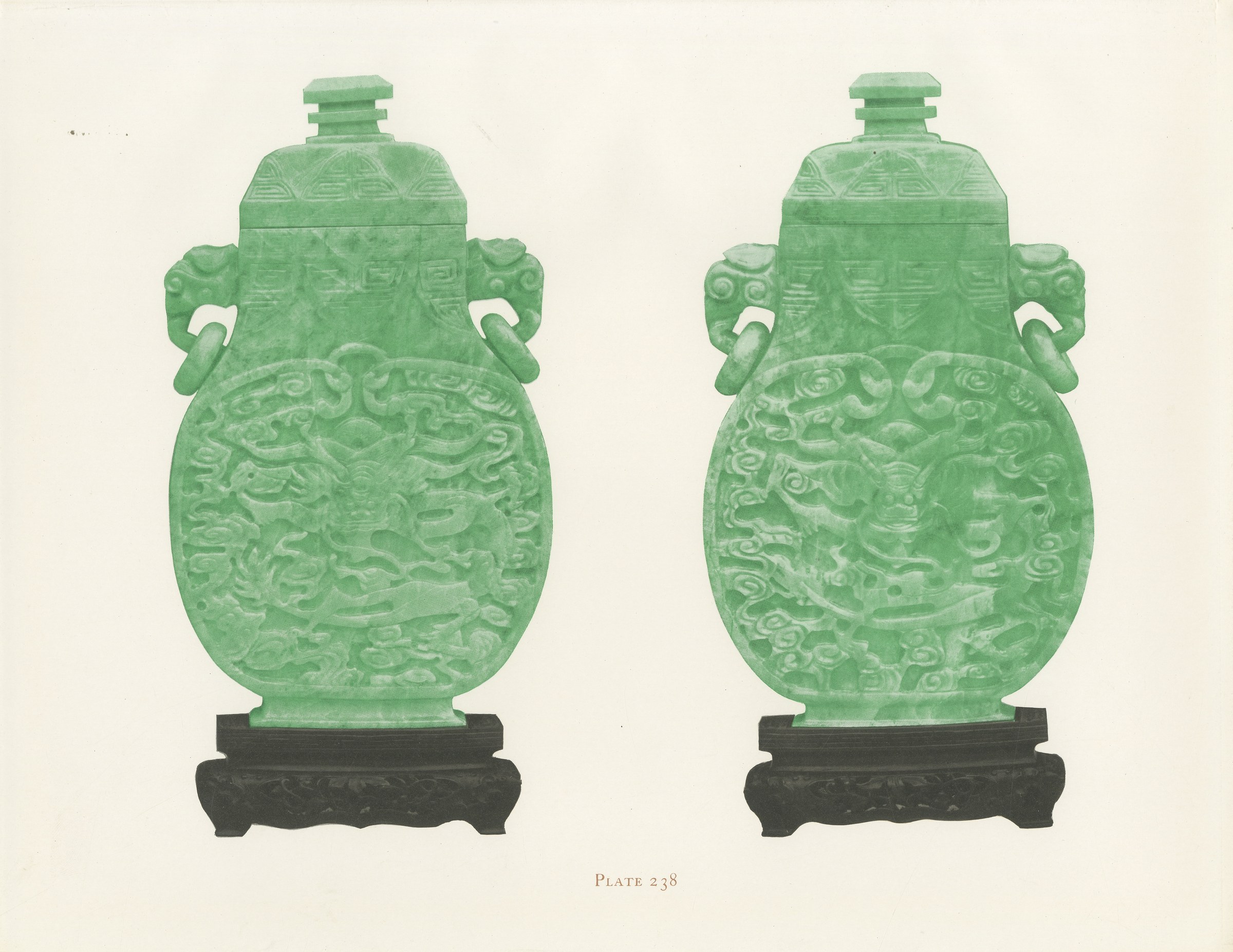
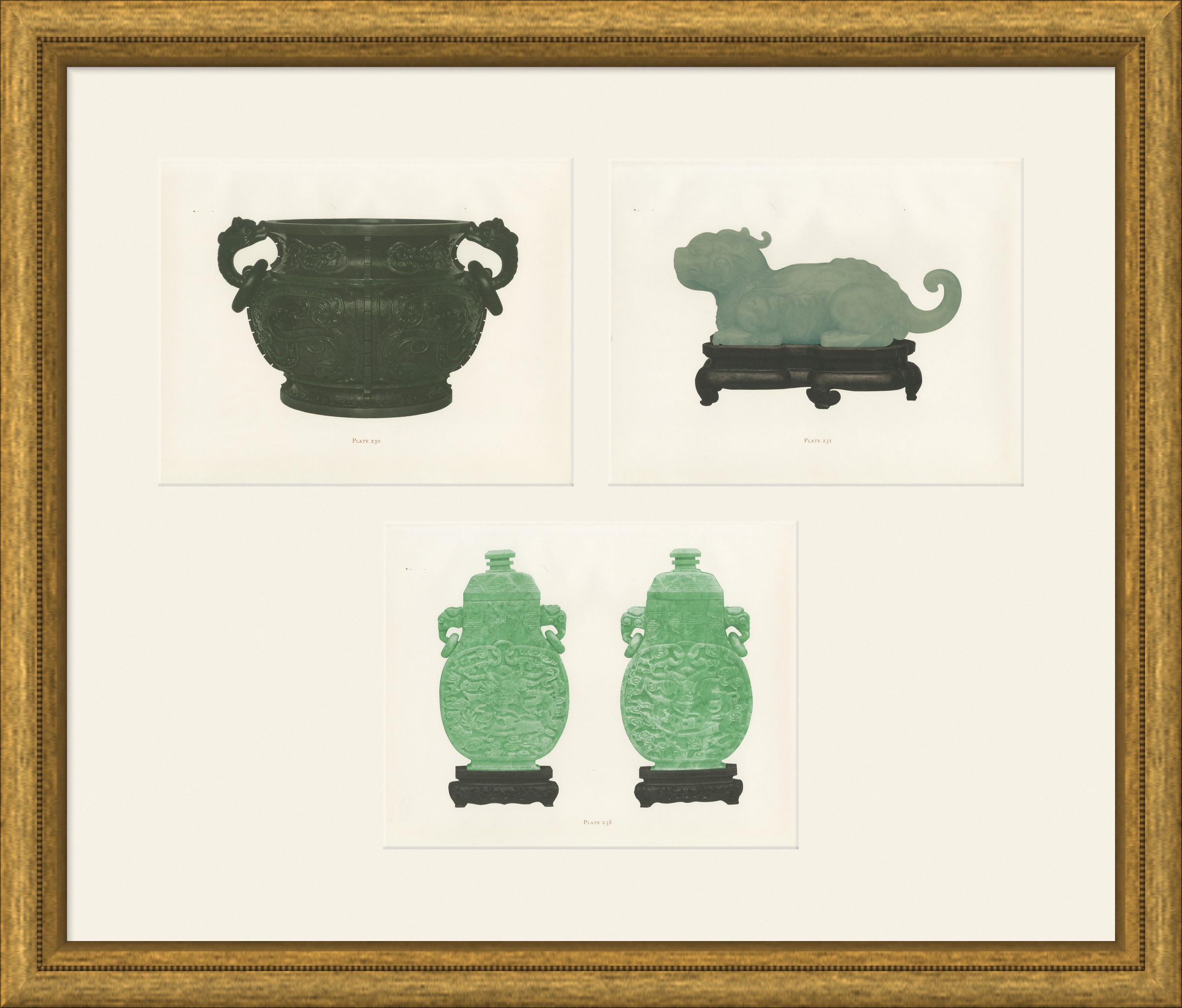
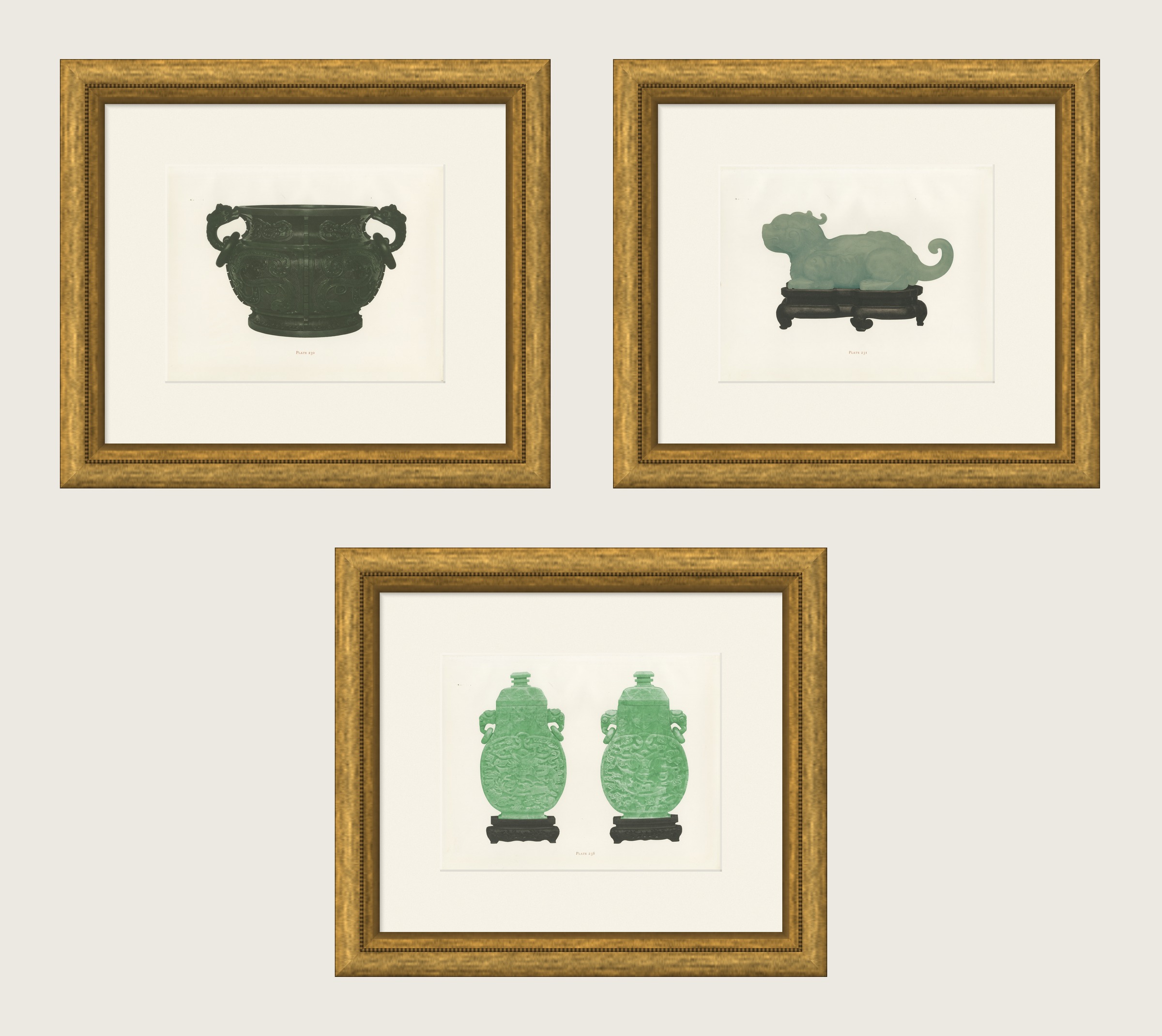
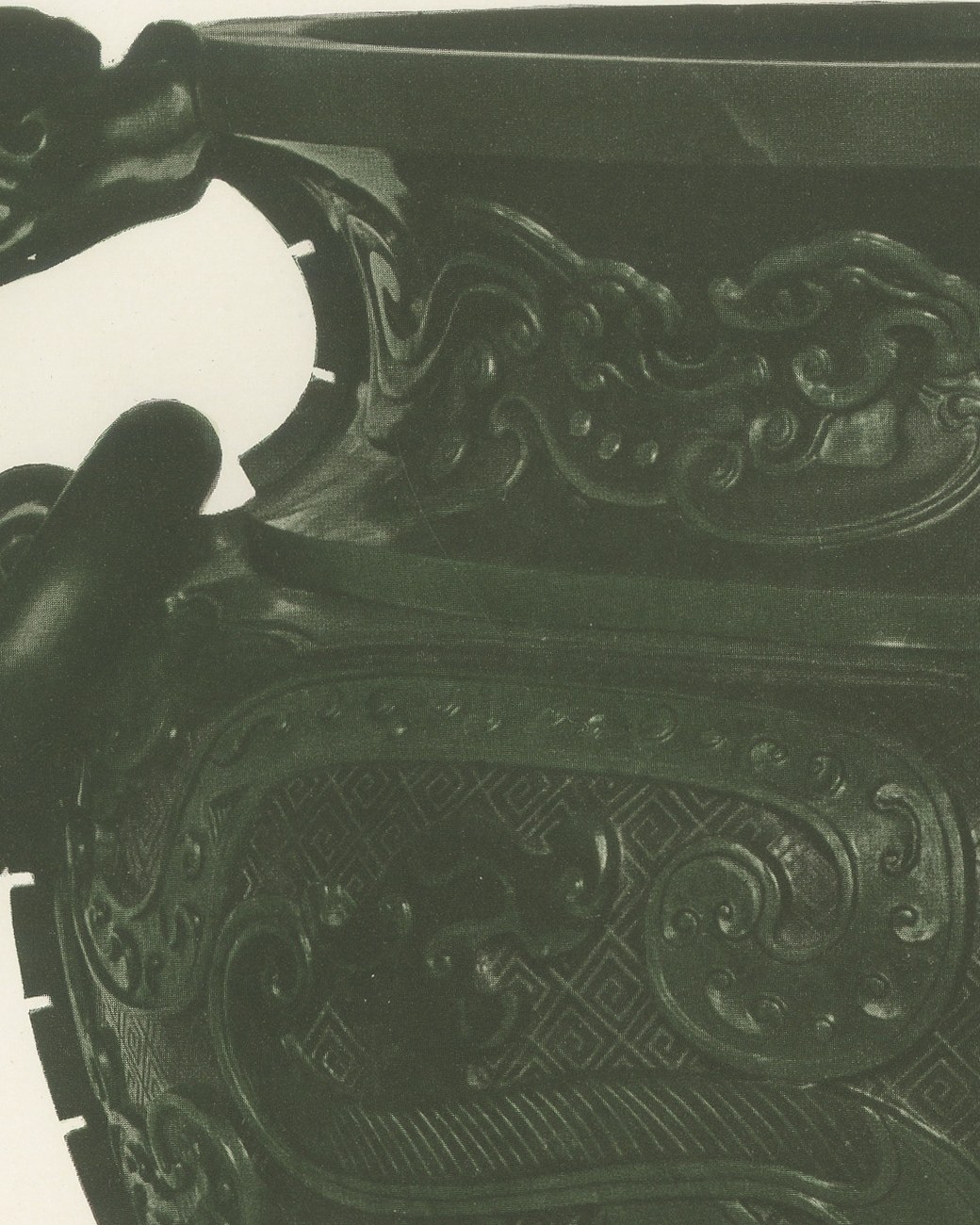
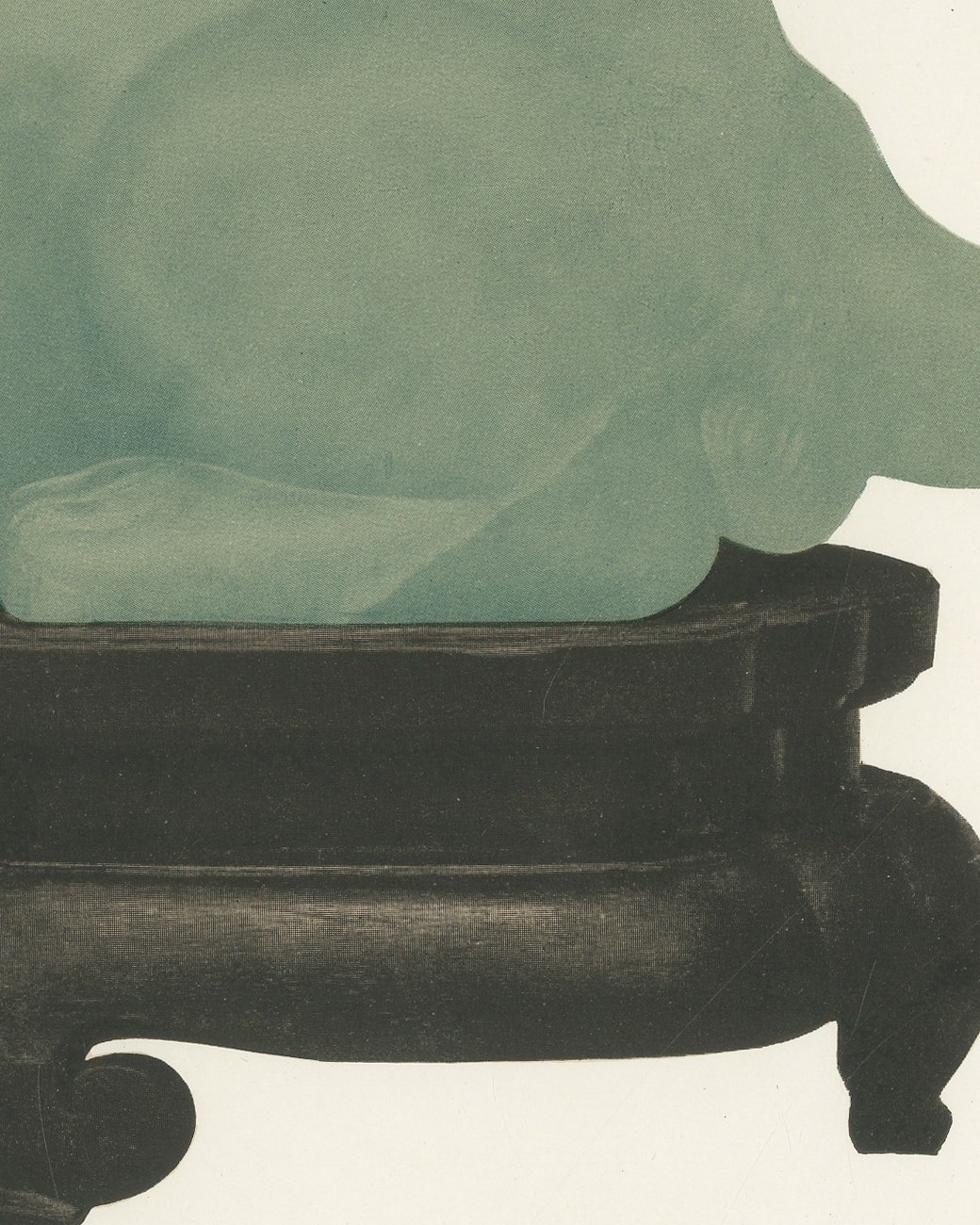
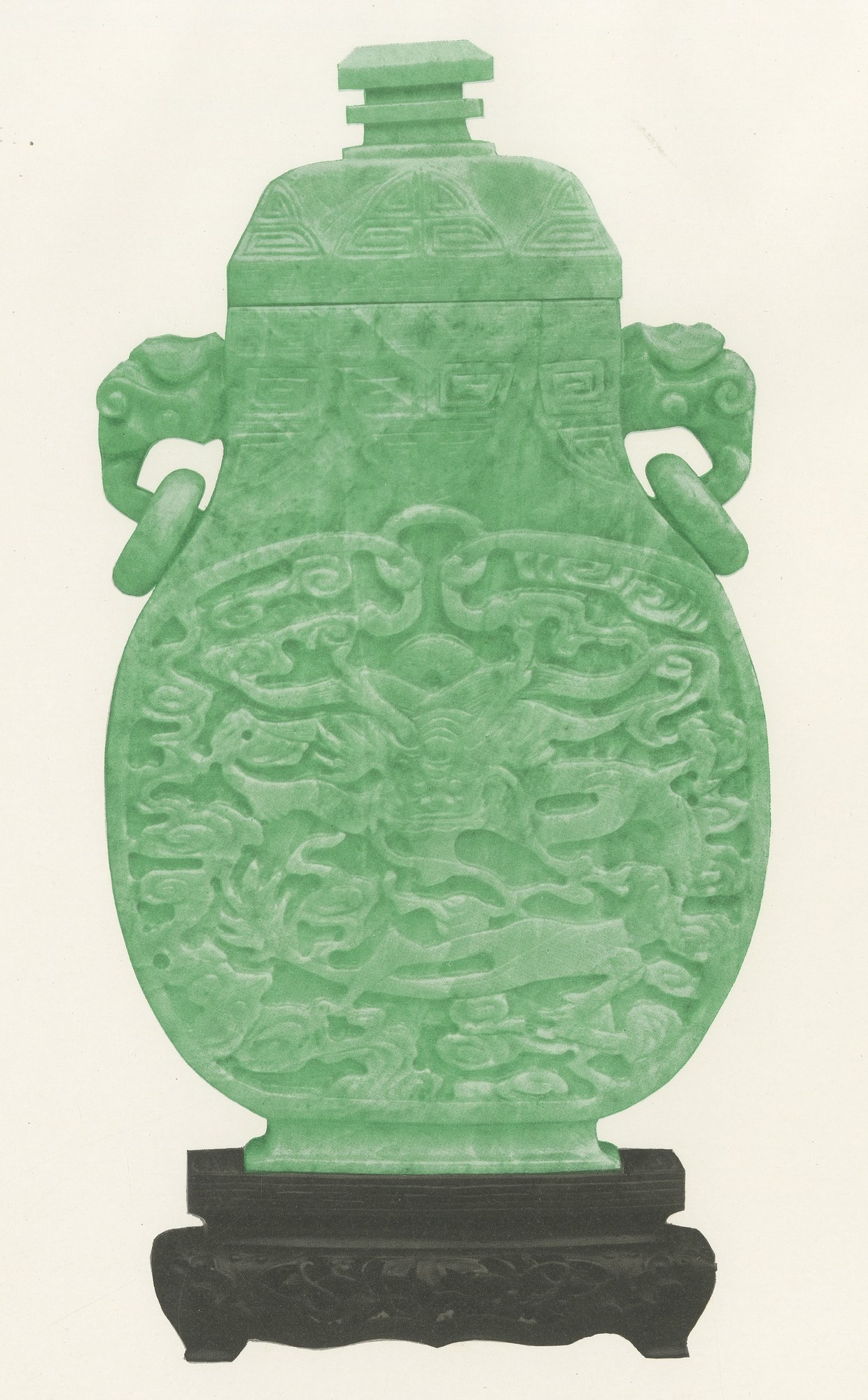
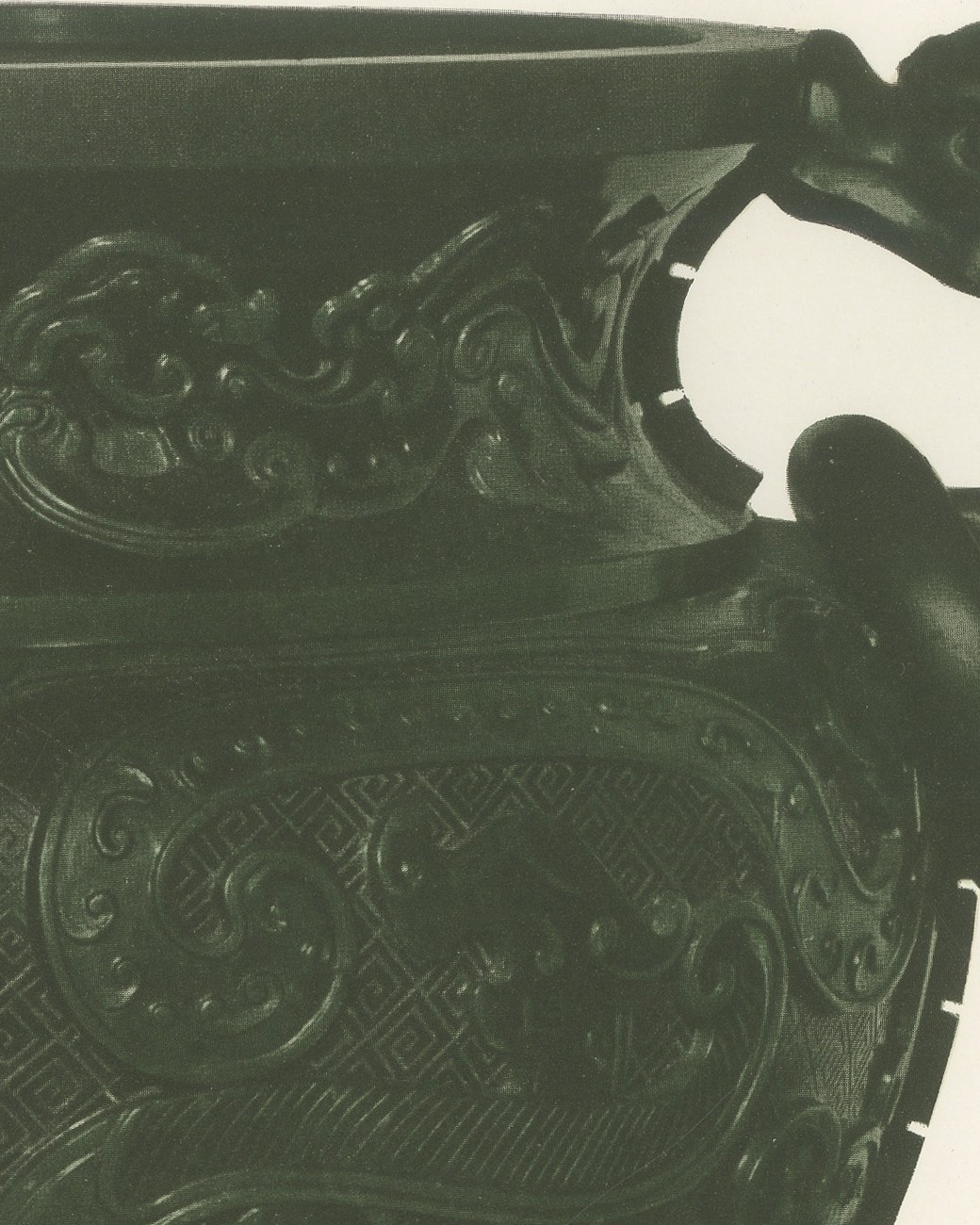
This is a set of three original 1911 color plates, Plates 230, 231 and 238 from Volume II of Gorer and Blacker's Chinese Porcelain and Hard Stones, sold together as one lot. What links them: three important jade vessels. Plate 230: Vase, wine-cooler or seau, in dark olive-green jade, with large ring handles. One of the most important specimens in existence. The vase is divided into four panels, separated by projecting ridges; on the body each of the framed panels encloses three conventional serpents of flattened form in high relief, with lightly carved scrolls. The book gives it to the Kien-lung (marked) period and records height 10 inches (25.3 cm); width 16 3/4 inches (42.5 cm). In the collection of H. S. Whitaker, Esq. Plate 231: Large wine-pot, in the form of a recumbent dragon, carved in blue-gray jade. Marked with the seal character of Kien-lung. The design, drawn from the Imperial catalog of the Po Ku, shows a very ancient form, hollowed out to hold wine for sacrificial use; the dragon has claws, and owing to the depth of the hollowing the transmitted light reveals lines and mottlings in green. The book gives it to the Kien-lung period. In the collection of J. Pierpont Morgan, Esq. Plate 238: Vases, a pair, pilgrim-bottle shaped, of large size, in emerald green jade splashed with white. Each large flat side has a panel enclosed by a fillet joined at the top by a simple ju-i head curve; the panel contains a dragon deeply engraved and extended amongst cloud forms. The handles are elephant heads supporting large rings. The book gives it to the Kien-lung period and records height 11 3/4 inches (30 cm); width 6 7/8 inches (17.5 cm).
The plates belong to Edgar Gorer and J. F. Blacker's Chinese Porcelain and Hard Stones, issued in London by Bernard Quaritch in 1911, a work in two volumes whose two hundred and fifty four color plates were printed to the highest standard the period could reach. The plates are color collotypes, a photographic process that reproduces continuous tone without a visible dot screen, which is why the glazes keep their depth on paper.
Edgar Gorer was one of the most visible dealers in Chinese art of his generation. He traded as S. Gorer and Son at 170 New Bond Street with a branch at 500 Fifth Avenue in New York, dealt chiefly in Kangxi, Yongzheng and Qianlong porcelain, and sold to Sir William Lever. He died on 7 May 1915 when the Lusitania was torpedoed, and his body was never recovered.
Collectors of Chinese ceramics, of early color printing and of Edwardian book illustration all look for these plates, and they work equally well in an interior scheme as in a collection. The three sheets are the same size and were printed by the same hand, so they hang as one group.
These are original antique prints, not modern reproductions. They are three original sheets sold together as one lot, and the set is never split.
Even age toning throughout. Light foxing in the margins of two of the three sheets. Slight wear at the corners of one of the three sheets.
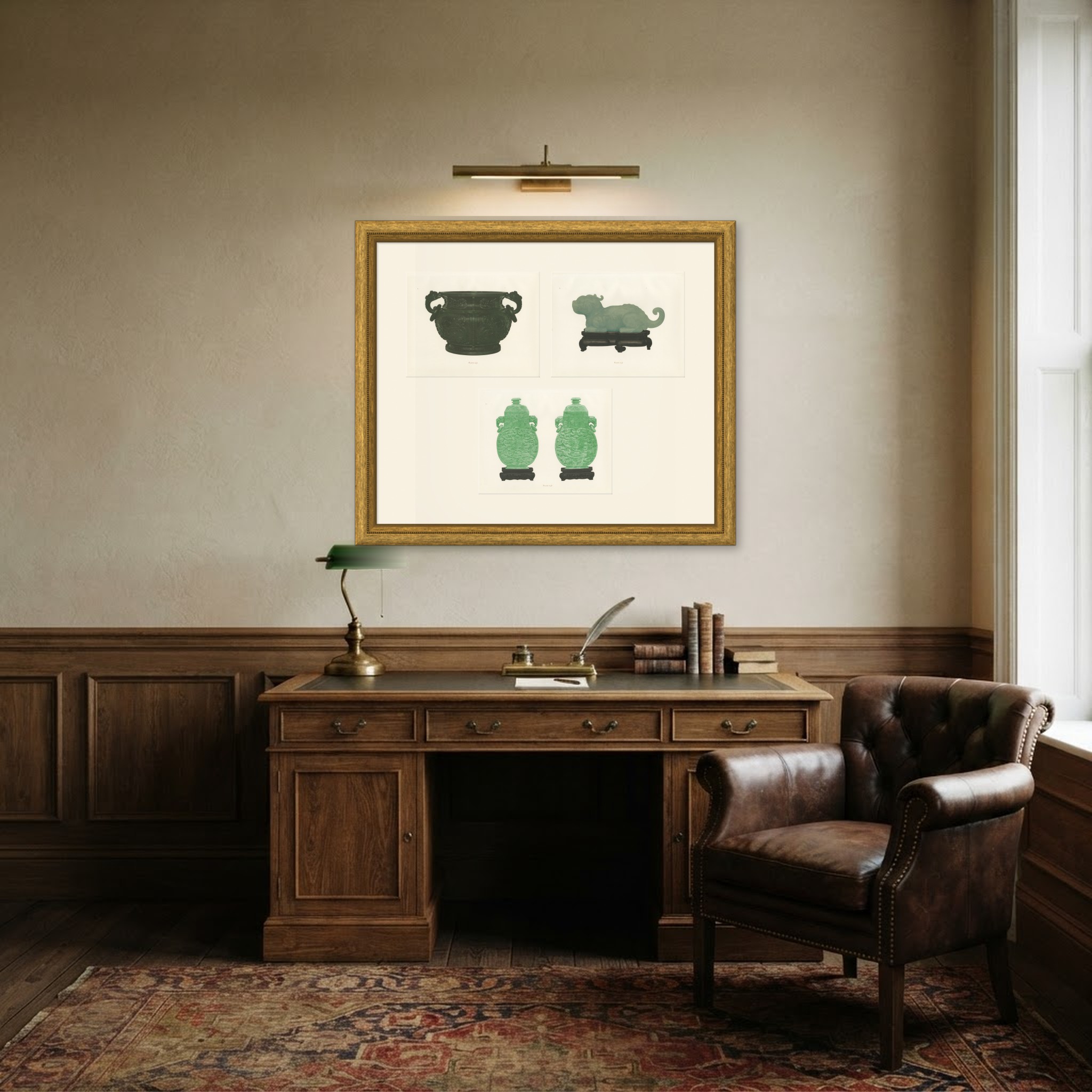
This item is sold unframed. Any framed or interior images are shown for presentation and inspiration only, unless the listing explicitly states that the item is sold framed.