About this sheet
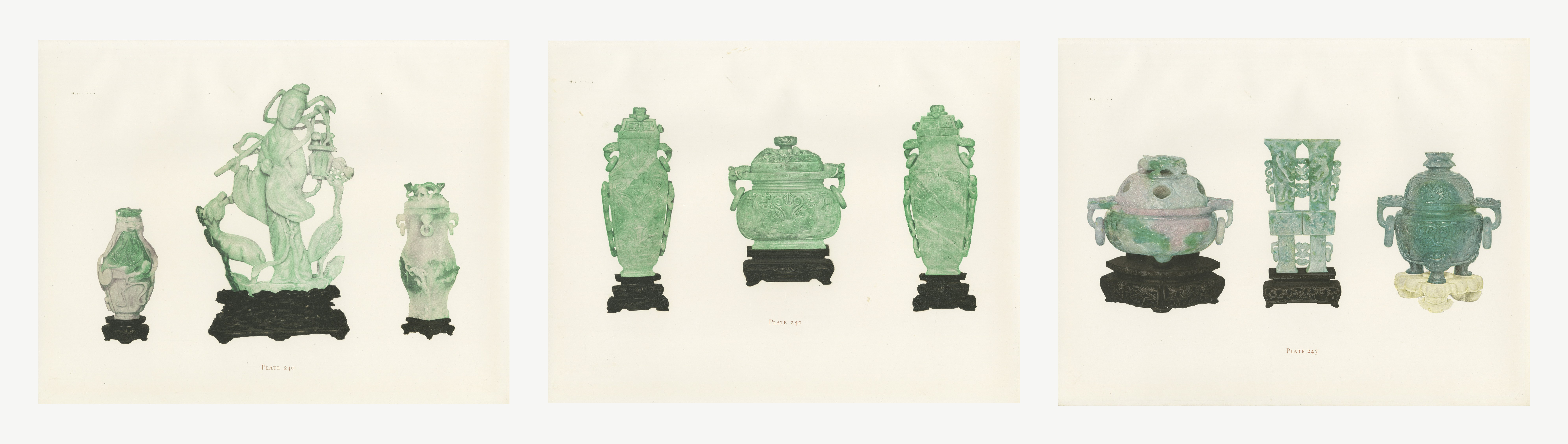
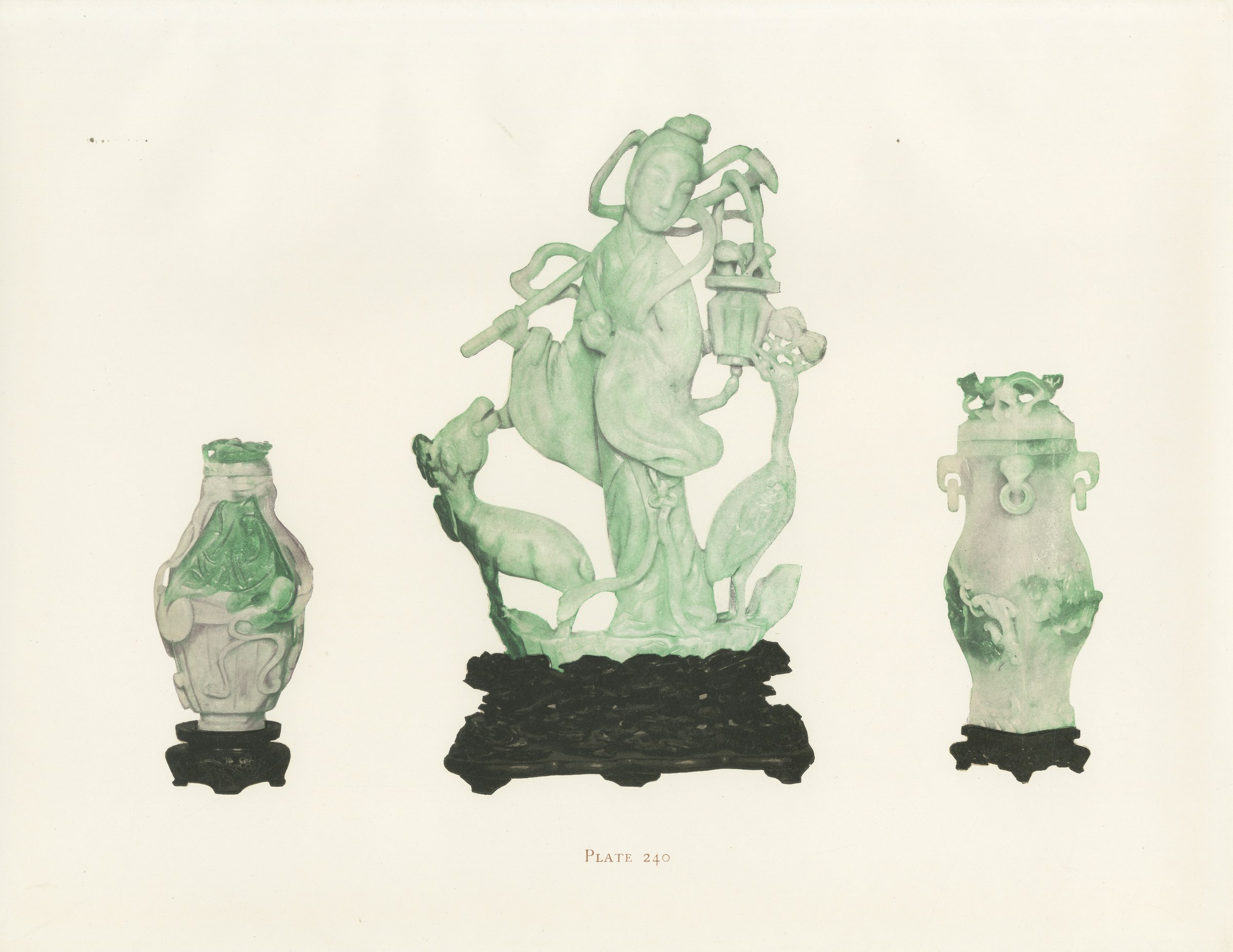
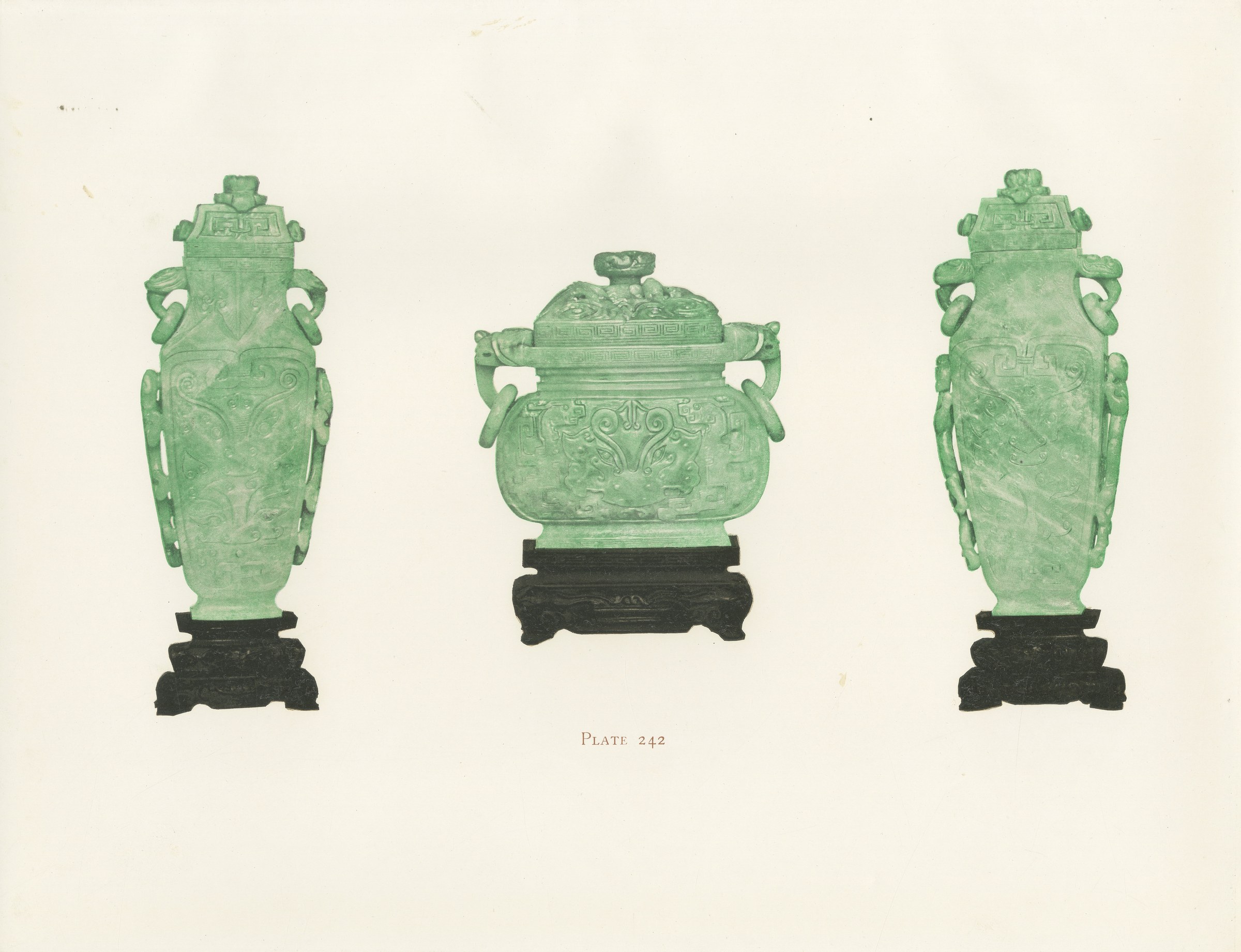
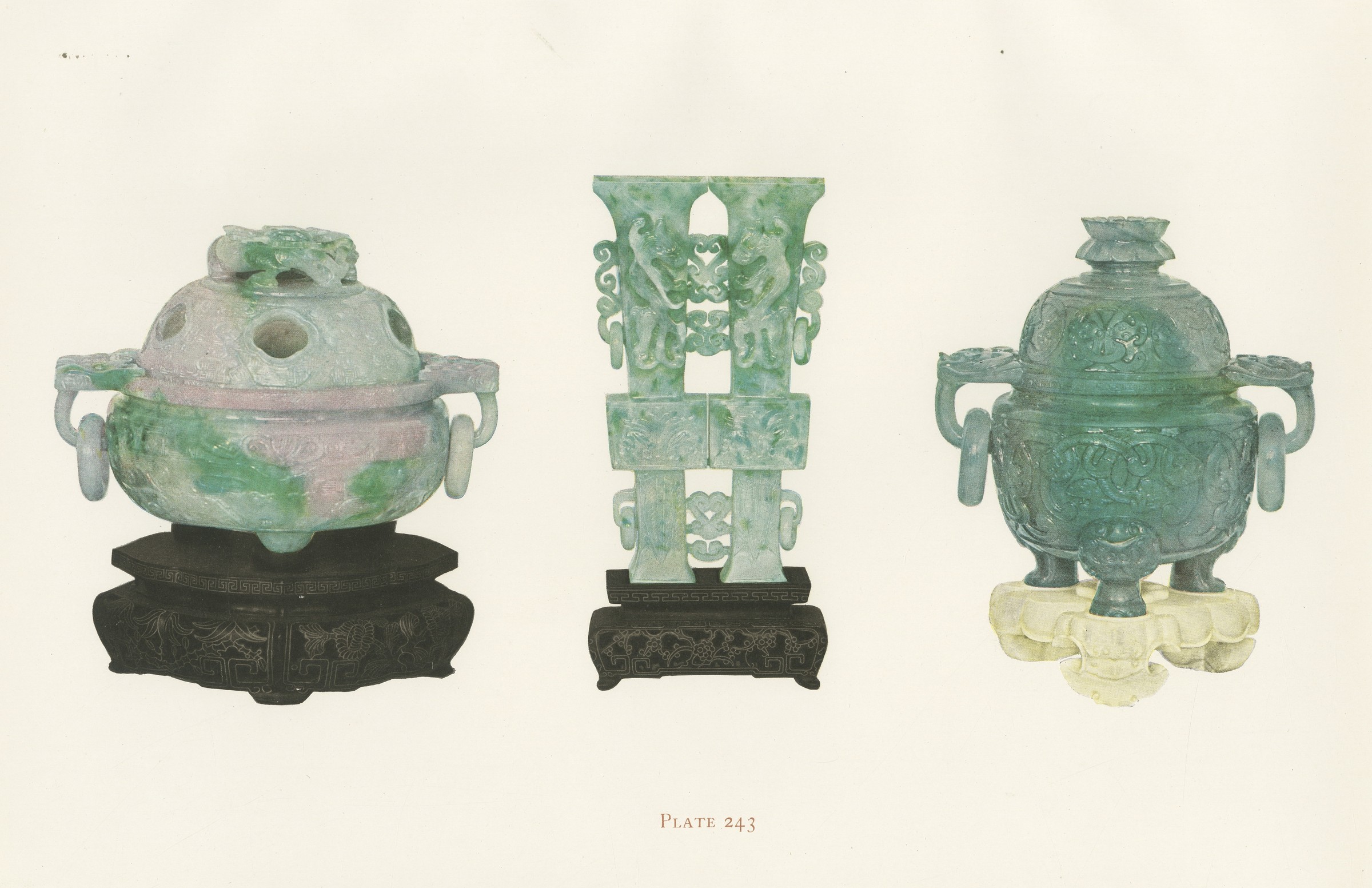
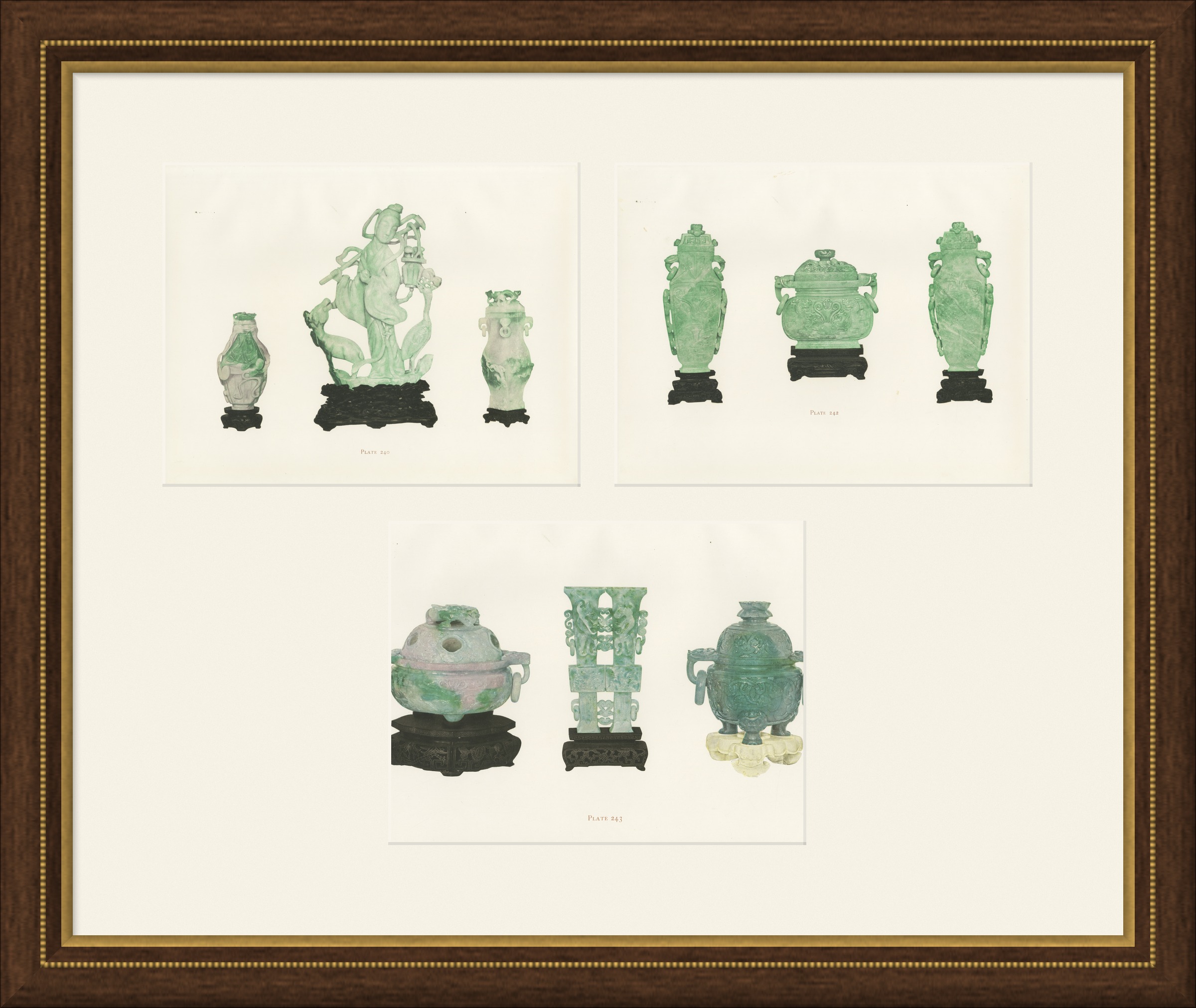
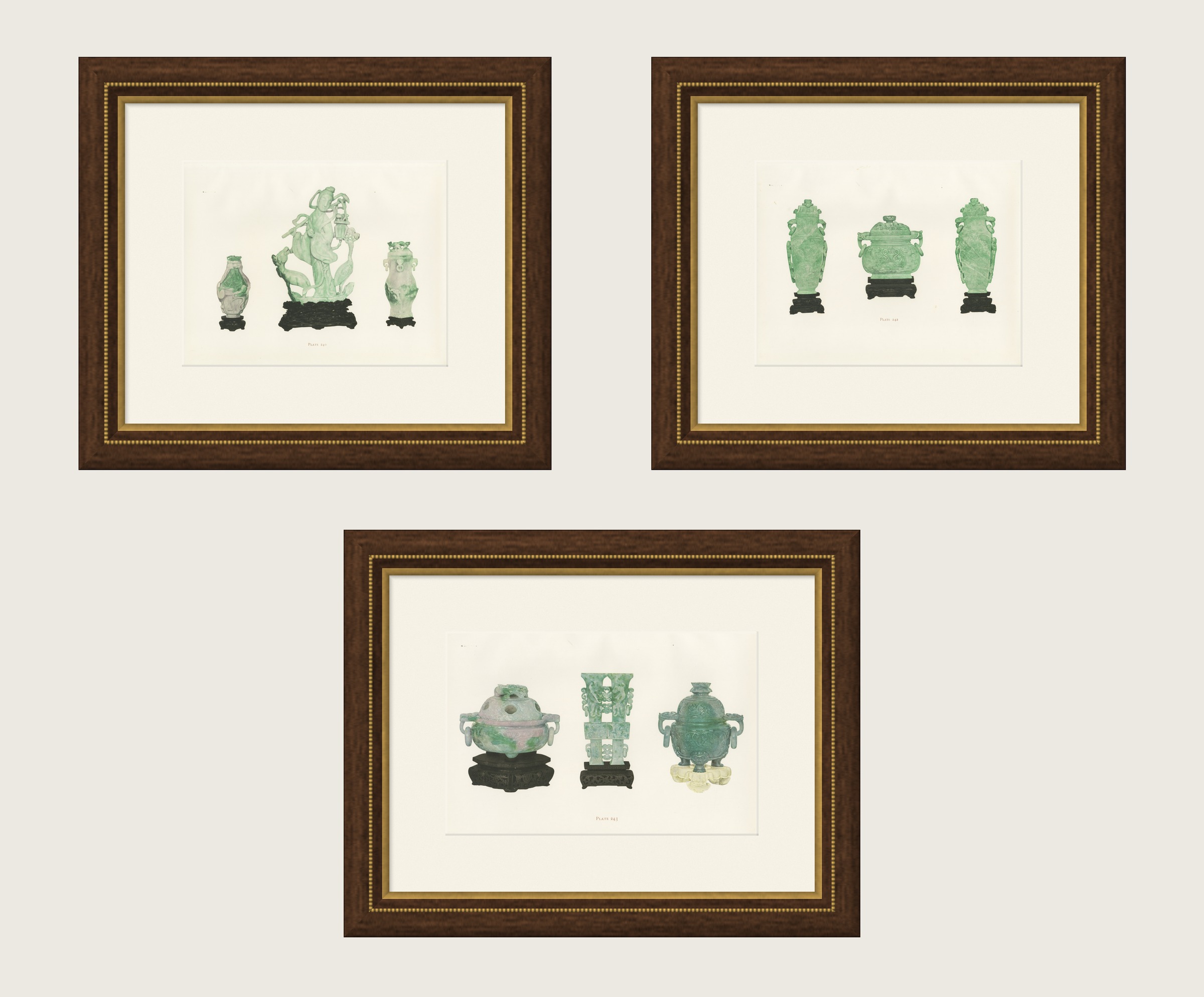
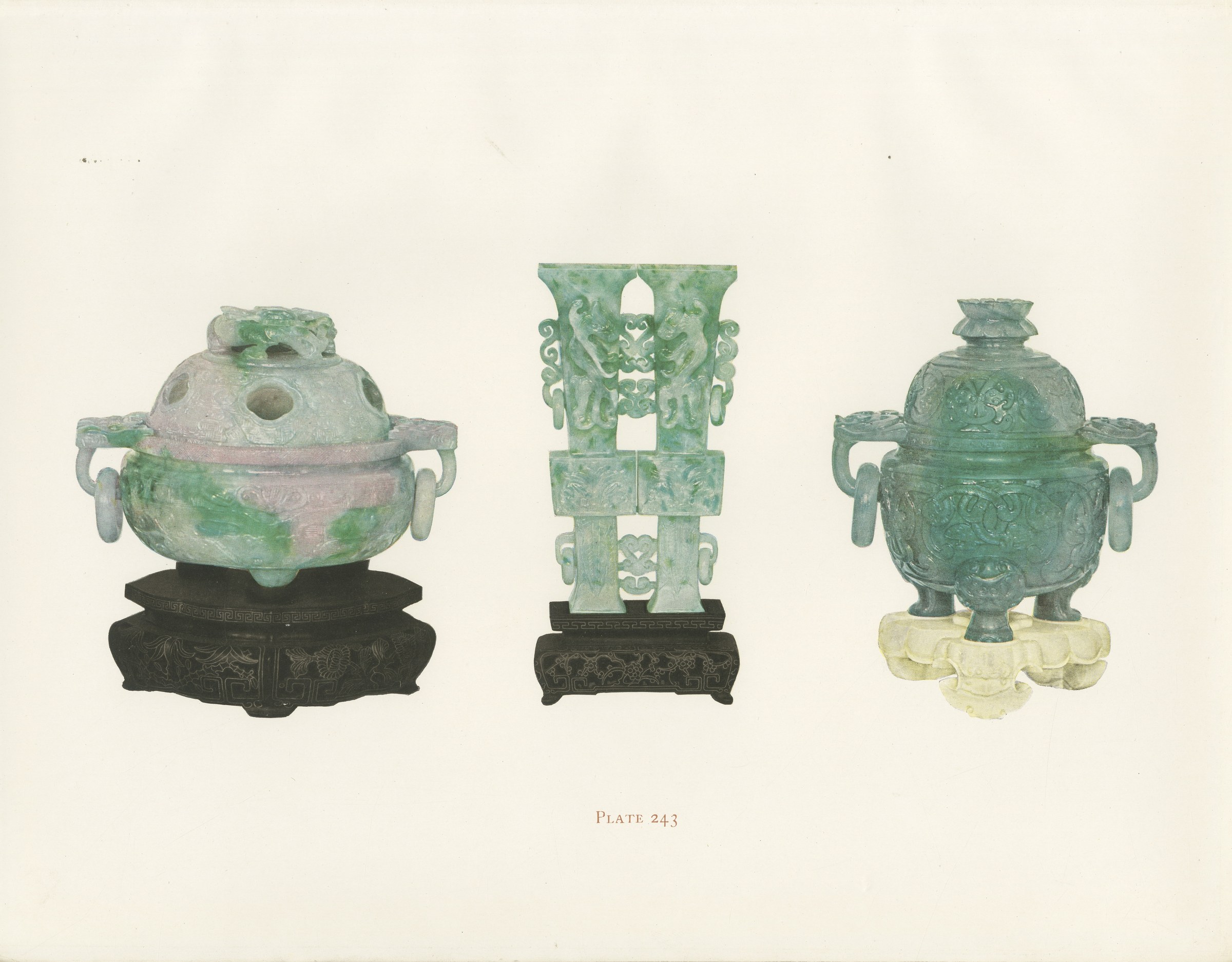
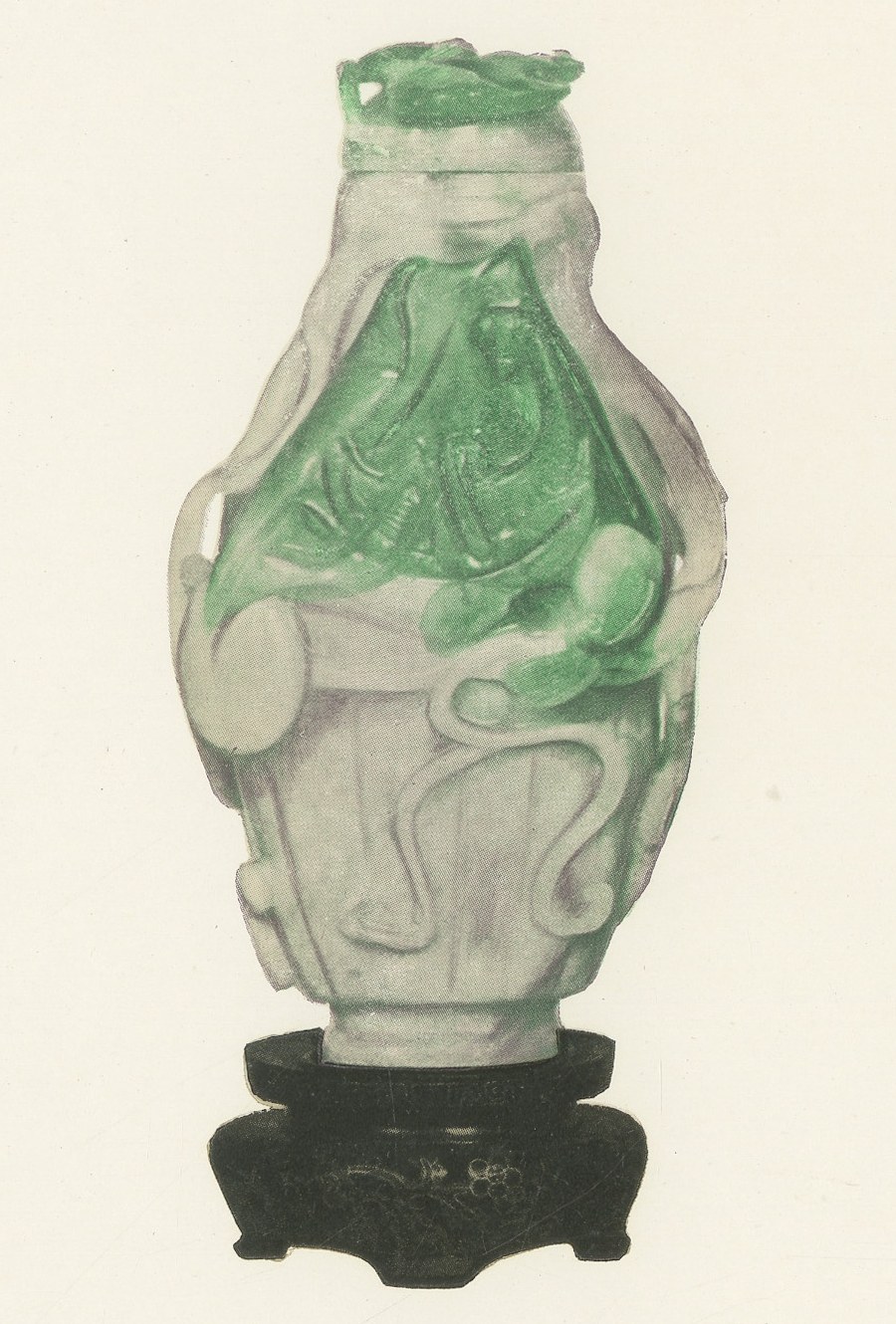
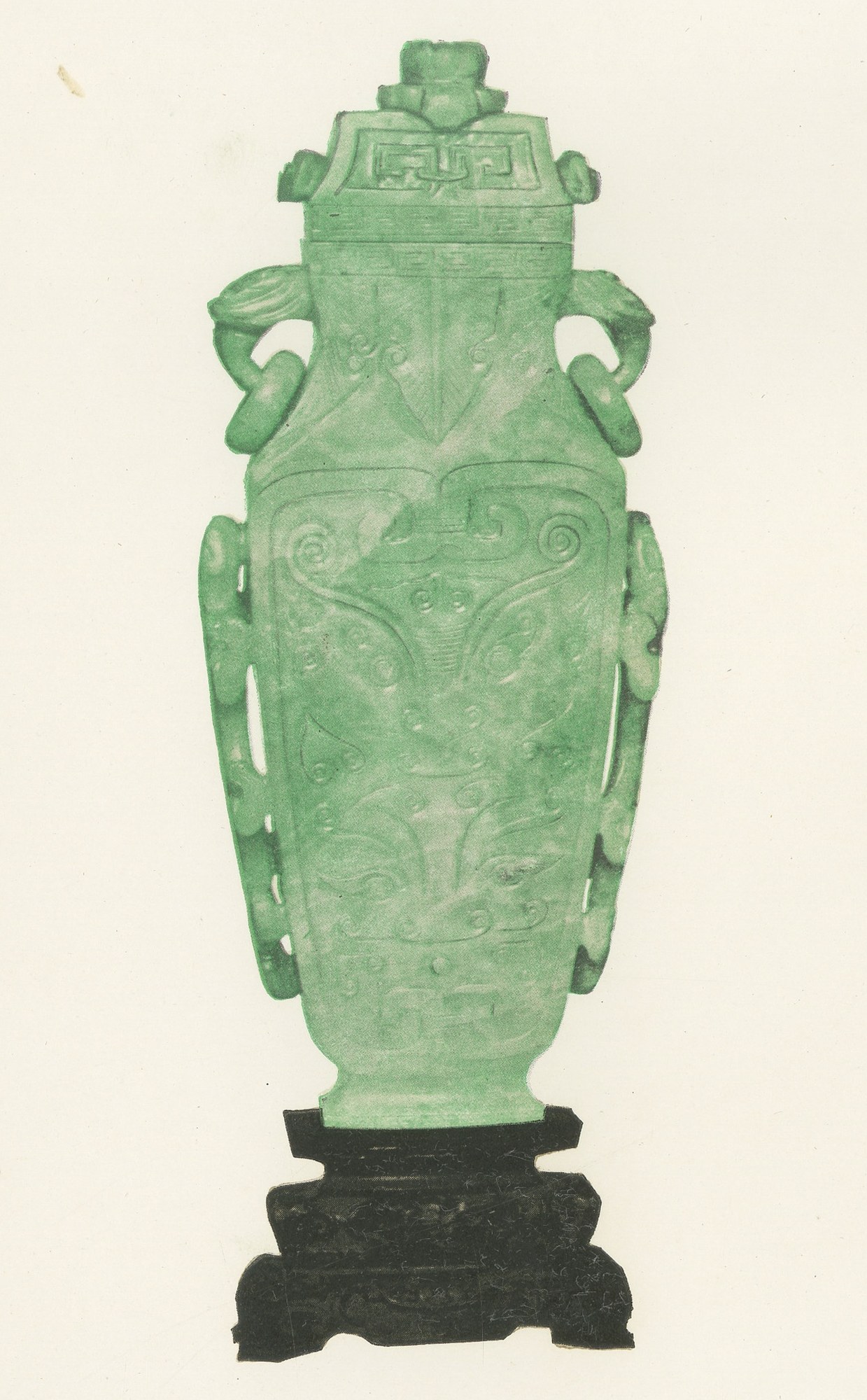
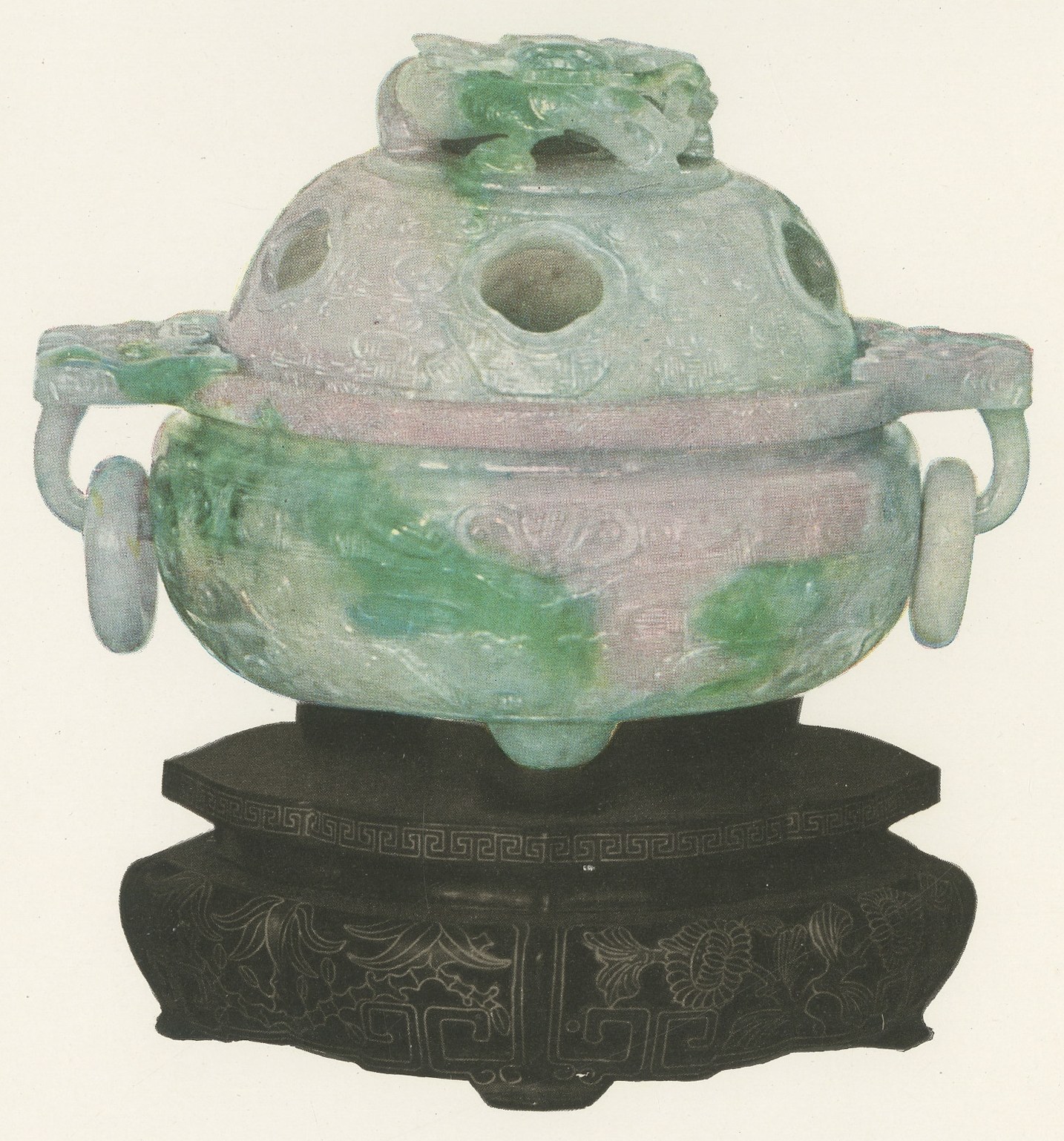
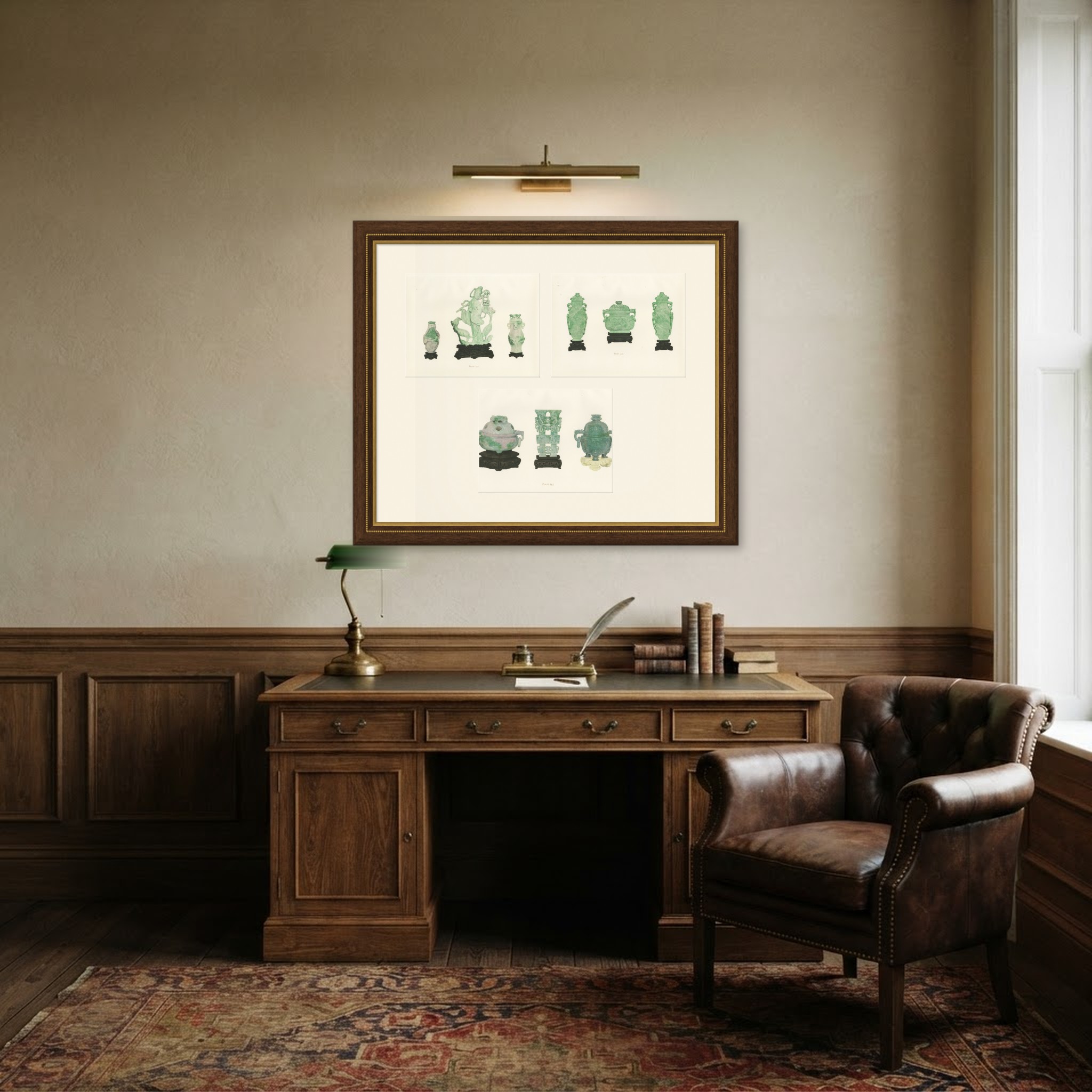
This is a set of three original 1911 color plates, Plates 240, 242 and 243 from Volume II of Gorer and Blacker's Chinese Porcelain and Hard Stones, sold together as one lot. What links them: green jade vases and incense burners. Plate 240: Group of two vases and a figure in green jade. The vase on the left shows a brilliant emerald green color modified by white and lavender, decorated with a melon, whose fruit and flowers, vines, and leaves are relieved by insects such as the praying mantis (mantis religiosa), the whole design carved in relief and openwork. The figure is Hsi Wang Mu, queen of the genii, the royal mother of the West, carved in green jade mottled with white, carrying a basket at the end of a hoe containing the fungus ling-chih, and in her left hand a peach. The book gives it to the Kien-lung period and records height 8 inches (20.5 cm); width 2 7/8 inches (7.4 cm), the book giving a size for each piece shown. In the collection of H. S. Whitaker, Esq. Plate 242: Group of three green jade vases and covers, carved in relief and openwork. The middle vase, quadrangular in form, is decorated with scroll-work and key pattern, the former representing the head of the archaic ogre, the t'ao t'ieh, the latter indicating a conventional chih-lung; the handles are lions' heads. The other two flattened quadrangular vases have somewhat similar scroll decoration on their larger sides suggesting the ogre's head, framed with a fillet ending top and bottom in a Greek key, repeated on the cover, with a lotus flower and a bat on each side. The book gives it to the Kien-lung period and records height 5 3/4 inches (14.5 cm); width 5 1/2 inches (14.5 cm), the book giving a size for each piece shown. In the collection of H. S. Whitaker, Esq. Plate 243: Ting, or incense-burner, and cover, of lavender and green jade; with a twin flower vase cut from one piece of green jade. The ting's decoration, of conventional ogre-scrolls upon a ground of zigzags, is cut in low relief; the handles, surmounted by a flattened ogre's head, each support a loose ring, and the cover is pierced with five shaped holes. The twin flower vase has supports between the two parts of bands of pierced scroll-work, two scrolls in relief on the sides from which ring handles depend, and other suspended rings. The book gives it to the Kien-lung period and records height 4 1/2 inches (11.4 cm); diameter 6 1/4 inches (16 cm), the book giving a size for each piece shown. In the collection of H. S. Whitaker, Esq.
The sheets come from Chinese Porcelain and Hard Stones, the two volume work by the London dealer Edgar Gorer and the writer J. F. Blacker, published by Bernard Quaritch of 11 Grafton Street, New Bond Street, in 1911 in an edition of one thousand numbered copies. The plates are color collotypes, a photographic process that reproduces continuous tone without a visible dot screen, which is why the glazes keep their depth on paper.
What gives these plates their standing is the quality of the collections they record. Pieces illustrated here passed through the great Edwardian cabinets, and several are now in museums, so the book is a photographic record of where this material sat a century ago.
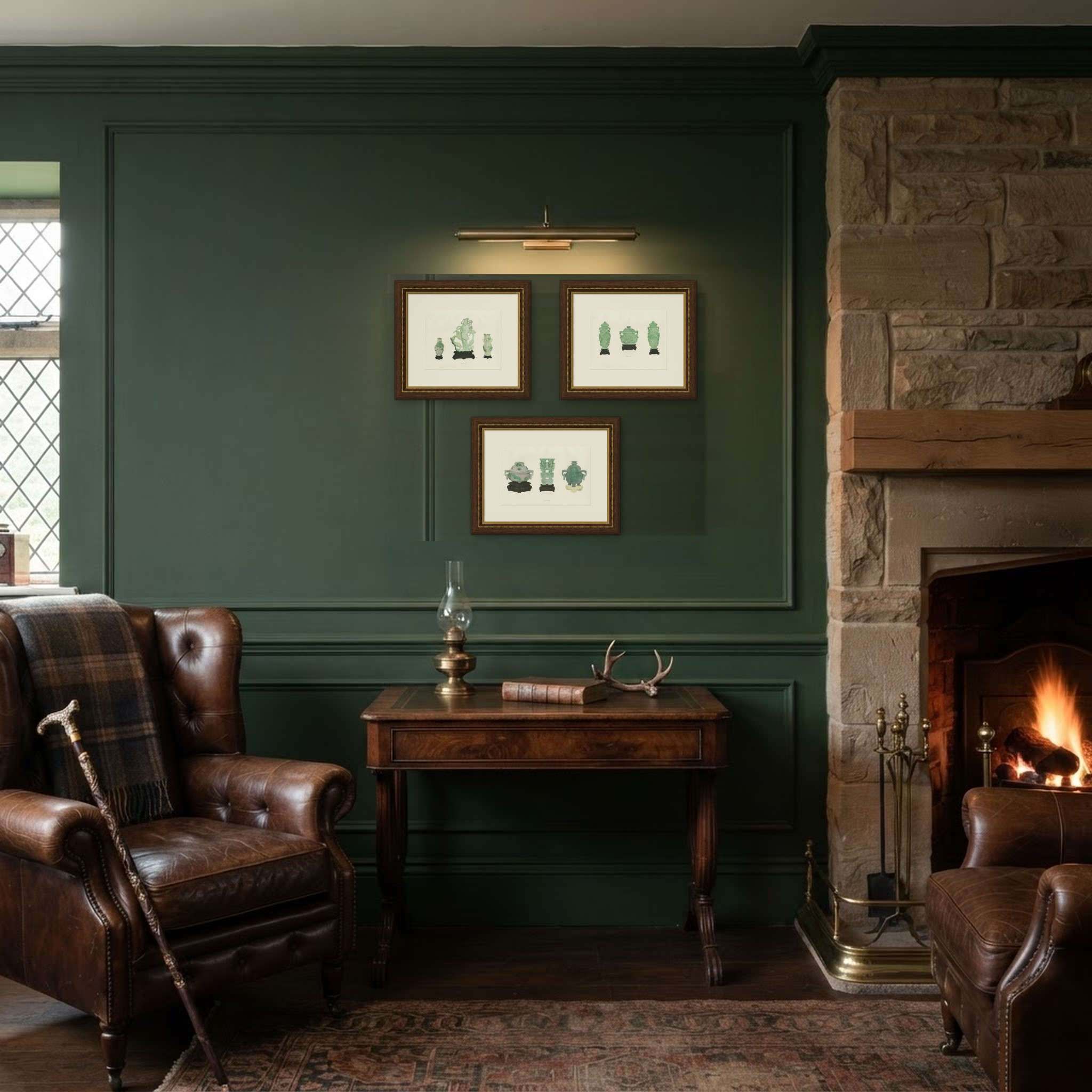
Collectors of Chinese ceramics, of early color printing and of Edwardian book illustration all look for these plates, and they work equally well in an interior scheme as in a collection. The three sheets are the same size and were printed by the same hand, so they hang as one group.
These are original antique prints, not modern reproductions. They are three original sheets sold together as one lot, and the set is never split.
Even age toning throughout. Light foxing in the margins of one of the three sheets. Slight wear at the corners of two of the three sheets.
This item is sold unframed. Any framed or interior images are shown for presentation and inspiration only, unless the listing explicitly states that the item is sold framed.