About this sheet
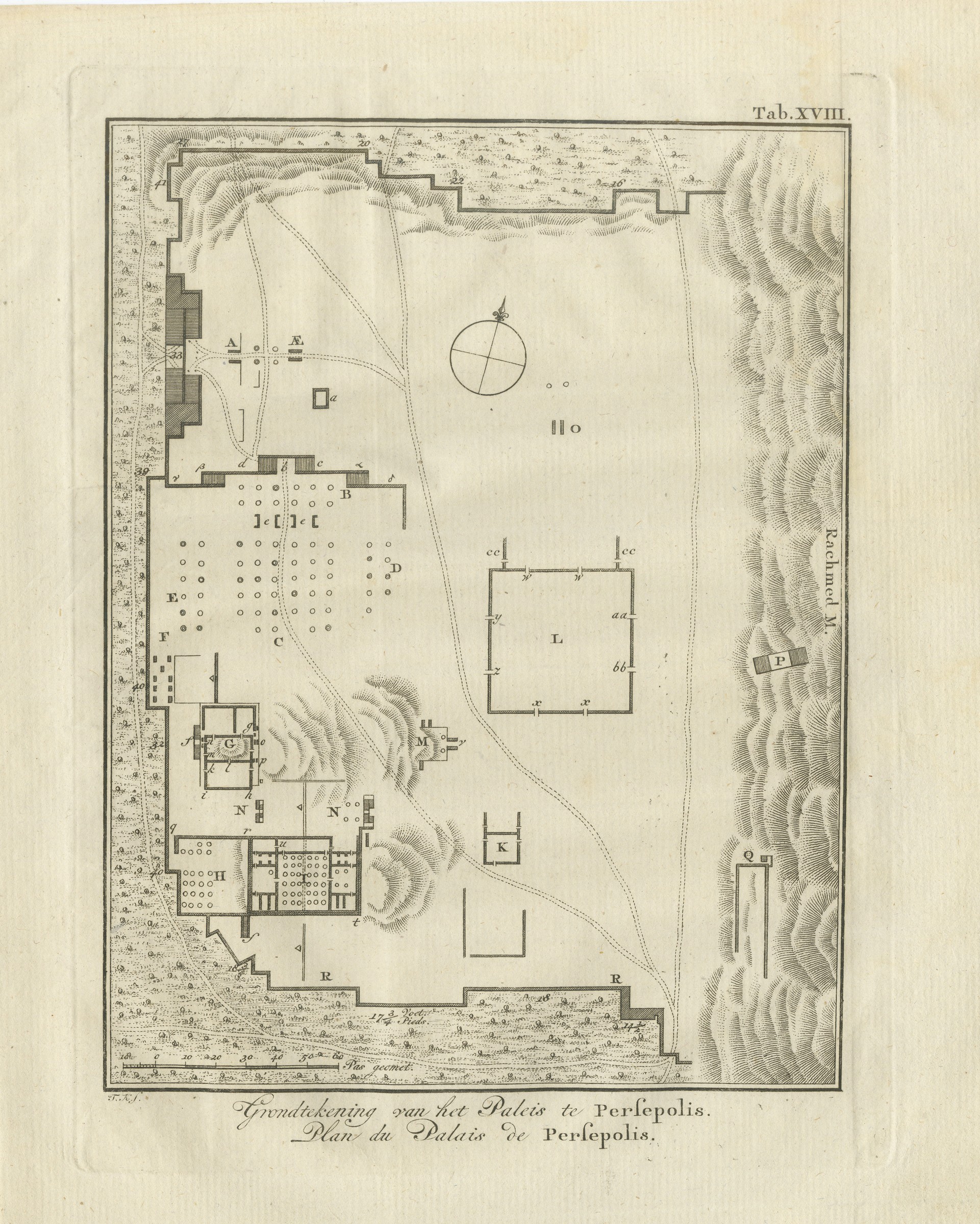
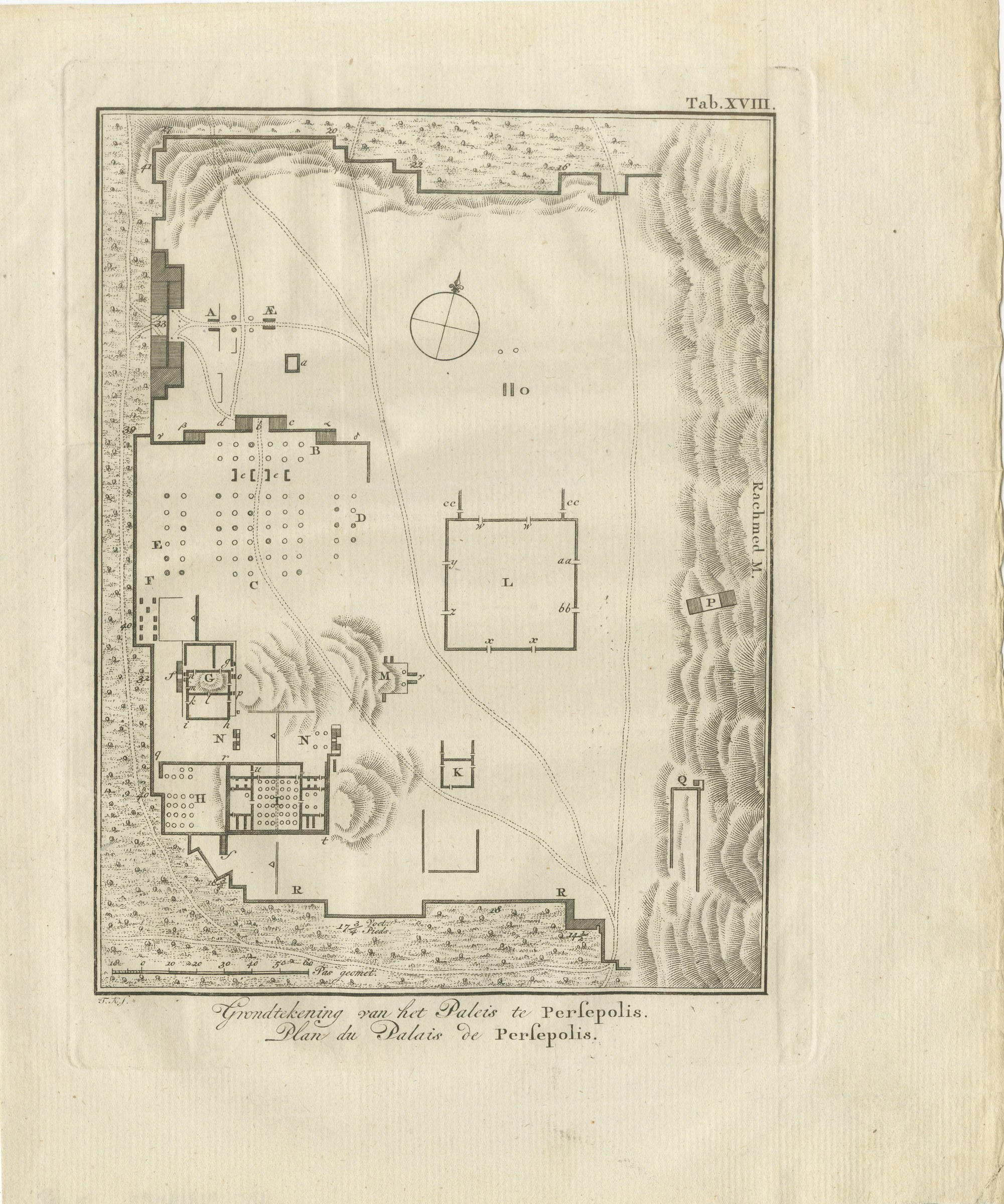
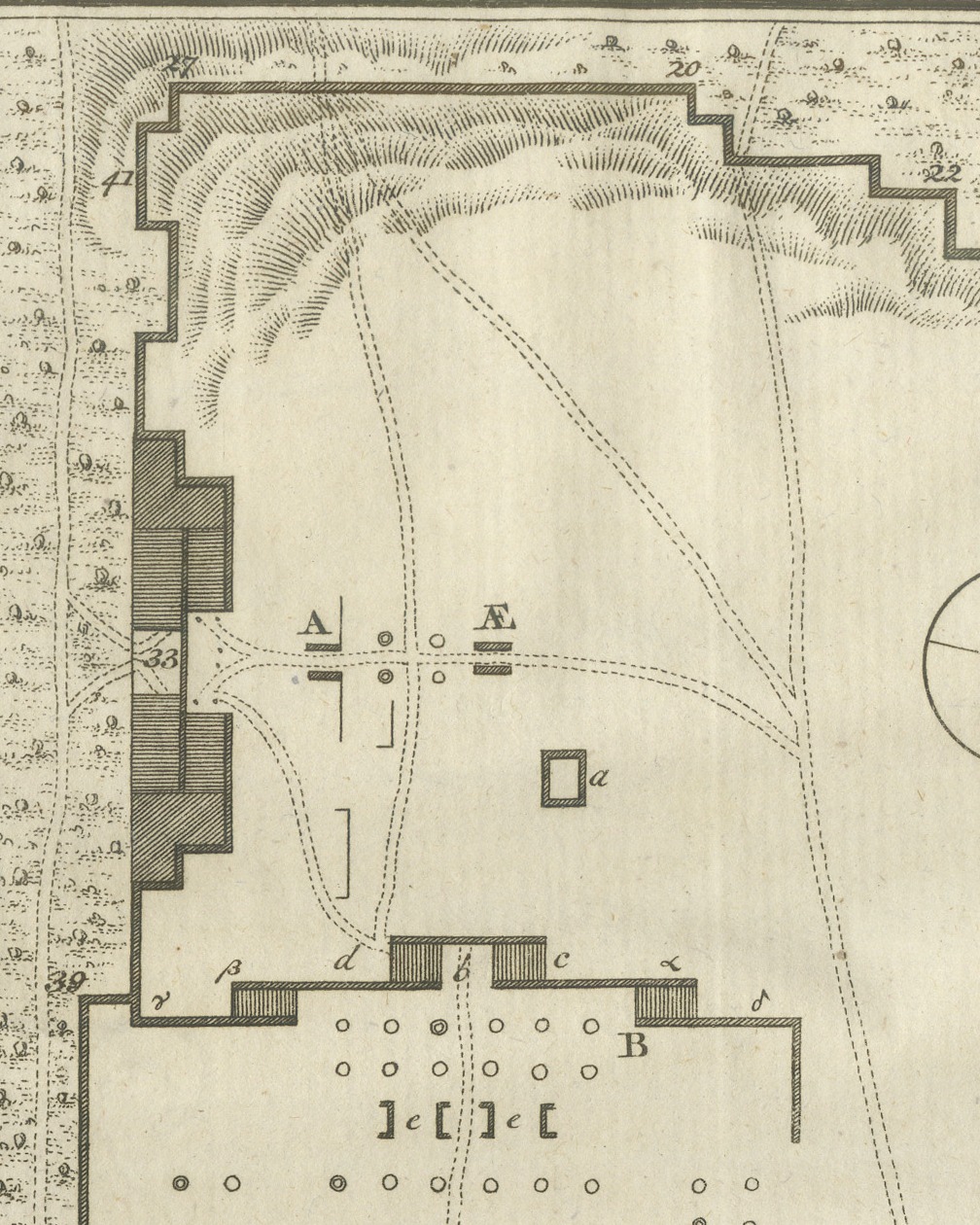
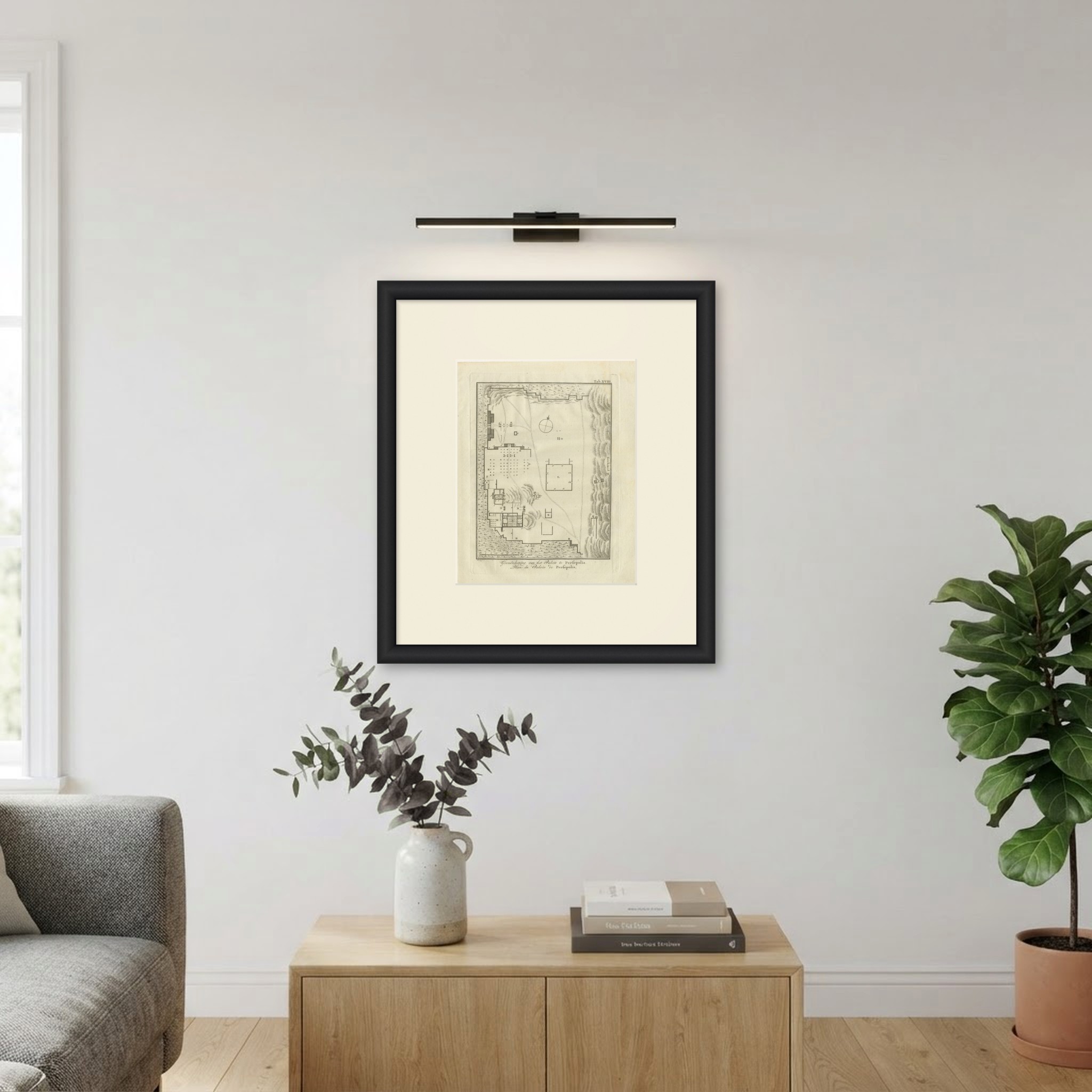
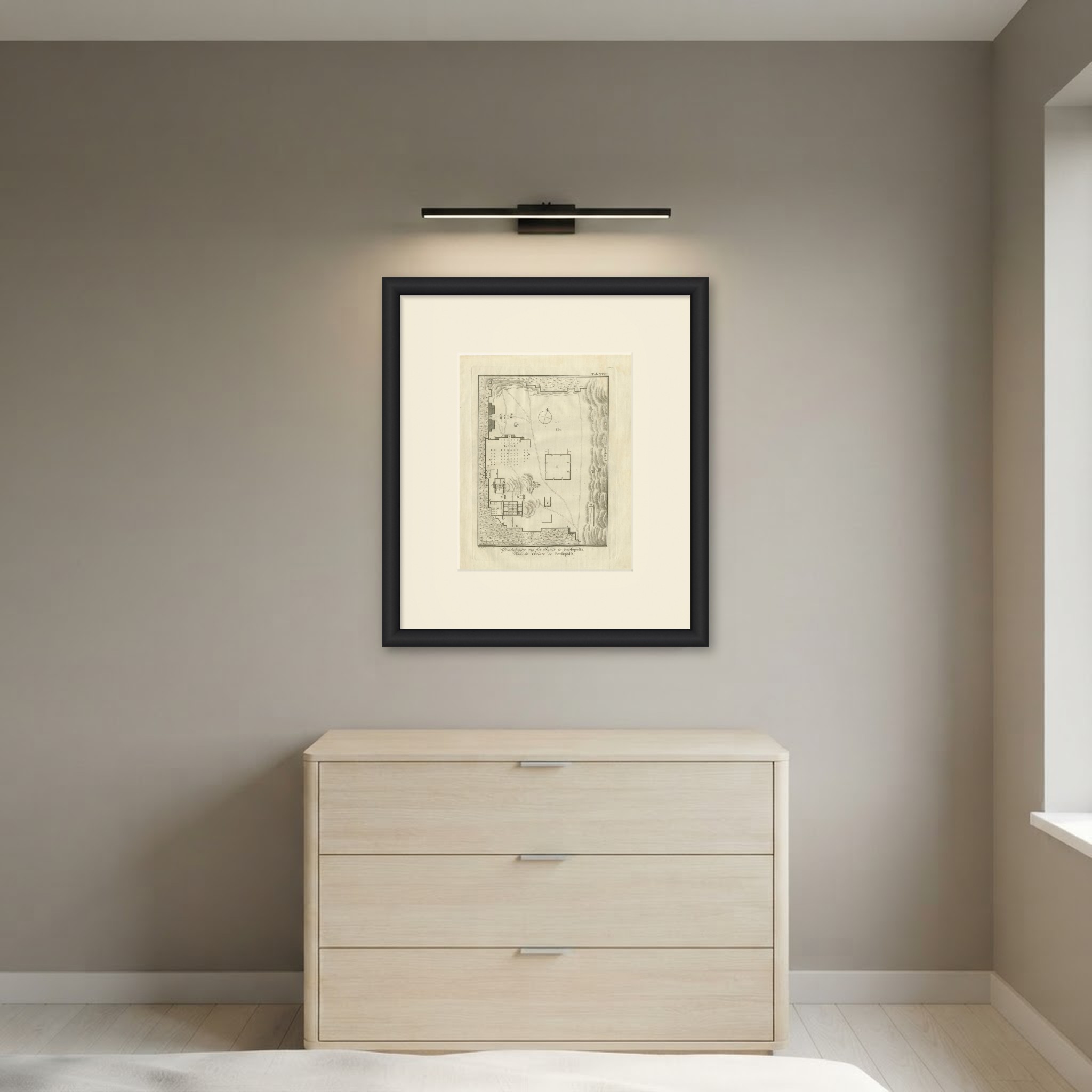
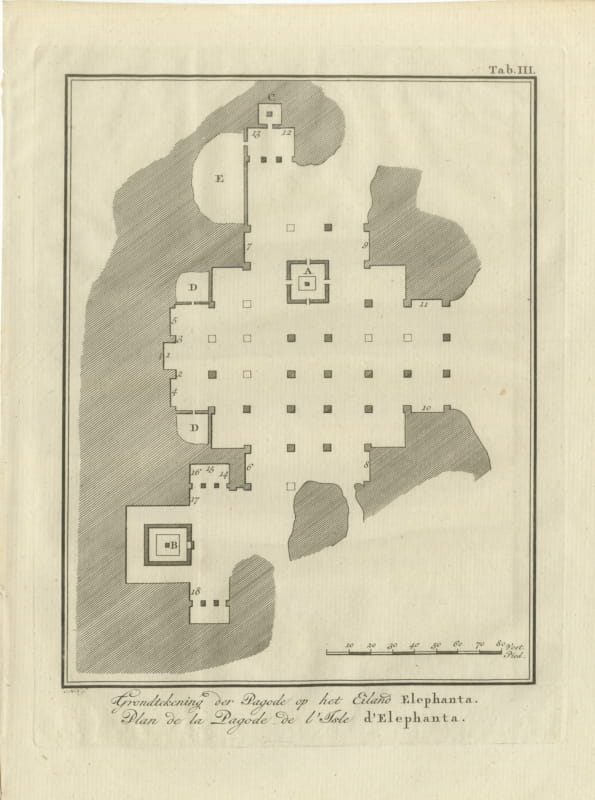
This is an original antique copper engraving, published in 1780, from the second volume of Carsten Niebuhr's account of his travels. The caption engraved in the lower margin reads in Dutch Grondtekening van het Paleis te Persepolis. and in French Plan du Palais de Persepolis., both meaning "Ground plan of the palace at Persepolis."
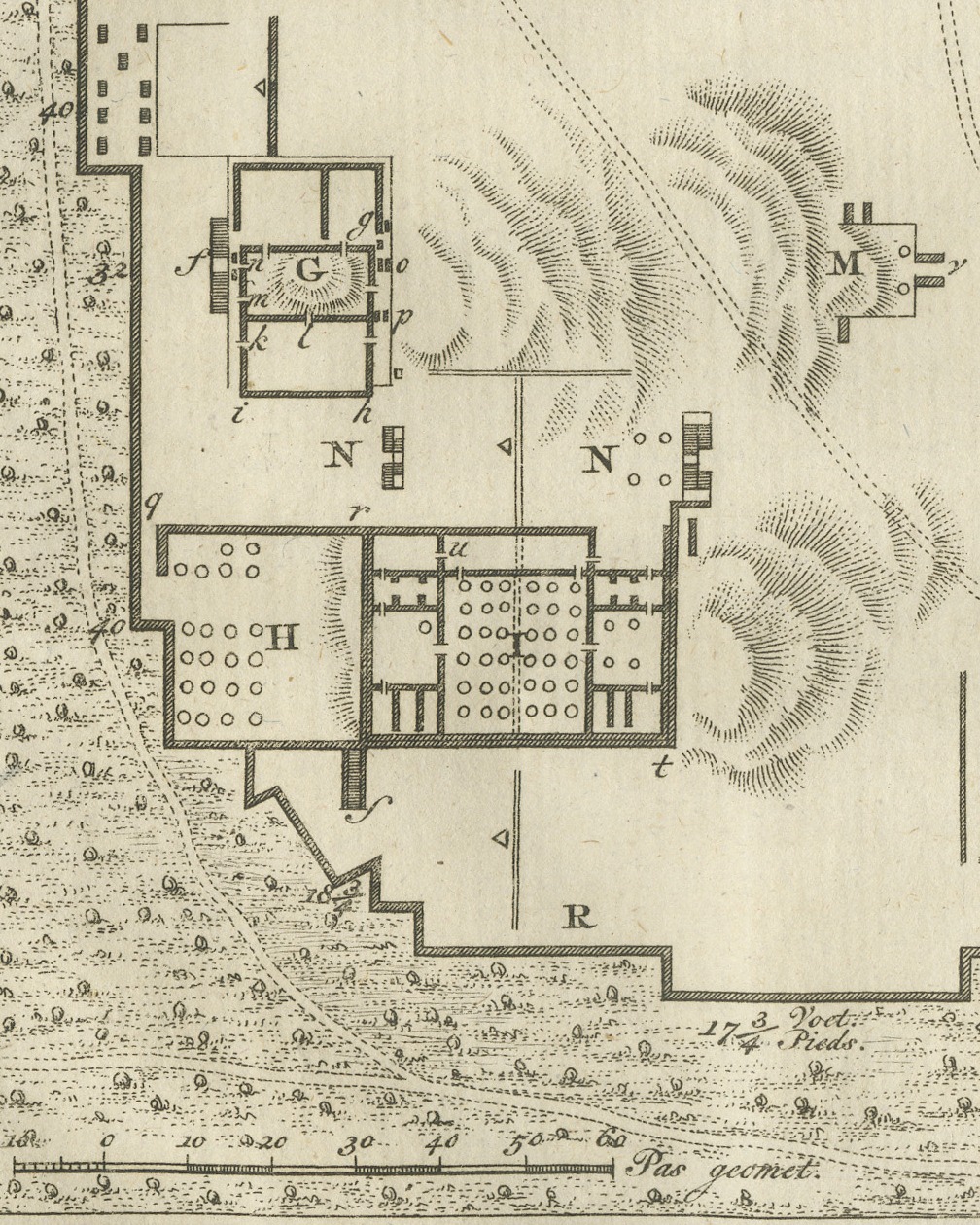
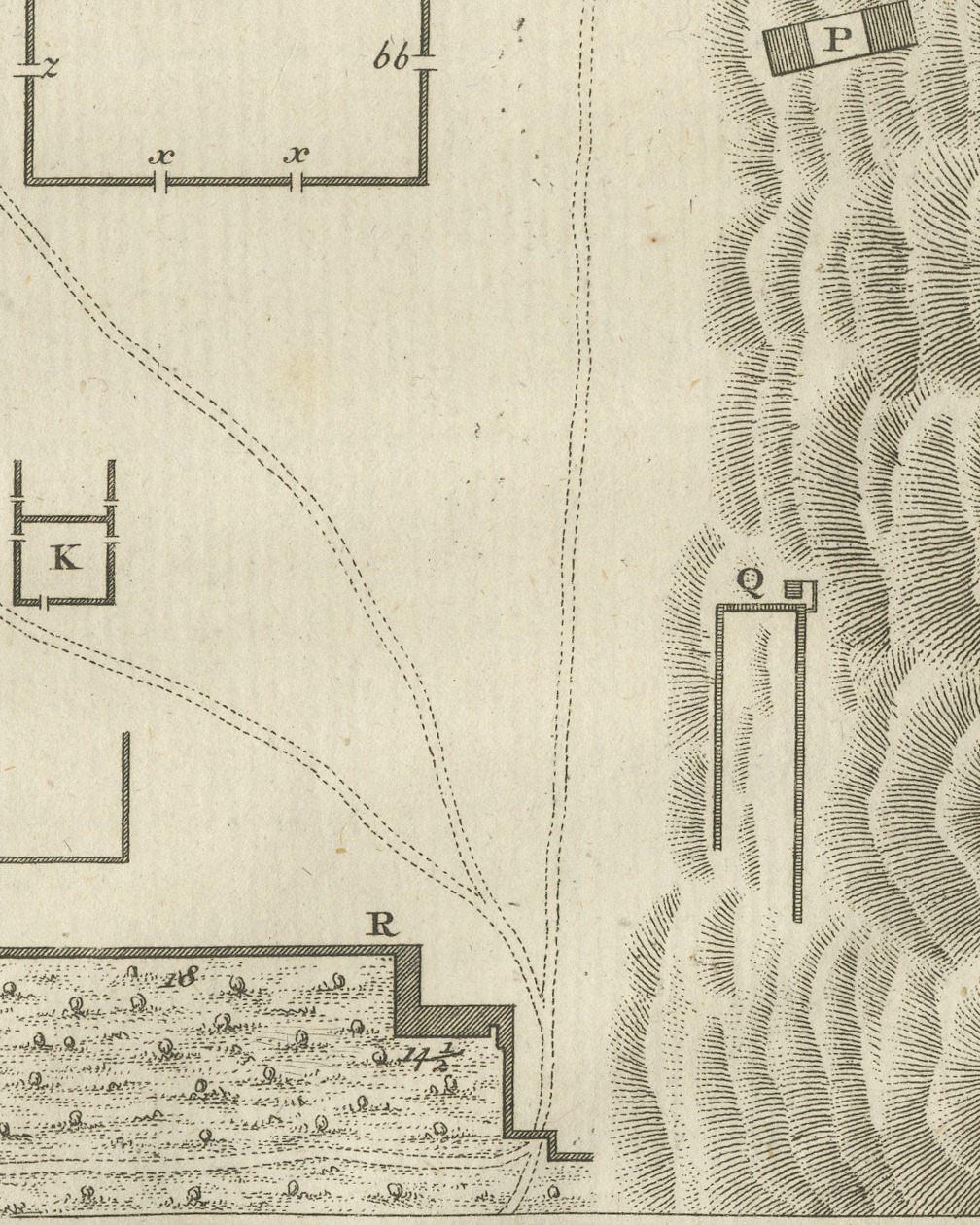
The plan shows the ruins on their walled terrace, the outer wall drawn as a heavy stepped line with its projecting corners. A broad stairway is drawn at the upper left of the platform, and the column bases of the halls are marked as rows of small circles in the left half of the plan. Buildings, doorways and walls are keyed with capital letters, among them A, Æ, B, C, D, E, F, G, H, K, L, M, N, O, P, Q and R, and with small letters along individual walls. A compass circle with a fleur de lis pointer sits near the top, and a large square enclosure lettered L stands open in the right center.
The rising ground along the right side is drawn in hatching and lettered Rachmed M., and the land outside the terrace wall is filled with small shrubs. Numbers are written against the outer wall, a note of Voet and Pieds is engraved near the lower edge of the terrace, and a scale lettered Pas geomet. runs along the bottom. The captions of the plates that follow in the volume refer back to this plate, Pl. XVIII, by these same letters. The lower left margin is signed T.K.f., and the plate number Tab. XVIII. is engraved at the upper right.
The plate comes from the second volume, Tome Second, of Carsten Niebuhr's Voyage en Arabie & en d'autres Pays circonvoisins, Traduit de l'Allemand, published by S. J. Baalde at Amsterdam and Barthelemy Wild at Utrecht, with the date MDCCLXXX, 1780, on its title page. Carsten Niebuhr (1733 to 1815) was a German born surveyor in Danish service and the only member of the Danish expedition to Arabia (1761 to 1767), sent by King Frederick V of Denmark, to return alive. The account was first published in German at Copenhagen; this is the French translation printed in Amsterdam and Utrecht.
Light uneven toning, browner toward the edges. Marked handling soiling along the right edge. Foxing over much of the margin. Several larger brown marks. All four corners are present.
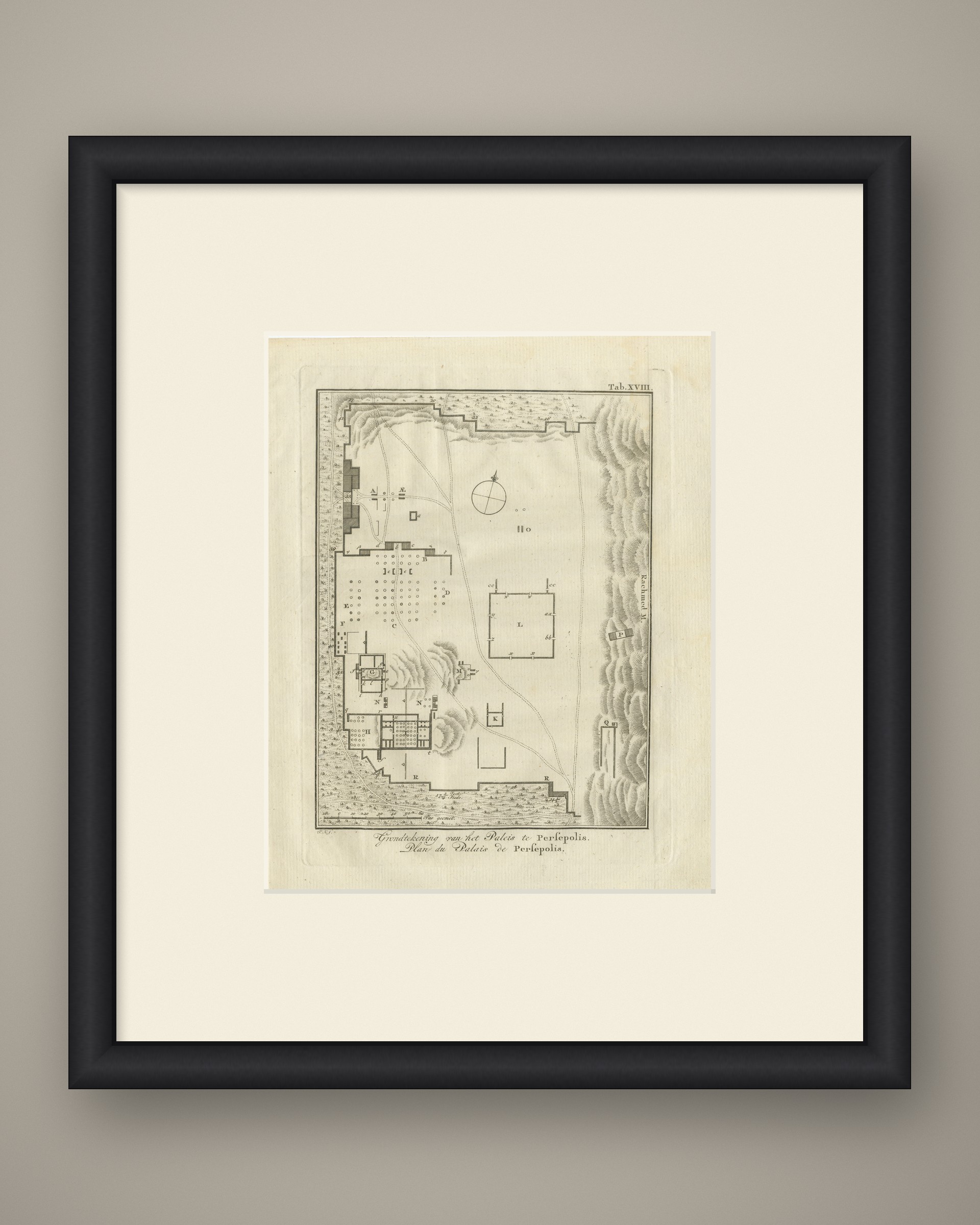
This is an original antique print, not a modern reproduction. This item is sold unframed. Any framed or interior images are shown for presentation and inspiration only, unless the listing explicitly states that the item is sold framed.