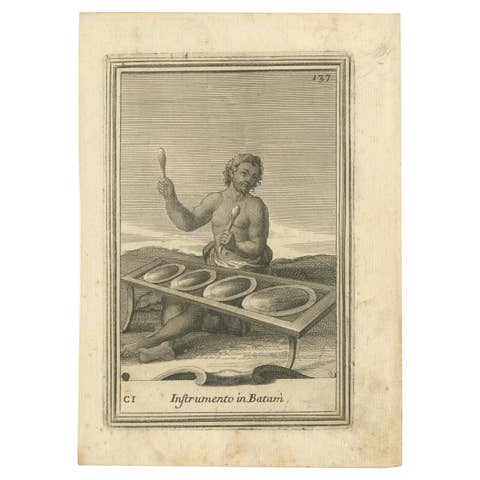
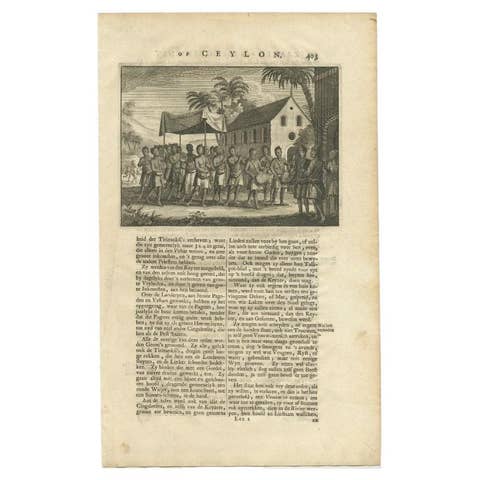
Earliest Depiction of Balinese Festival and Gamelan, Dutch Engraving c.1601
€ 330
Original antique · The actual sheet photographed · Certificate of authenticity on request · Sold unframed · Worldwide shipping from € 15 (rates)
Date
1601
Mapmaker / artist
After Jan Huygen van Linschoten, Amsterdam, c.1601
Technique
Copperplate engraving with letterpress text on laid paper
Sheet size
24 × 18.2 cm (9.4 × 7.2 in)
Condition
Fair
Reference
BG-13098-8
What the condition grades mean
Excellent
Bright and clean, with no faults worth mentioning.
Very good
Only light signs of age, such as faint toning.
Good
Normal signs of age for a sheet of this period: toning, some foxing, small marks or neat old repairs.
Fair
Clear faults such as staining, tears or repairs, priced to match.
Every fault we see is written in the condition note, and the whole sheet is shown uncropped in the photos.
Condition
Laid paper with typical age toning, light marginal wear, and some edge repairs; fine early impression with visible plate mark. The paper fair, but the Image itself very good and ready for framing.
About this sheet
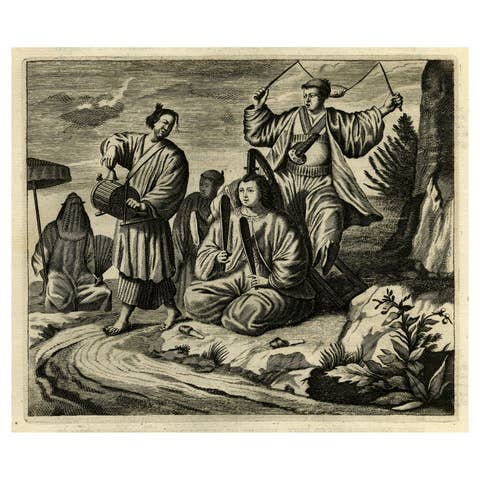
Rare early 17th-century Dutch engraving showing a royal festival and equestrian tournament on the island of Bali – one of the earliest European images of Balinese culture ever printed. The scene depicts mounted horsemen performing mock battles before a royal audience, with musicians playing gongs and drums in the background. Seated spectators line the walled arena, while European figures watch from the right, recording the spectacle.
This engraving was published in the Dutch edition of Jan Huygen van Linschoten’s Itinerario, voyage ofte schipvaert naer Oost- ofte Portugaels Indien, printed in Amsterdam by Cornelis Claesz around 1598–1601. Linschoten’s detailed account of his travels in the East Indies introduced Europe to the customs, ceremonies, and landscapes of Asia, directly inspiring the founding of the Dutch East India Company (VOC).
This engraving, together with the image of the King of Bali, represents the first European depiction of Bali and its people. The musicians with their hanging gongs are the earliest known European representation of a Balinese gamelan ensemble, making this a cornerstone image in the history of ethnographic illustration.
Laid paper with typical age toning, light marginal wear, and some edge repairs; fine early impression with visible plate mark.
Framing tips: Float-mounted in an ebony or dark teak frame with a light mat to echo the tropical subject. Ideal for pairing with the companion leaf showing the King of Bali.