About this sheet
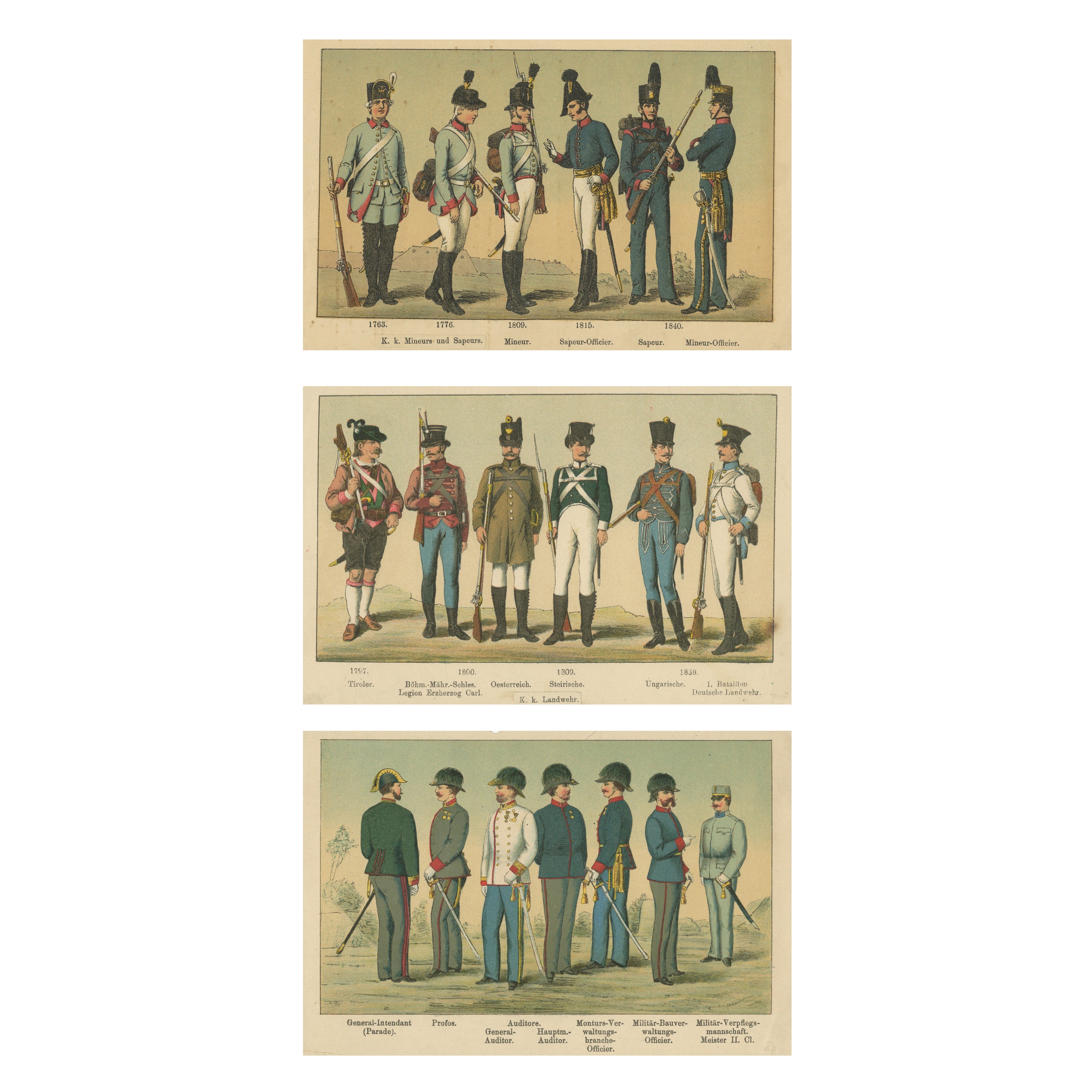
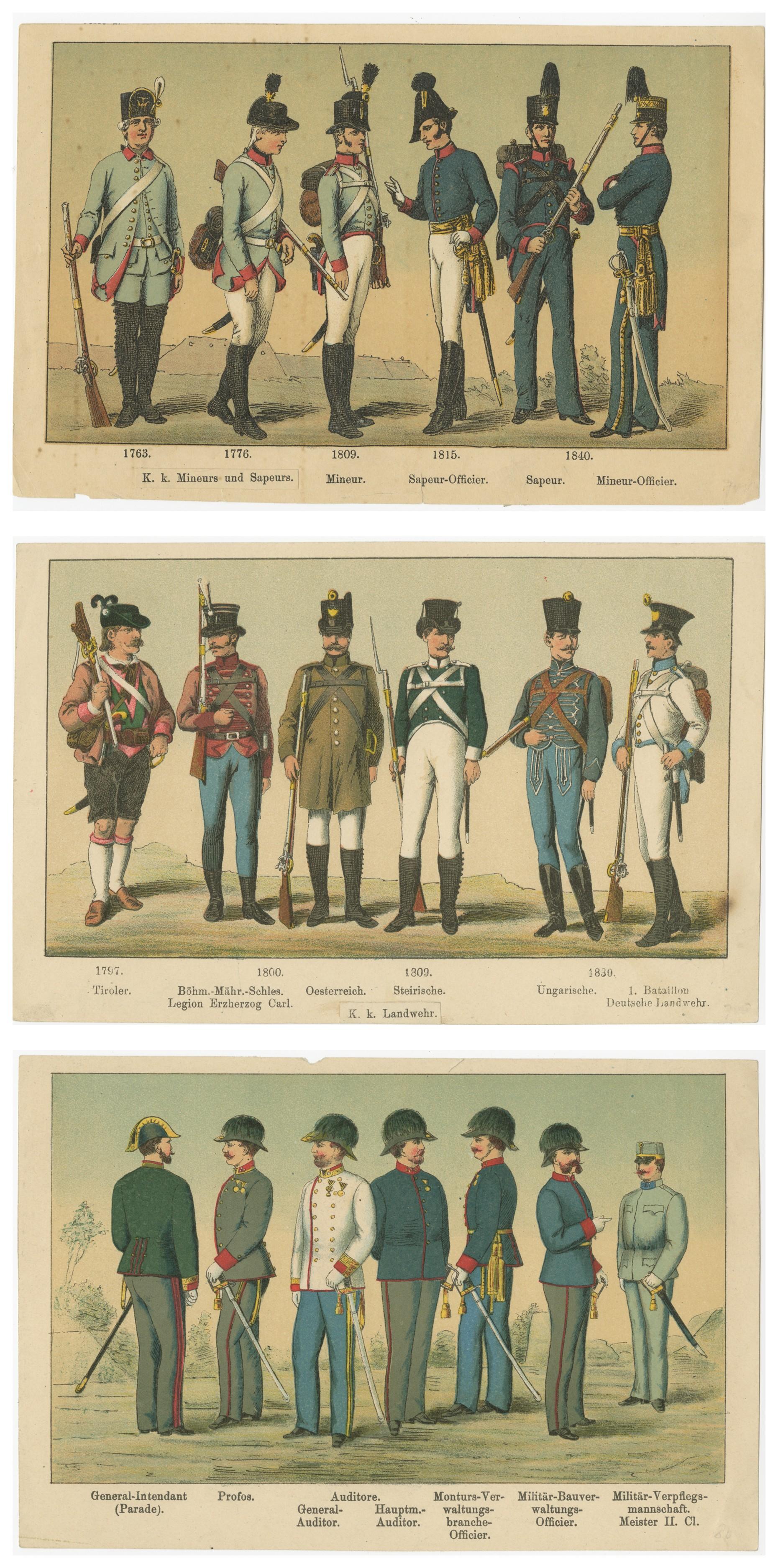
Set of three antique lithographs depicting a rich selection of Austrian military uniforms from the 18th and 19th centuries, presented in three detailed panels.
Each figure is carefully rendered with accurate period colors, showcasing the evolution of uniforms across specialized units, regional forces, and administrative branches of the Kaiserlich-königliche (K.k.) Austrian Army. This print provides an invaluable visual record for military historians, collectors of uniformology, and enthusiasts of 19th-century European military art.
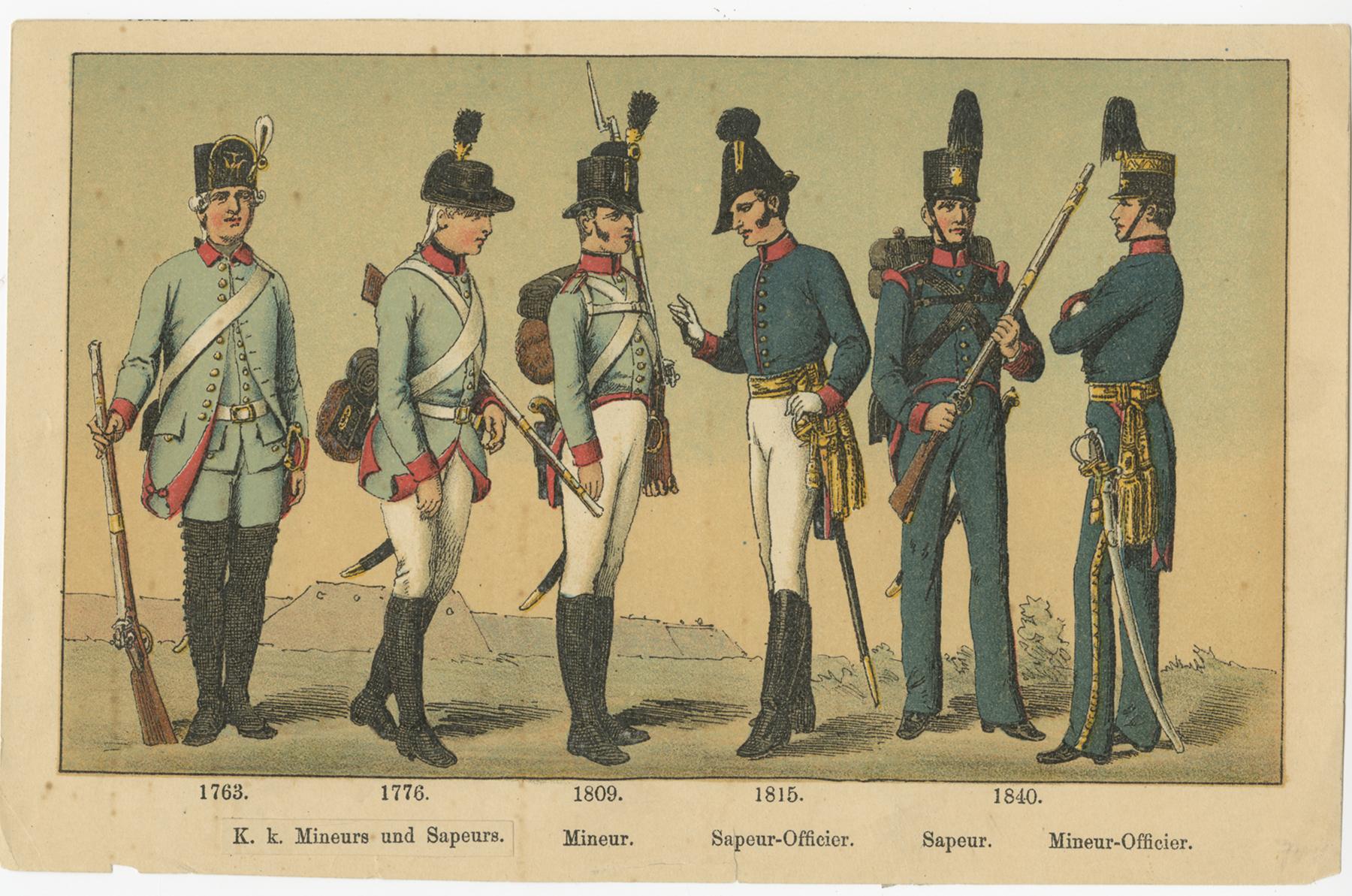
The upper panel portrays the K.k. Miners and Sappers, essential engineering troops of the Austrian military, from 1763 to 1840. Figures include: 1763 K.k. Mineurs und Sapeurs, 1776 Mineur, 1809 Mineur, 1815 Sapeur-Officier, and 1840 Sapeur and Mineur-Officier. Each uniform reflects the evolving styles, weaponry, and headgear of the Austrian engineering corps during a period of significant military reform and technological change.
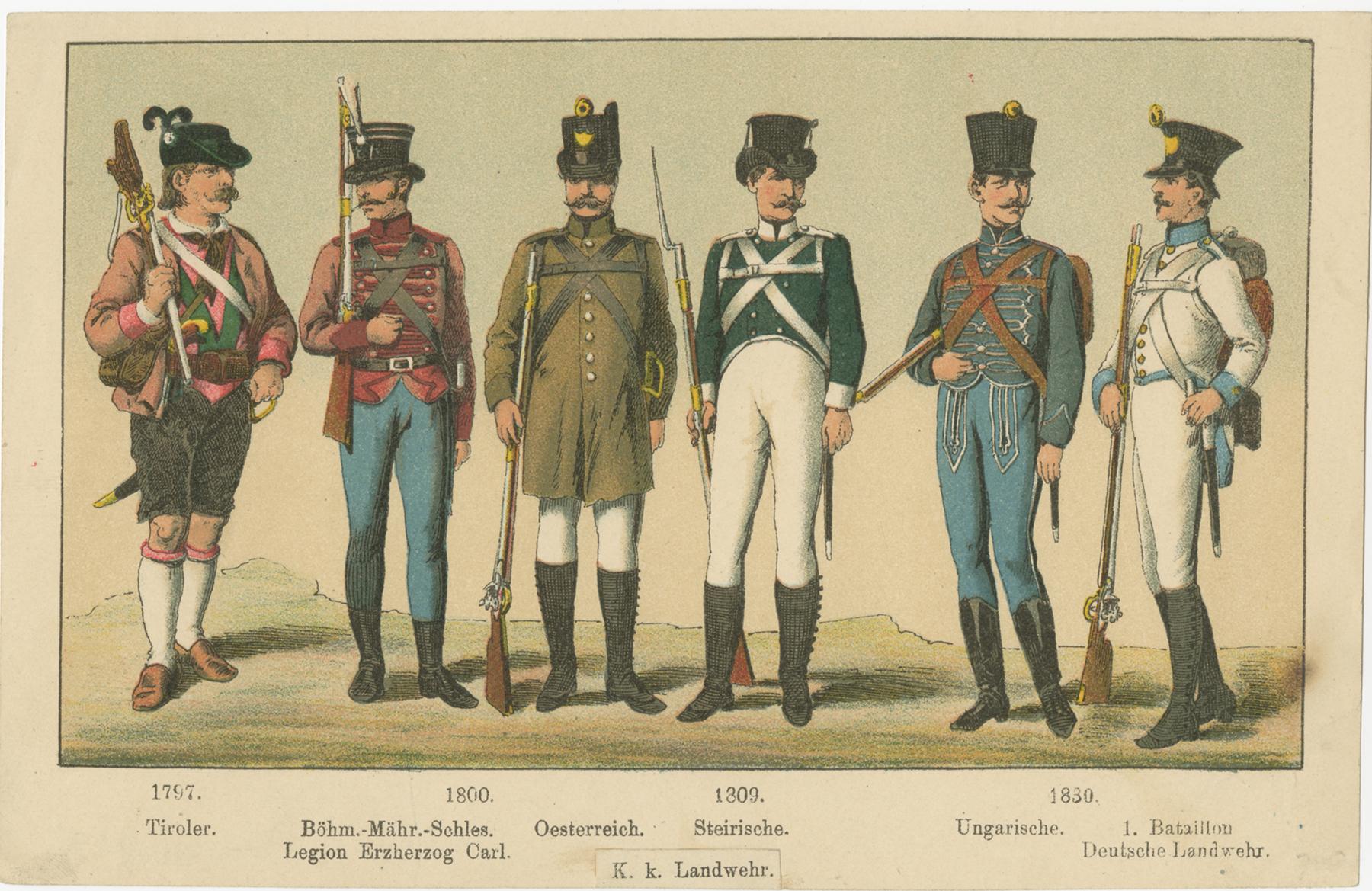
The middle panel focuses on regional and auxiliary units between 1797 and 1830. Depicted are a 1797 Tiroler in distinctive Alpine dress, an 1800 member of the Böhmisch-Mährisch-Schlesische Legion Erzherzog Carl, a 1809 Austrian Steirische Landwehr soldier, an 1830 Hungarian infantryman, and a 1st Battalion Deutsche Landwehr soldier. These uniforms reflect the diversity of the Habsburg Empire’s multi-ethnic military forces, highlighting differences in cut, color, and equipment between regions.
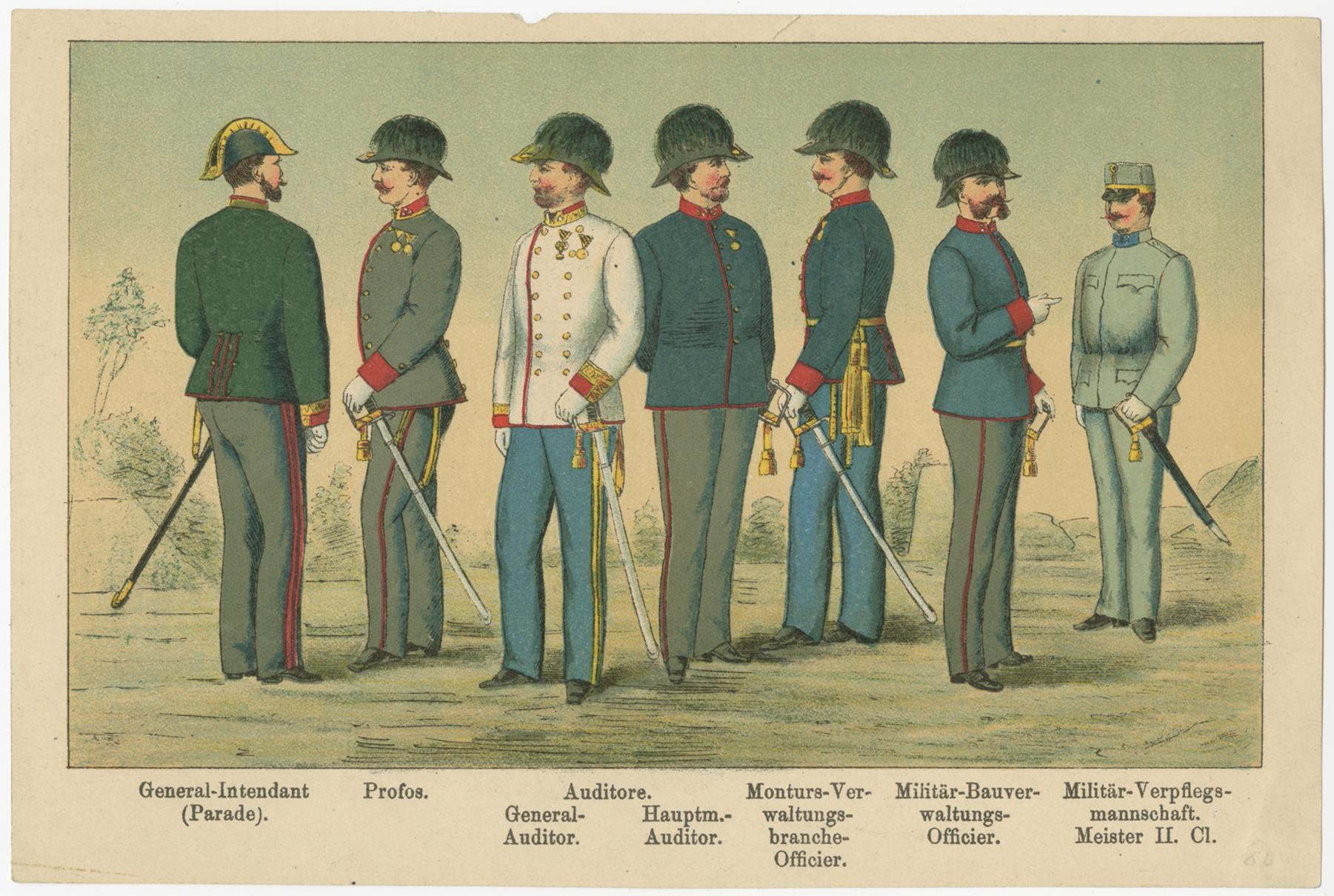
The lower panel presents high-ranking administrative officers and support staff, likely from the late 19th century, including: General-Intendant (Parade), Profos, Auditore General-Auditor, Hauptmann-Auditor, Monturs-Verwaltungsbranche-Officier, Militär-Bauverwaltungs-Officier, and Militär-Verpflegsmannschaft Meister II. Klasse. These uniforms demonstrate the ceremonial and practical dress of the army’s logistical and judicial branches, emphasizing the Austrian military’s detailed hierarchy and specialization.
This print is an excellent reference for scholars, museums, and collectors, providing clear, colorful depictions of historically significant uniforms. Its precise labeling and chronological arrangement make it both a decorative and educational piece, suitable for framing or archival display.
Condition: Good, with light toning and minor handling marks consistent with age. Colors remain strong and vibrant.
Framing tips: A dark wood or mahogany frame with a cream or pale ivory mat will complement the historic colors and enhance the period feel. For a more formal presentation, consider a gold-leaf frame with a double mat in cream and deep green to echo the uniform tones.
Technique: Lithograph, hand-colored
Maker: Unknown, Austrian, late 19th century