About this sheet
Antique Egyptian Cavalry Battle Scene from Maximilian in Bavaria, 1846
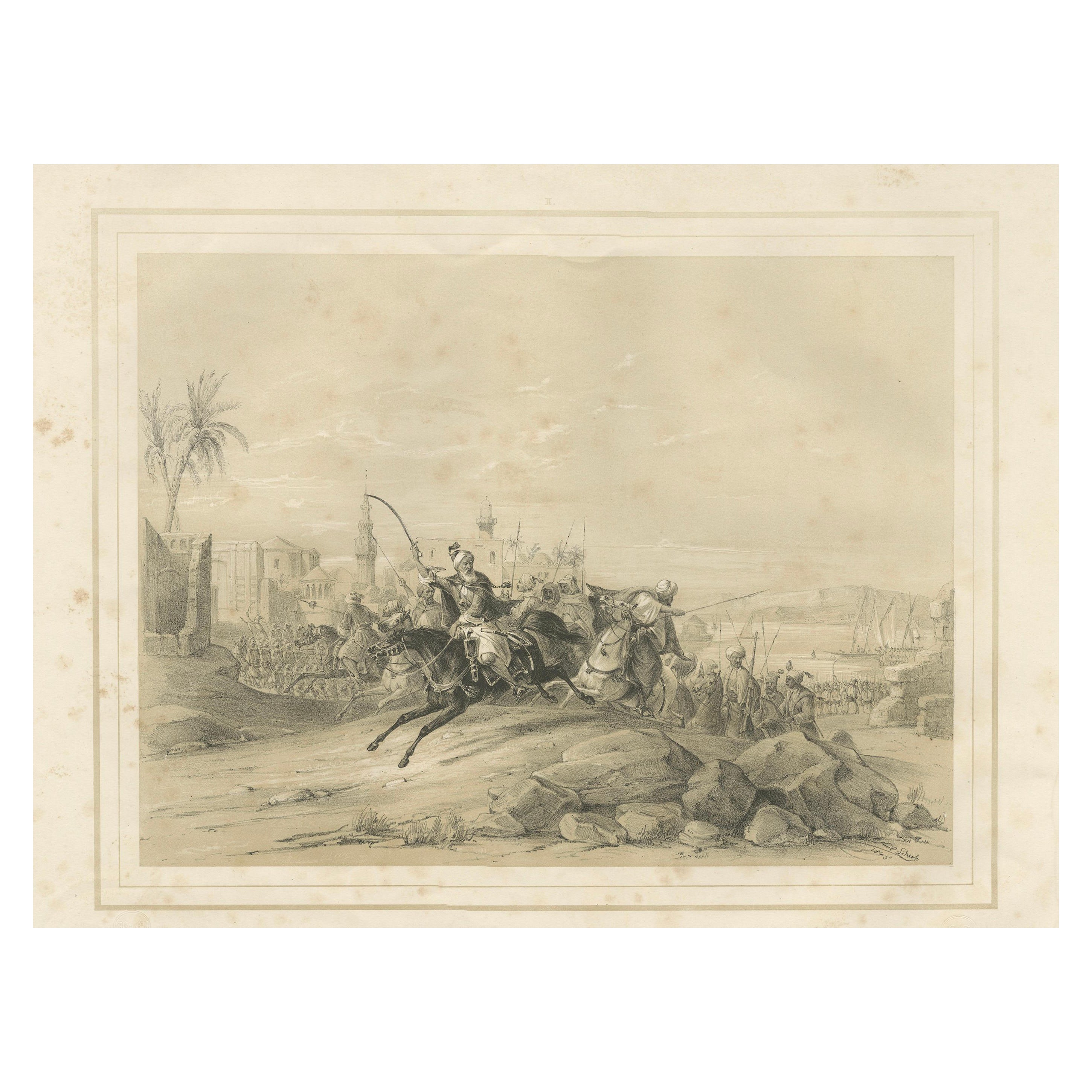
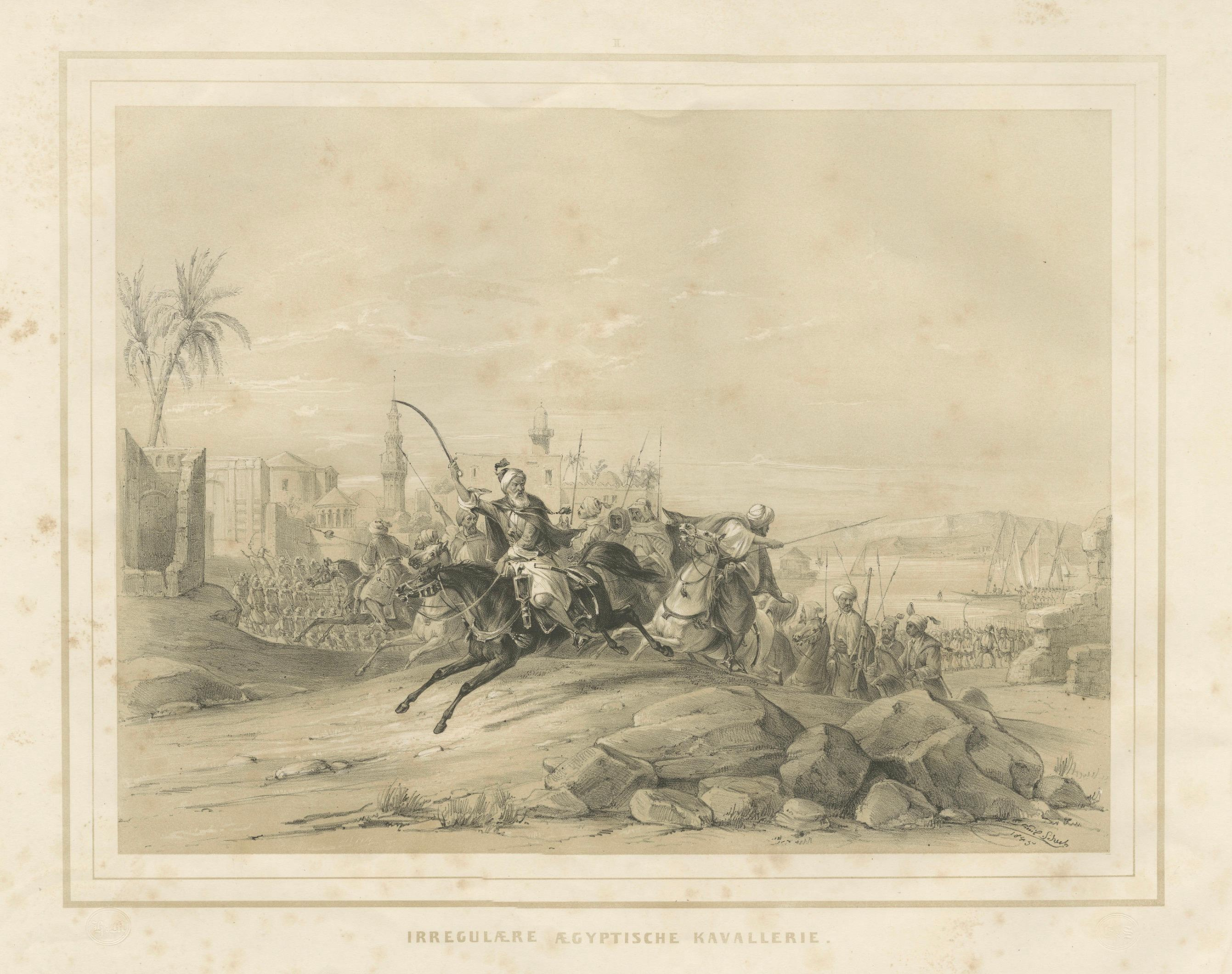
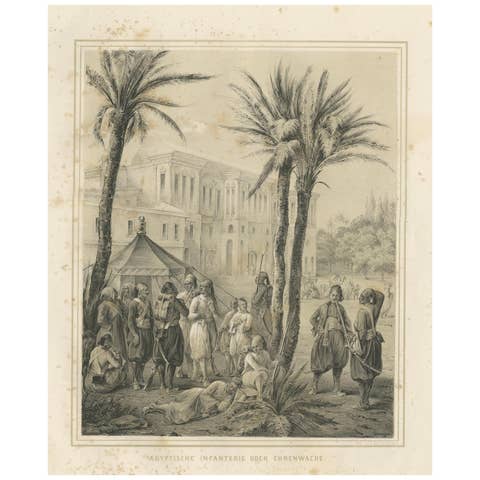
This dynamic and finely detailed 19th-century Orientalist engraving depicts a charge of irregular Egyptian cavalry in full motion, captured during the period of military modernization under Mehmed Ali Pasha. The composition is filled with movement and tension: mounted horsemen sweep across the rugged foreground, sabres raised, while infantry formations, palm trees, and domed city architecture recede into the background along the Nile landscape.
The scene forms part of the celebrated travel publication documenting the oriental journey of Duke Maximilian of Bavaria, with drawings by Heinrich von Mayr and explanatory text by Dr. Sebastian Fischer. Von Mayr’s ability to combine ethnographic observation with dramatic narrative is fully evident here. The horses surge forward in a powerful diagonal rhythm, their riders rendered with crisp precision in both costume and posture. Dust, broken stone, and uneven terrain heighten the sense of speed and disorder that defines irregular cavalry warfare.
Historically, this image reflects the transformation of Egypt’s military forces during the first half of the 19th century. Mehmed Ali Pasha reshaped Egyptian armies along European lines while still relying on traditional irregular horse units for reconnaissance, shock attacks, and desert warfare. European viewers were deeply fascinated by these hybrid forces, seeing them as both exotic and strategically formidable. This print captures that dual impression with remarkable clarity.
Artistically, the engraving stands out for its cinematic composition. The charging riders break strongly from left to right across the sheet, balanced by the disciplined ranks of infantry and the architectural skyline beyond. The interplay between controlled formations and chaotic forward momentum gives the print great visual depth and narrative force. It is a quintessential example of European Orientalist military imagery at its most energetic and collectible.
Today, this work holds strong appeal for collectors of Middle Eastern history, Ottoman-era military subjects, and 19th-century European travel illustration. At the same time, its dramatic composition makes it highly desirable as an interior statement piece in libraries, studies, offices, or gallery walls devoted to exploration, history, or classic warfare imagery.
Condition report:
Good antique condition. Light overall age-related toning and scattered foxing, primarily in the margins and outer areas. Minor handling marks at sheet edges. Image remains clear, sharp, and well-defined. Faint plate impression visible.
Framing tips:
A wide ivory or light stone-colored mat will enhance contrast and emphasize the action. A black, dark walnut, or lightly antiqued gilt frame will give the piece a strong museum presence. UV-protective glass is strongly recommended.
Technique: Steel engraving
Maker: Heinrich von Mayr, Germany, 1846