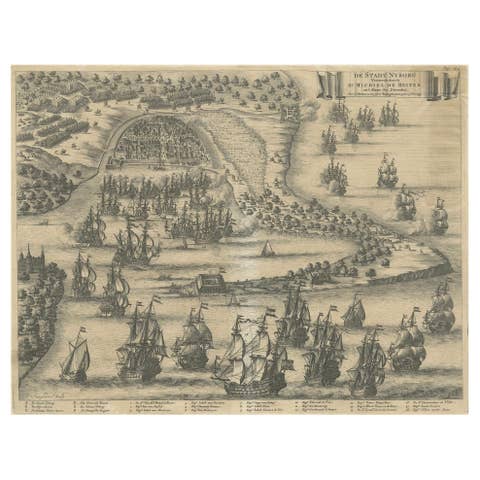
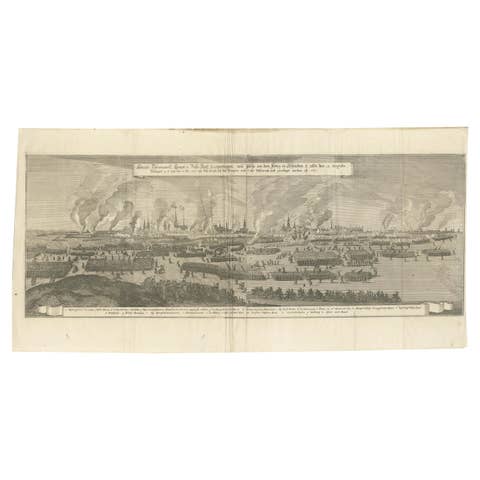
Antique Battle Scene of the Attack on Split on the Adriatic Coast, ca.1660
€ 640
Original antique · The actual sheet photographed · Certificate of authenticity on request · Sold unframed · Worldwide shipping from € 15 (rates)
Date
1660
Sheet size
29.2 × 31.1 cm (11.5 × 12.2 in)
Condition
Fair
Reference
BG-13380
What the condition grades mean
Excellent
Bright and clean, with no faults worth mentioning.
Very good
Only light signs of age, such as faint toning.
Good
Normal signs of age for a sheet of this period: toning, some foxing, small marks or neat old repairs.
Fair
Clear faults such as staining, tears or repairs, priced to match.
Every fault we see is written in the condition note, and the whole sheet is shown uncropped in the photos.
Condition
Strong toning, original folding line. Shows overall wear/creasing and soiling, blank verso. Please review the images for further condition details.
About this sheet
Antique print titled 'Abbildung der Statt und Vestung Sovazchi, so von den Venetianern, durch den H. G. Lazaro Mocenigo, erobert und Demolirt worden den 18. May 1657'. Great battle scene of the attack on Split on the Adriatic coast, on May 18, 1657. The bay is filled with ships shrouded in clouds of smoke and armies are shown throughout the countryside. German text explanation in banner at bottom. Published circa 1660 by M. Merian.
Mathaus Merian (1593-1650) was the father of engraver Matthäus the Younger, and of the painter, engraver, and naturalist Maria Sibylla Merian. He was born in Basel, Switzerland and trained in engraving in Zurich. After a time in Nancy, Paris and Strasbourg, he settled in Frankfurt. While there, he worked for Johann Theodor de Bry, the publisher and son of the travel writer. In 1617, he married Maria Magdalena de Bry, Johann Theodor’s daughter. In 1623, Merian took over the de Bry publishing house upon the death of his father-in-law. Merian’s best known works are detailed town views which, due to their accuracy and artistry, form a valuable record of European urban life in the first half of the sixteenth century.