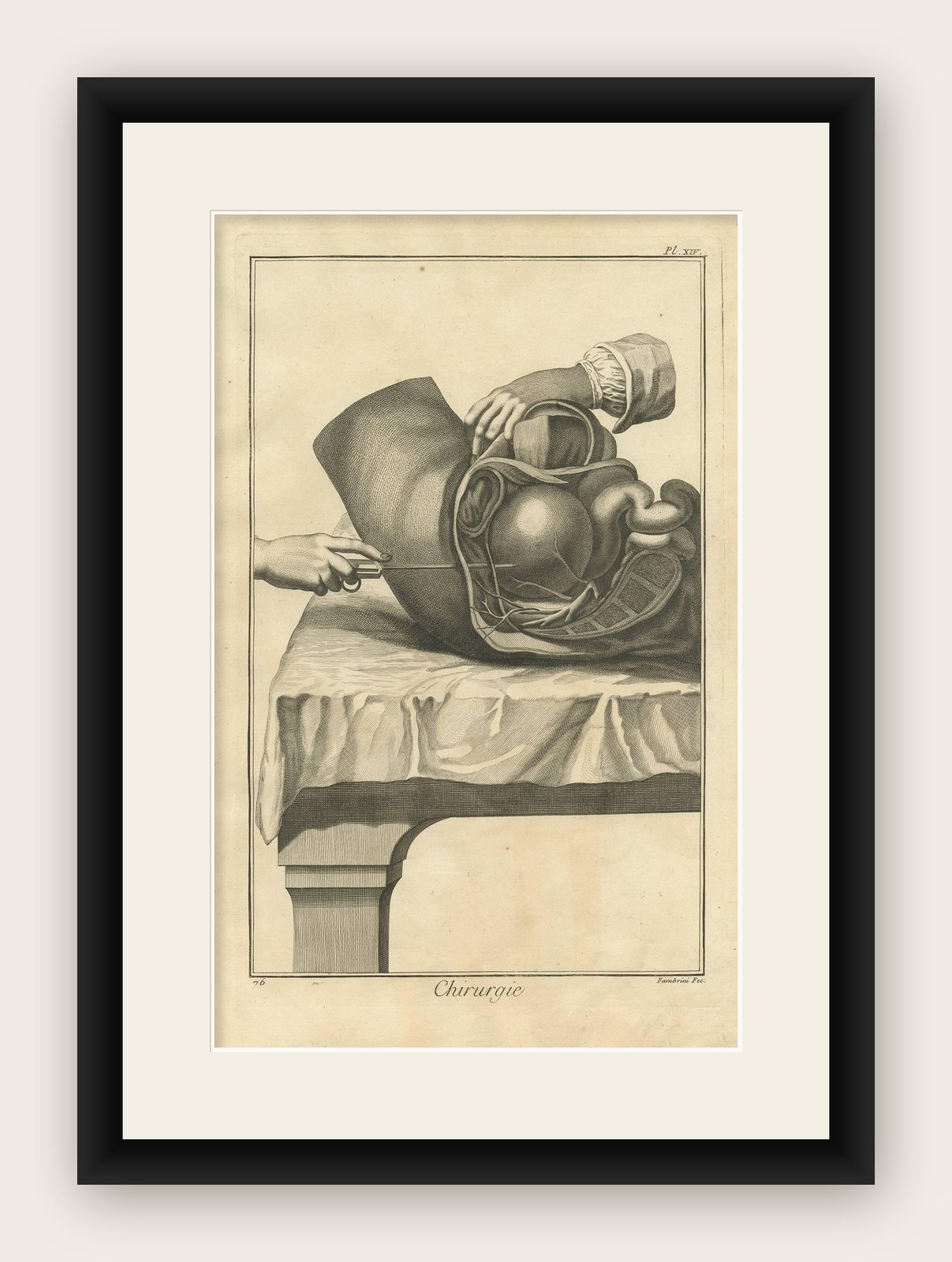
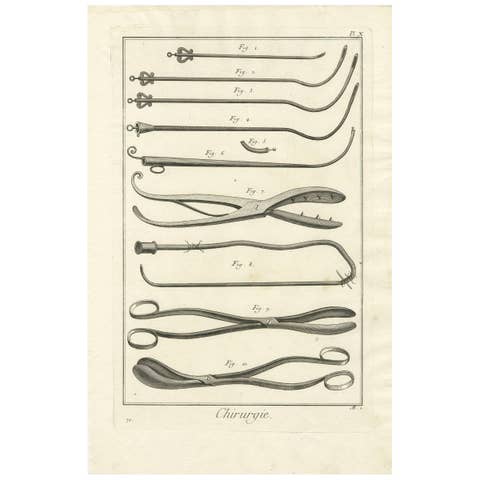
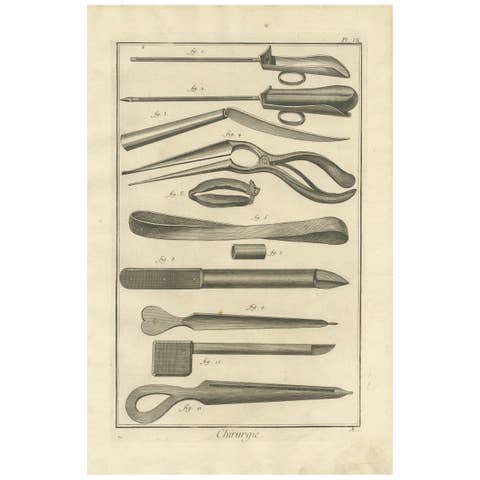
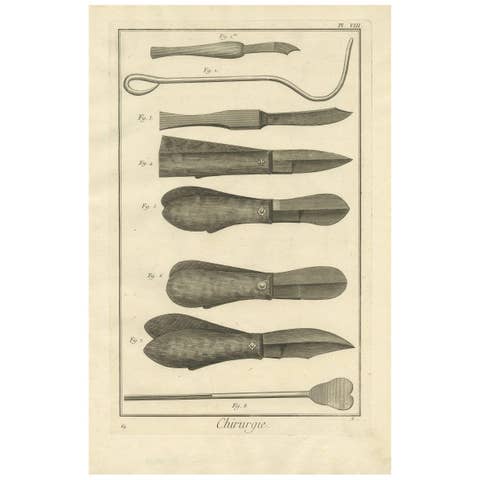
Antique Medical Print of a Lateral Section of the Hypogastrium, Abdomen, ca.1760
€ 295
Original antique · The actual sheet photographed · Certificate of authenticity on request · Sold unframed · Worldwide shipping from € 15 (rates)
Date
1760
Sheet size
41 × 27 cm (16.1 × 10.6 in)
Condition
Good
Reference
BG-10672
What the condition grades mean
Excellent
Bright and clean, with no faults worth mentioning.
Very good
Only light signs of age, such as faint toning.
Good
Normal signs of age for a sheet of this period: toning, some foxing, small marks or neat old repairs.
Fair
Clear faults such as staining, tears or repairs, priced to match.
Every fault we see is written in the condition note, and the whole sheet is shown uncropped in the photos.
Condition
Good. Please review the images for further condition details.
About this sheet
This engraving, designated as Plate XIV and titled 'Chirurgie' (Surgery), presents a detailed lateral cross-section of the hypogastrium, the lower region of the abdomen. This intricate illustration is sourced from the 'Encyclopédie' by Denis Diderot, an ambitious and comprehensive work that aimed to encapsulate and share the span of human knowledge during the Age of Enlightenment. Published around the year 1760, the 'Encyclopédie' is renowned for its contributions to the spread of enlightenment ideas.
The image itself serves an educational purpose, meticulously depicting the anatomical structures within the hypogastric region, which may include parts of the intestines, bladder, and reproductive organs. The illustration would have been utilized as a reference for scholars, physicians, and students of medicine, providing a clear visualization to accompany textual descriptions of surgical techniques and internal anatomy.
As an artifact of medical history, the print reflects the state of surgical knowledge and anatomical study in the 18th century. It encapsulates the scientific curiosity and dedication to understanding the human body that was characteristic of the period. The precision and clarity of the illustration also underscore the importance of visual aids in the practice and teaching of medicine, a principle that remains central to the field today.