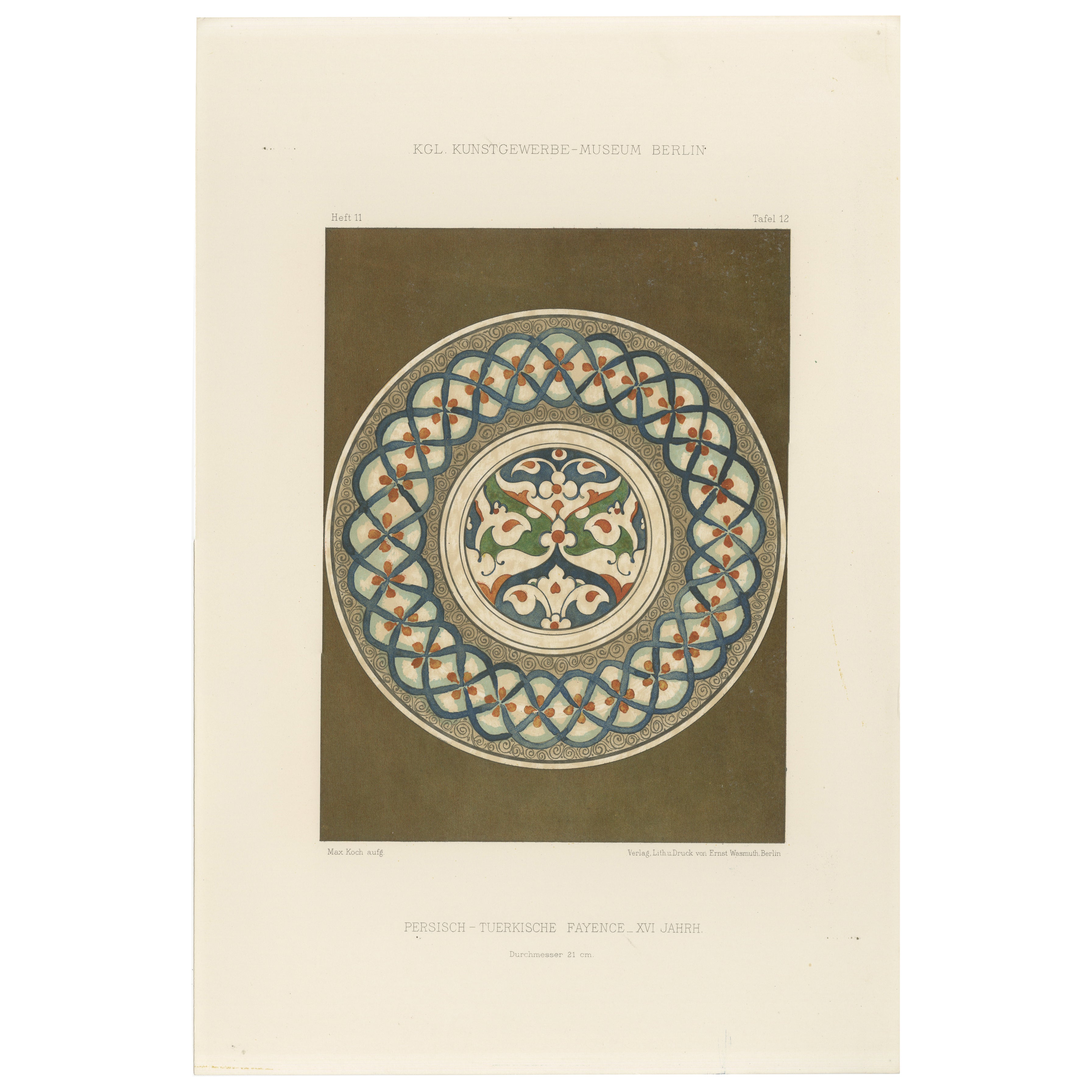
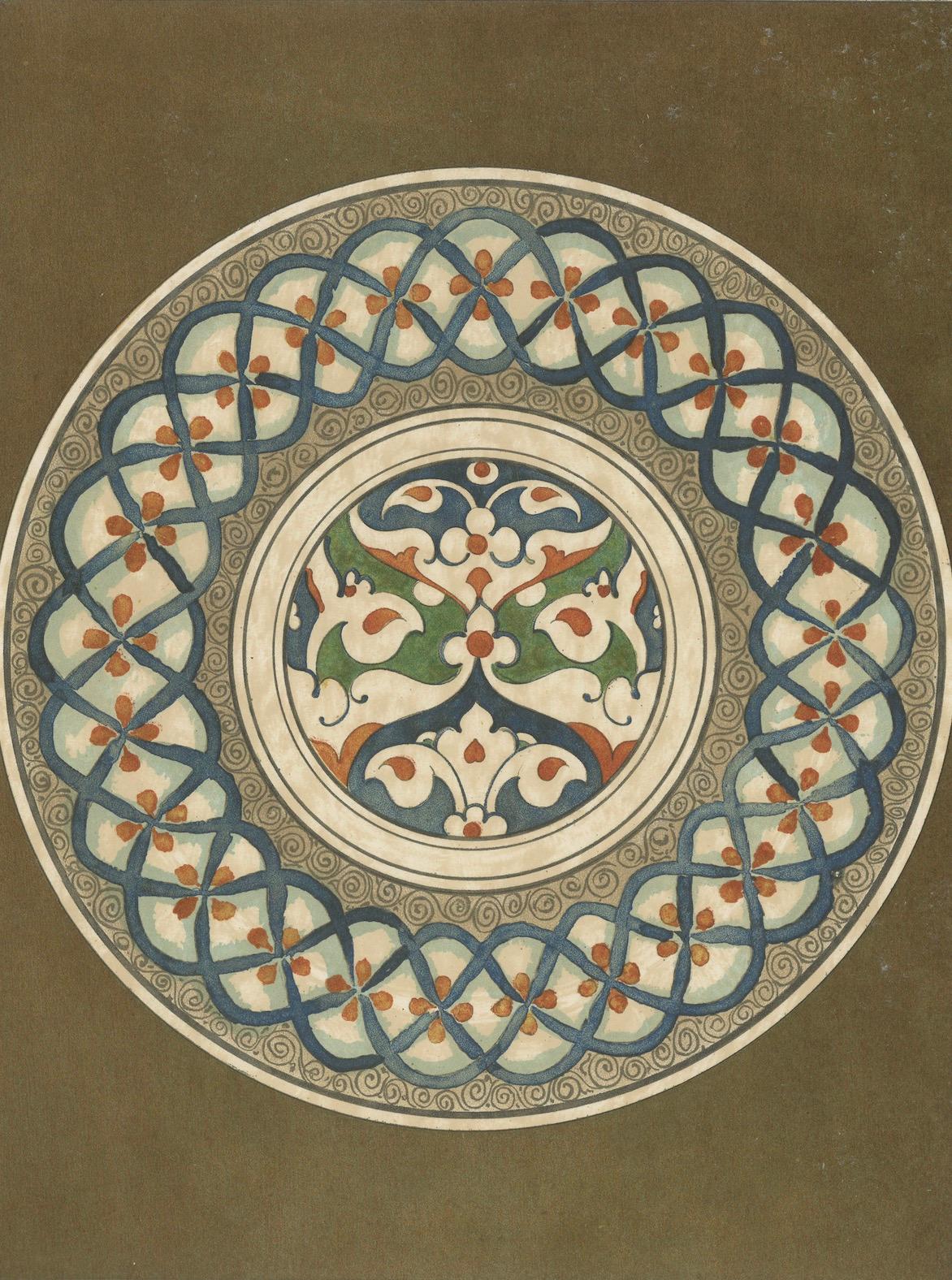
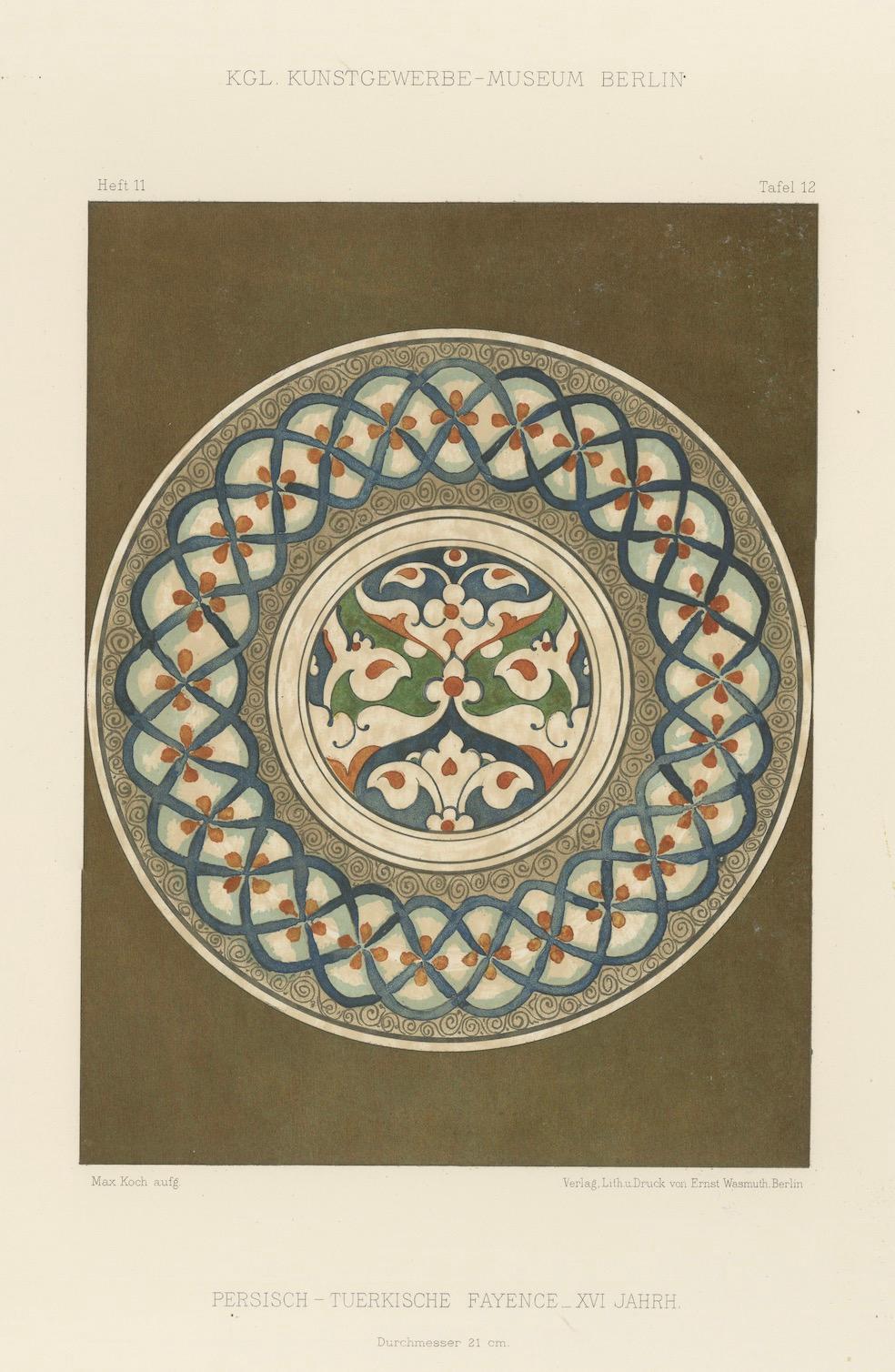
Persian-Turkish Faience Plate with Interlaced Pattern – J. Lessing, Berlin 1890
€ 340
One of a kind: this is the sheet in the photographs. Ships from Langweer, the Netherlands.
Date
1890
Sheet size
49 × 33 cm (19.3 × 13.0 in)
Condition
Good
Reference
BG-14139-12
Condition
Excellent preservation with bright, unfaded colors and crisp detail. Slight marginal toning, typical for age, but no stains or tears. Full margins intact.
About this sheet
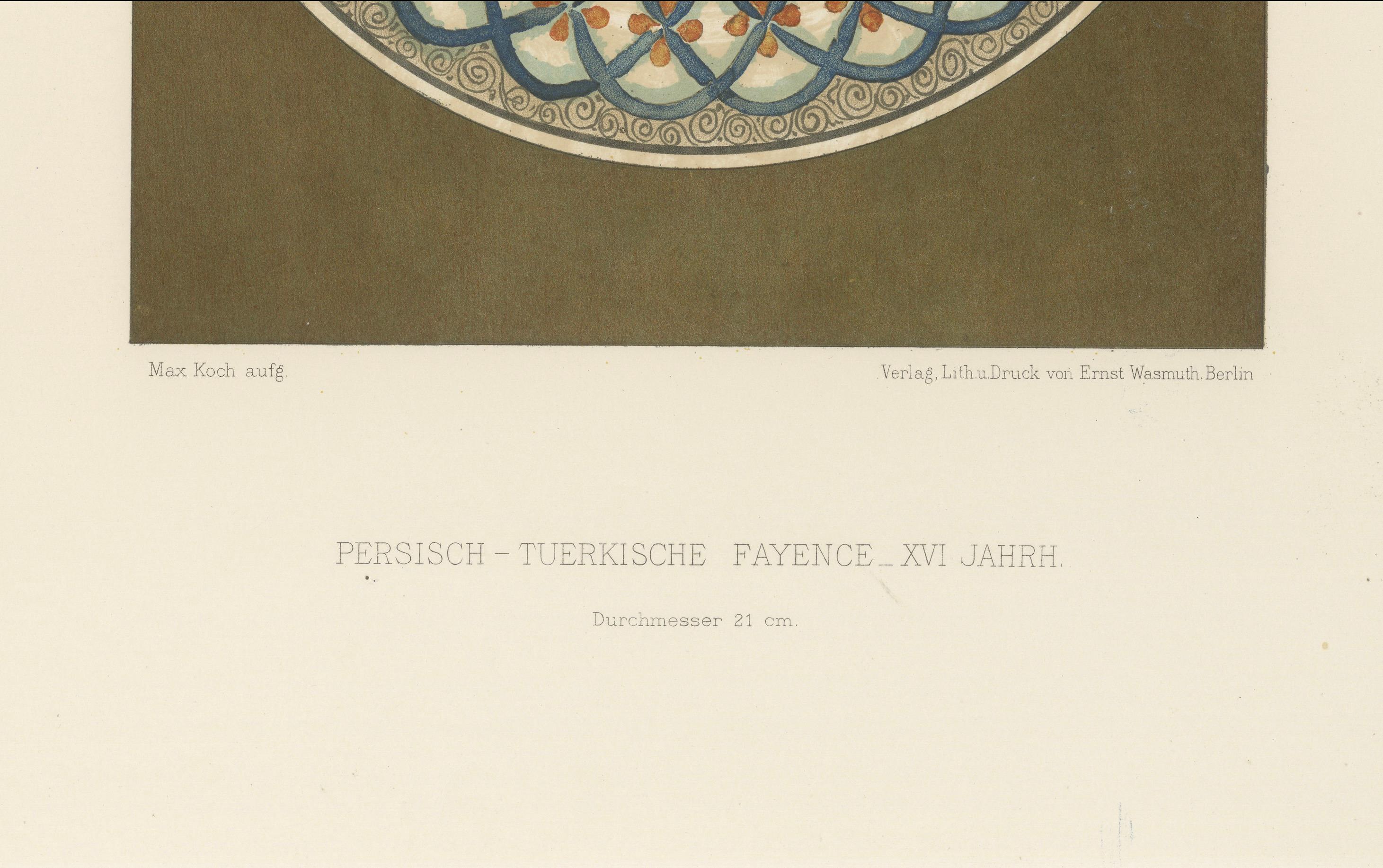
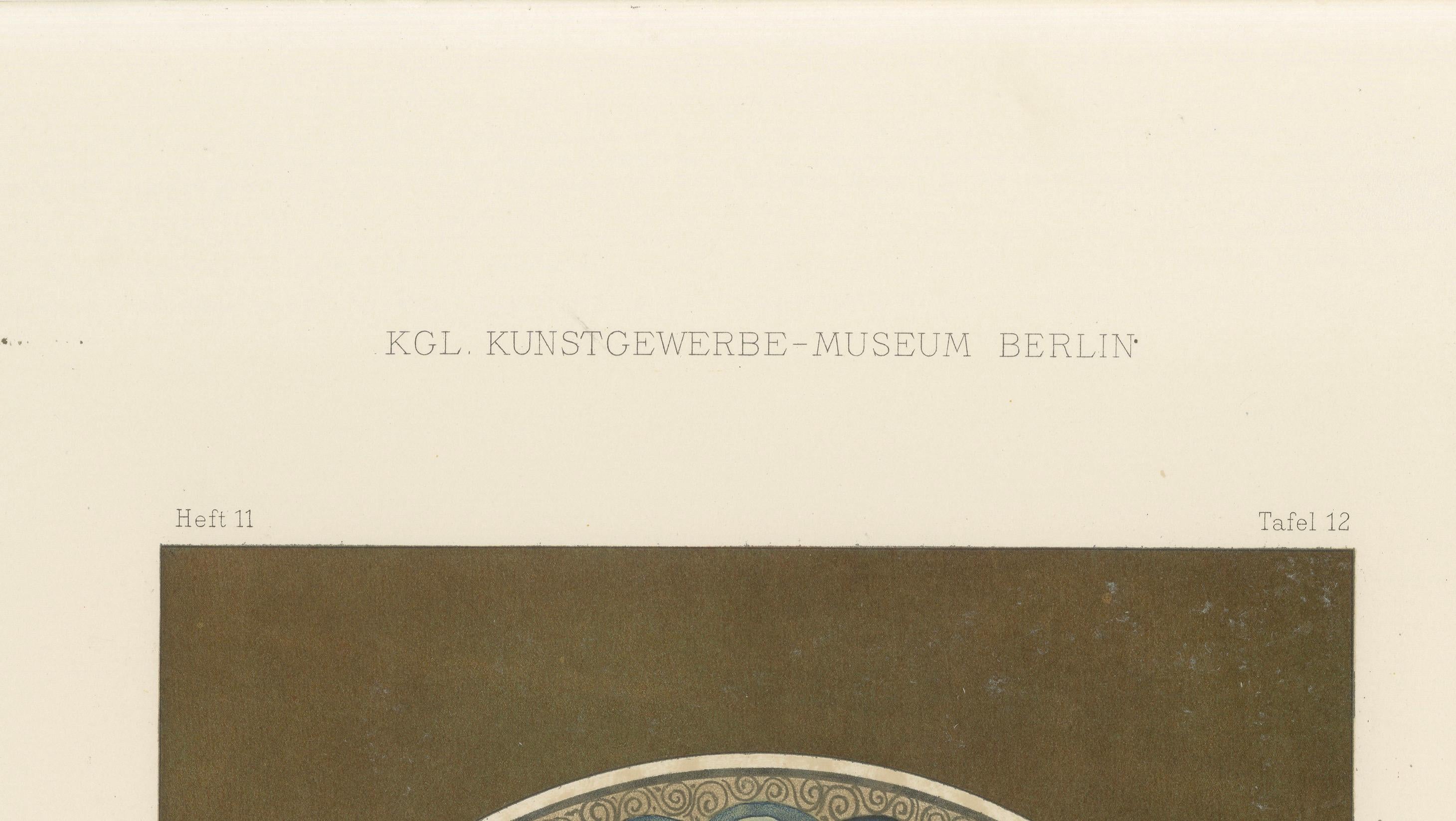
Persian-Turkish Faience Plate with Interlaced Pattern – Julius Lessing, Berlin 1890 An elegant chromolithograph from Julius Lessing’s Persisch-Türkische Fayencen (Persian-Turkish Faience), published in Berlin by Ernst Wasmuth in 1890 as part of Vorbilder-Hefte aus dem Königlichen Kunstgewerbe-Museum, Heft 11. This plate (Tafel 12) reproduces a 16th-century Persian-Turkish faience dish from the Kgl. Kunstgewerbe-Museum Berlin (Royal Museum of Decorative Arts, Berlin).
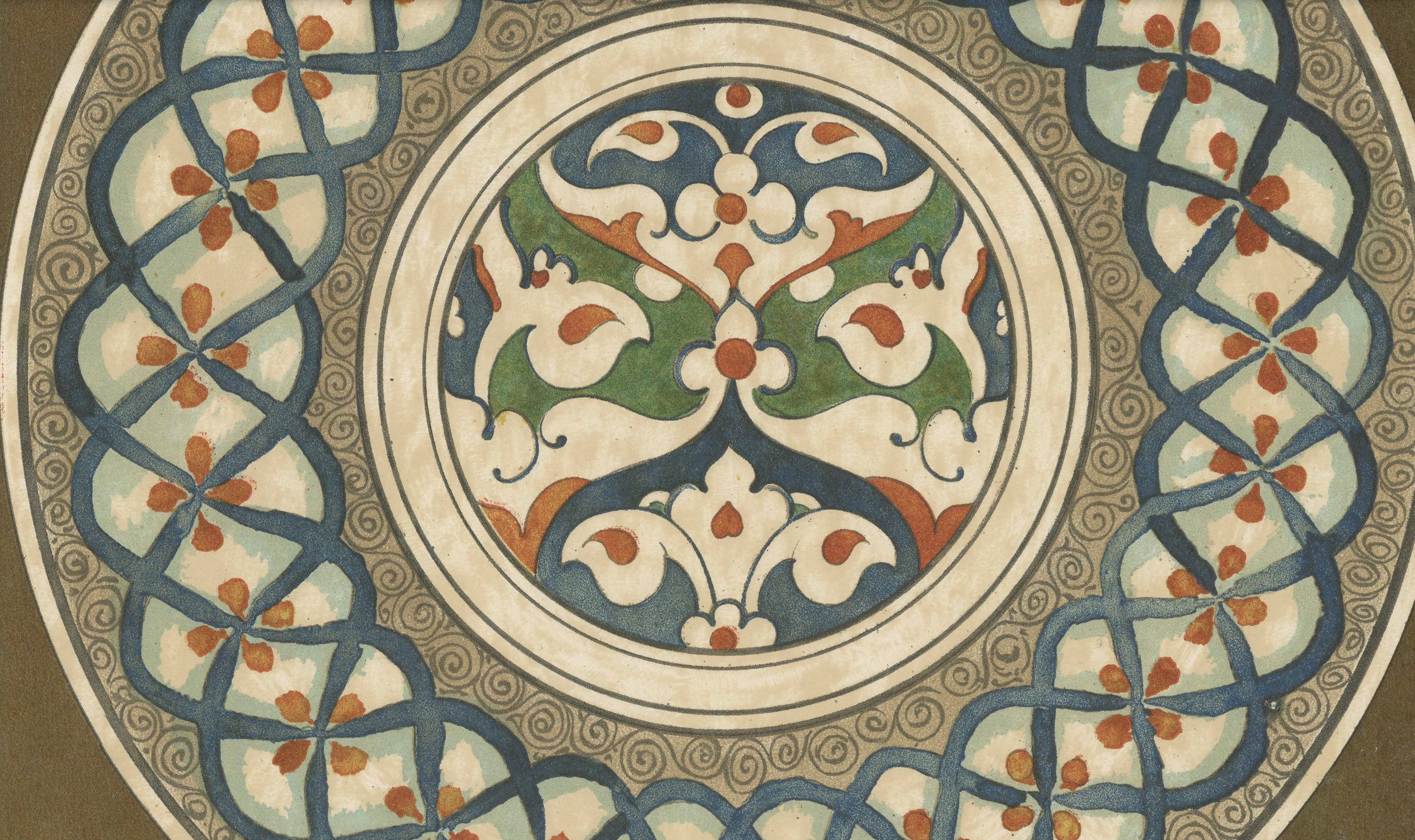
This print captures the refined geometric and floral harmony of early Ottoman ceramic design. The plate features a symmetrical interlaced border of turquoise and cobalt bands forming a rhythmic lattice of eight-pointed star shapes enclosing orange blossoms. The central medallion presents a stylized floral arabesque with red, green, and ivory tones, creating a balanced dialogue between geometry and natural ornamentation.
The design exemplifies the synthesis of Persian and Anatolian traditions in Ottoman faience production, notably from Iznik workshops around the mid-16th century. The color palette of soft turquoise, deep cobalt blue, and sienna-red—hallmarks of Iznik ceramics—reflects the influence of Islamic geometry and vegetal symbolism, representing unity and eternal life.
Drawn by Max Koch and printed by *Verlag Lith. Druck von Ernst Wasmuth, Berlin*, this lithograph exemplifies the meticulous craftsmanship and aesthetic sensibility of late 19th-century art publications. Under the guidance of Julius Lessing, the *Vorbilder-Hefte* series aimed to preserve and disseminate masterpieces of decorative art from museum collections worldwide, serving as invaluable resources for artists, craftsmen, and scholars.
Condition report: Excellent preservation with bright, unfaded colors and crisp detail. Slight marginal toning, typical for age, but no stains or tears. Full margins intact.
Framing tips: Best presented in a soft ivory or pale gray mat with a dark wood or bronze frame. Works beautifully as part of a coordinated display of Islamic or Oriental decorative designs.
Technique: Chromolithograph Maker: Julius Lessing, Berlin, 1890