About this sheet
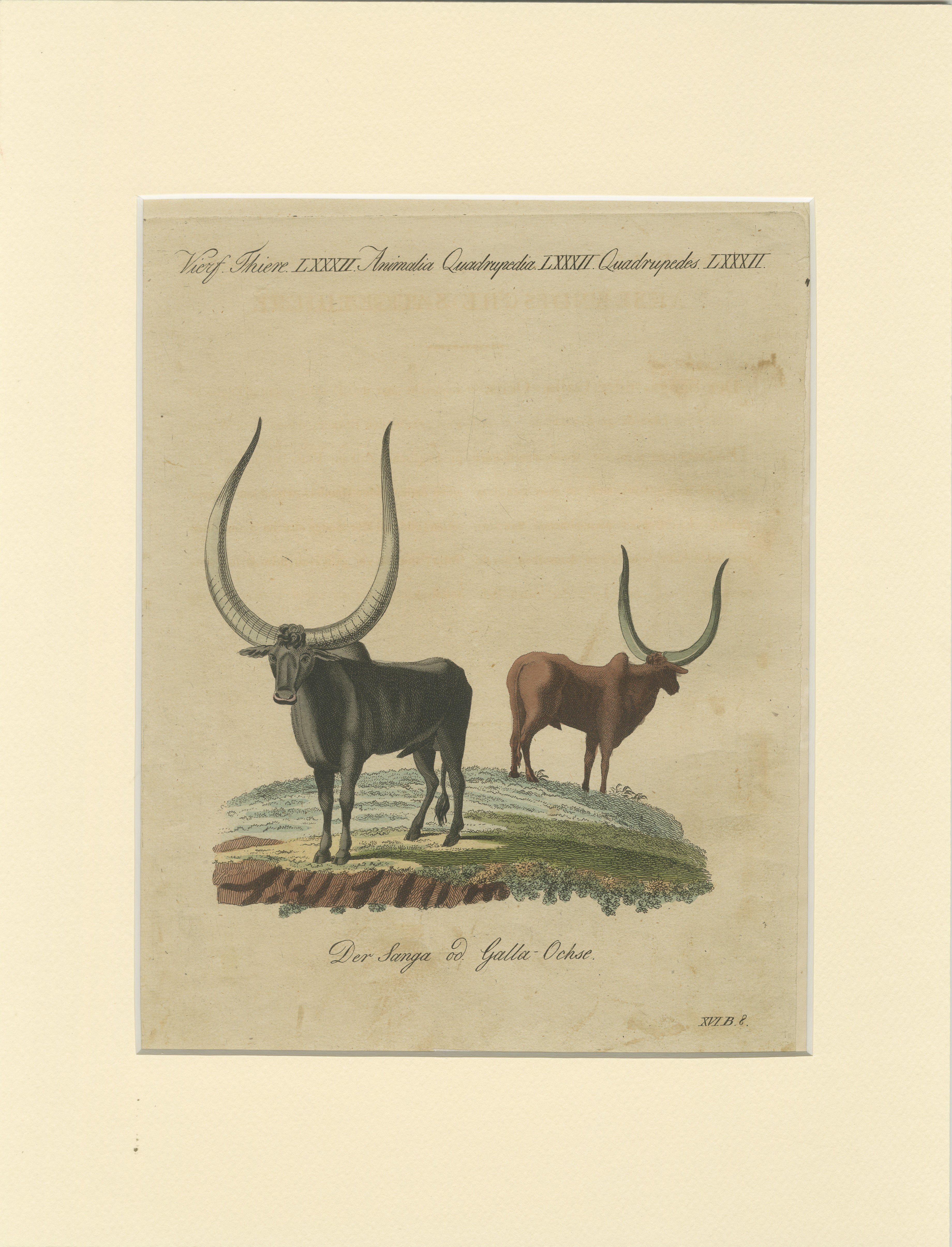
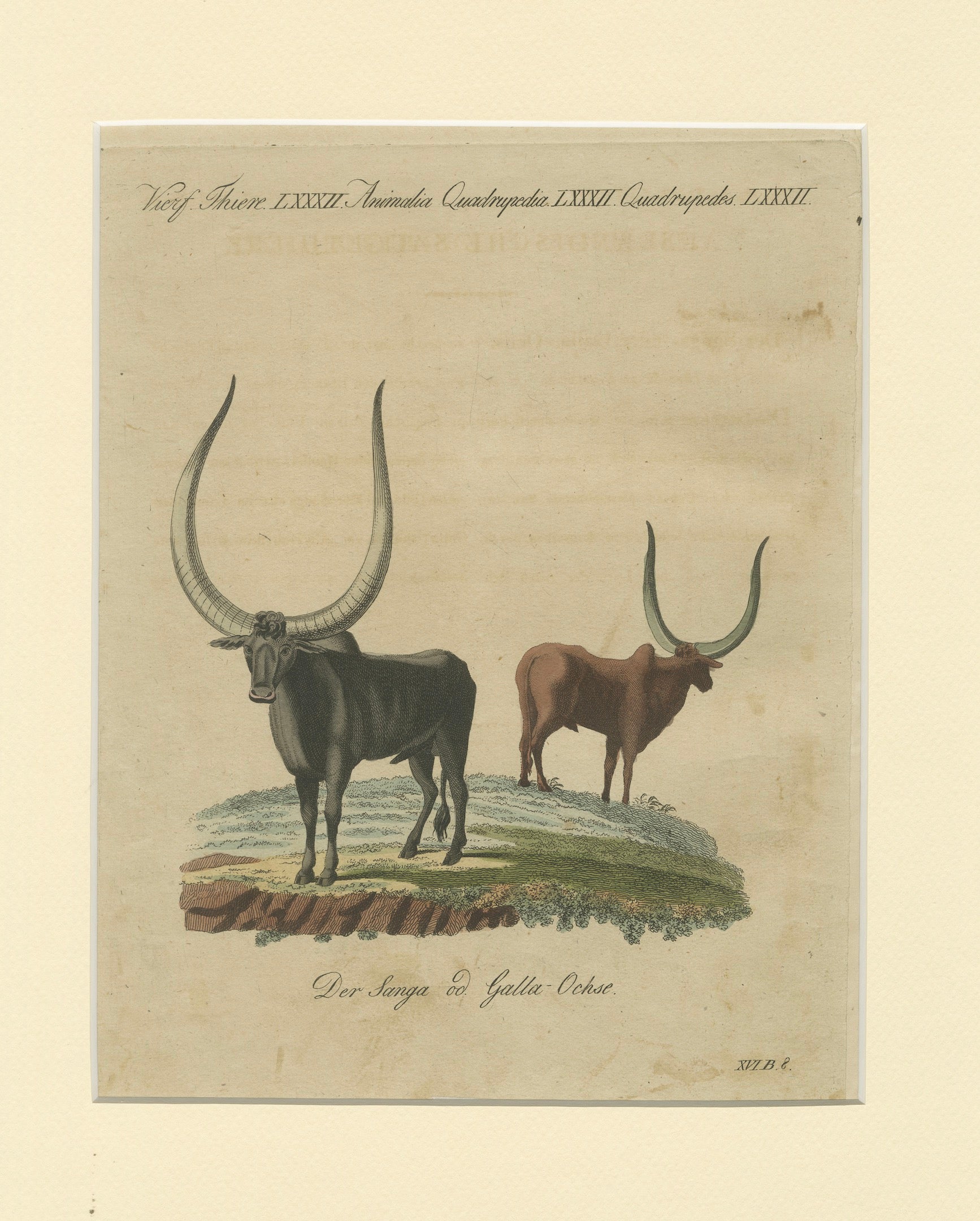
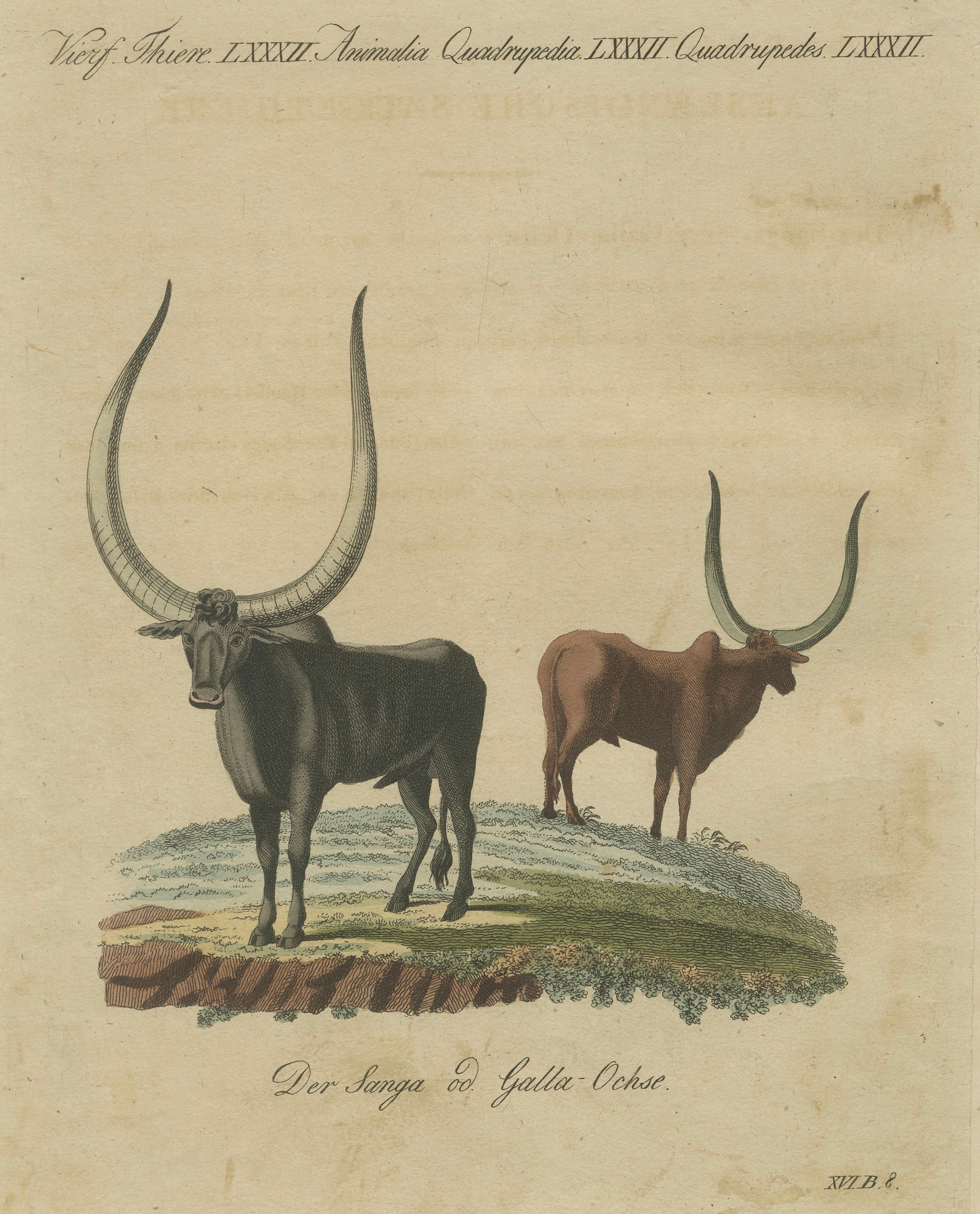
Original antique hand-colored copper engraving depicting the extraordinary African Sanga or long-horned cattle, published in Friedrich Justin Bertuch’s celebrated “Bilderbuch für Kinder” in Weimar in the early 19th century.
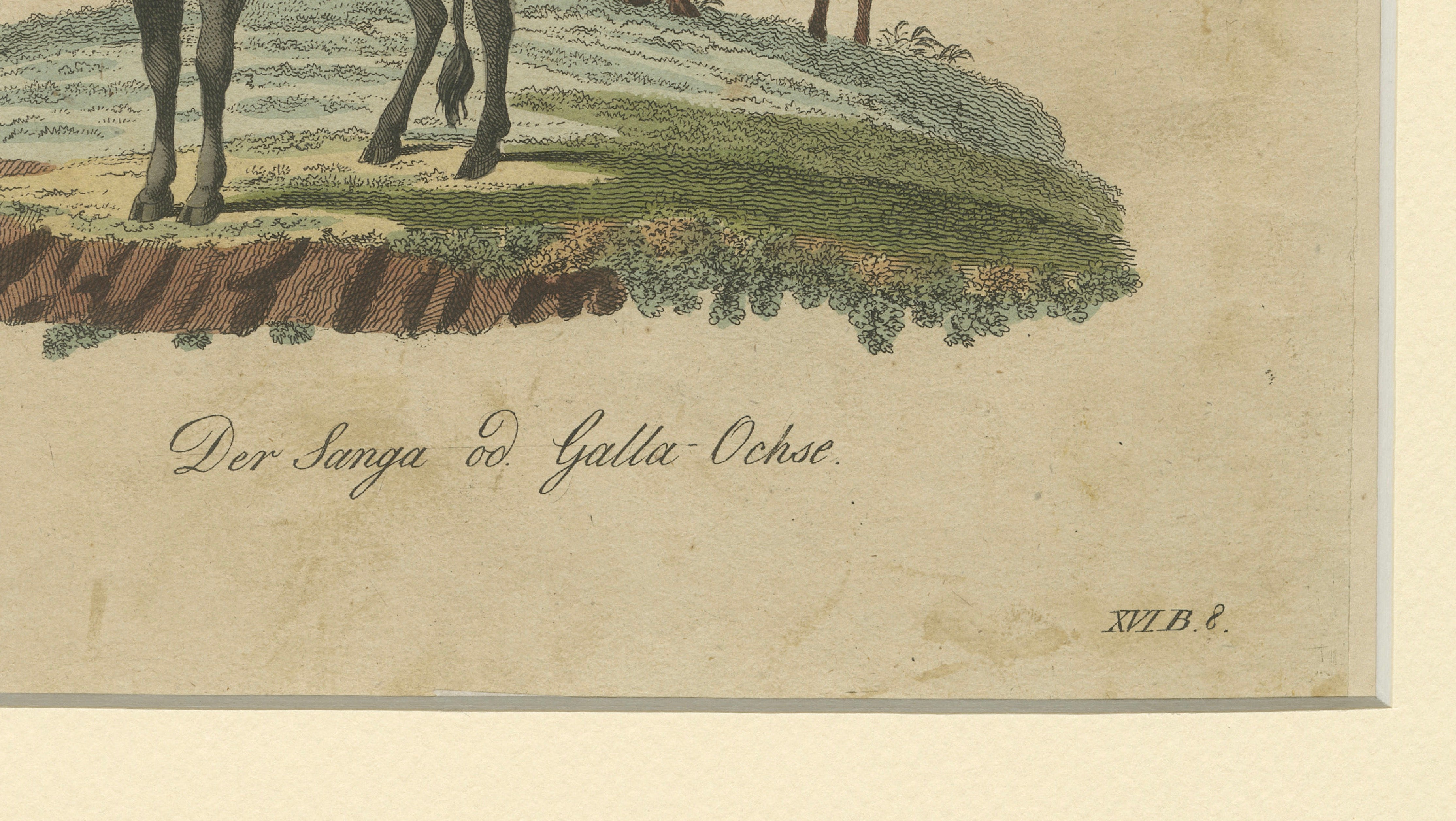
The plate is headed “Vierfüßige Thiere LXXXVI / Animalia Quadrupedia LXXXVI / Quadrupèdes LXXXVI” and bears the original German caption:
“Der Sanga od. Galla-Ochse”
– The Sanga or Galla Ox.
The Sanga Ox / African Longhorn
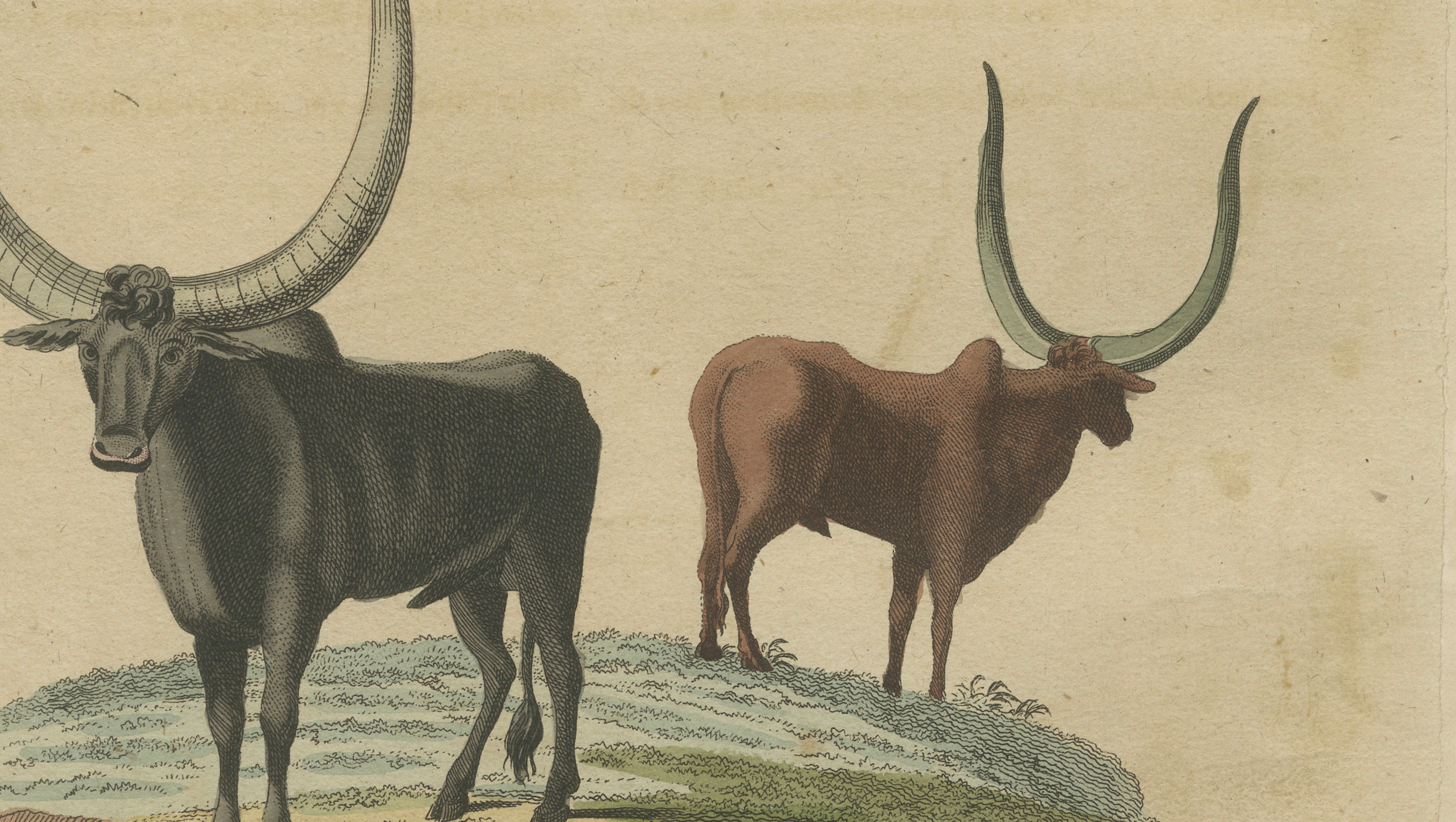
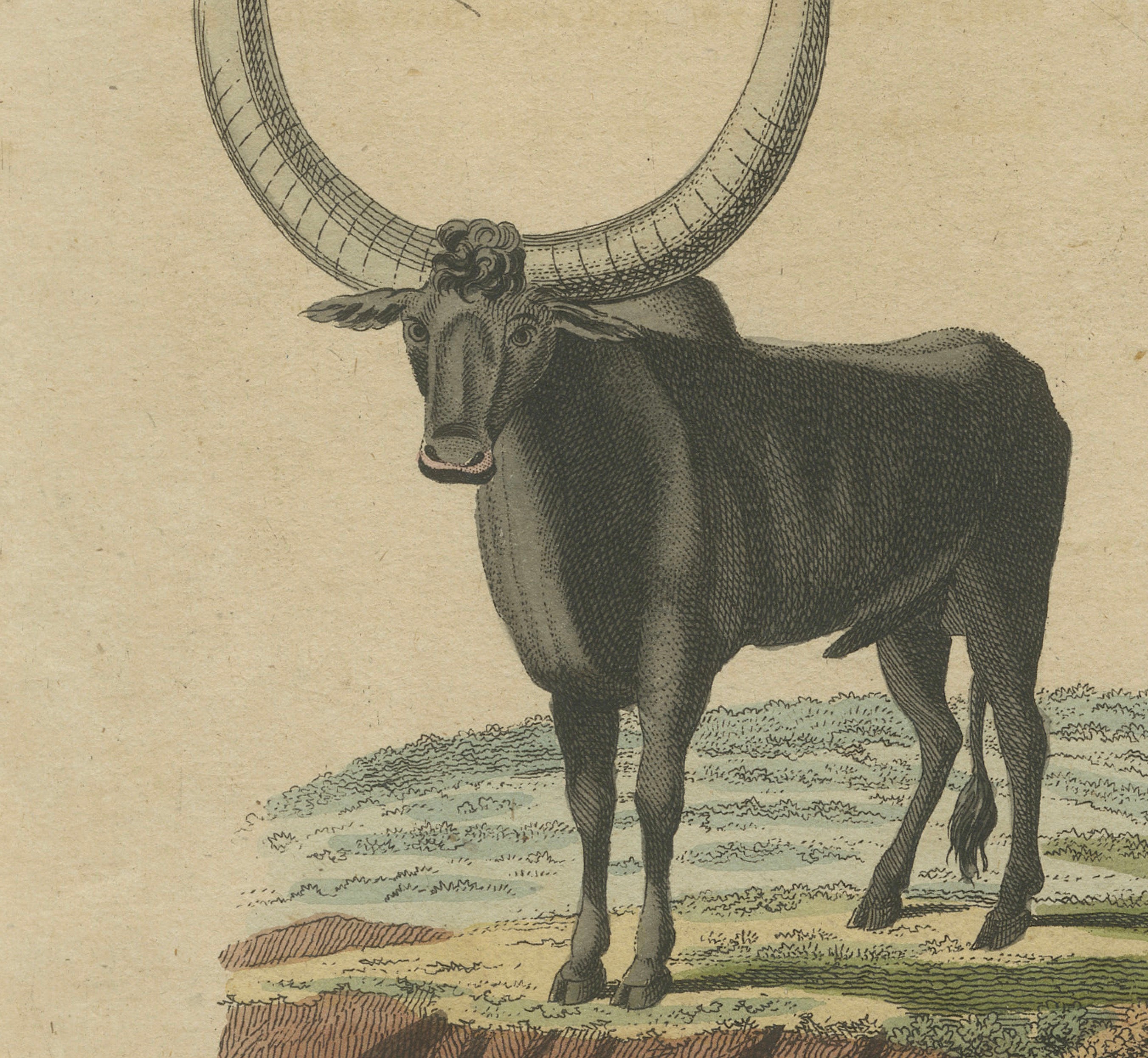
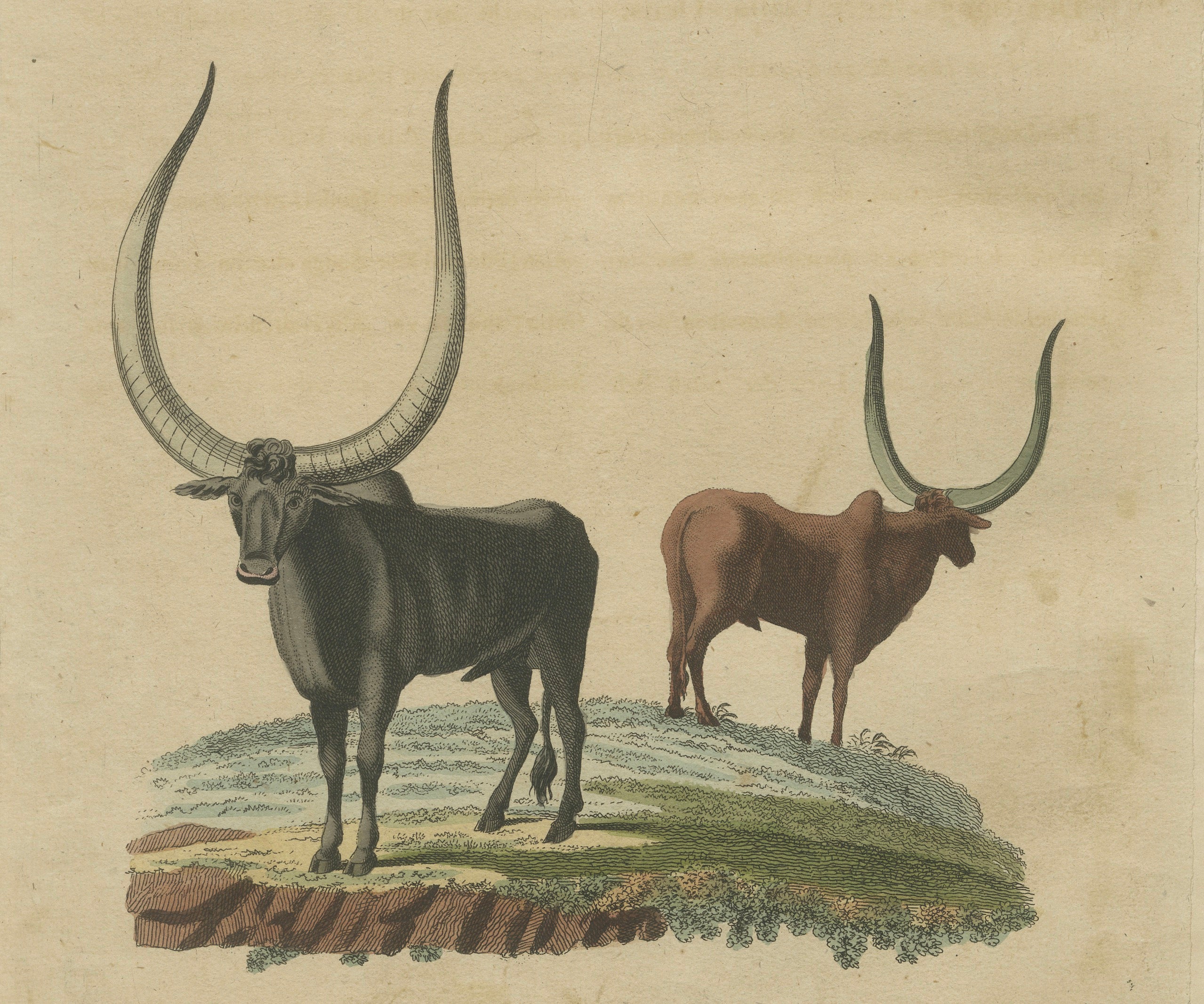
The engraving depicts two African cattle, dominated by the spectacular dark animal in the foreground with exceptionally long, slender horns sweeping dramatically upward.
Behind it stands a smaller reddish-brown animal, likewise displaying the characteristic elongated horns of the Sanga cattle group.
Sanga cattle are an ancient group of African cattle associated particularly with eastern, central and southern Africa. They are immediately recognizable by their impressive horns, which in certain breeds can reach extraordinary dimensions.
The term Sanga is still used for a broad group of indigenous African cattle. They are historically related to some of the spectacular long-horned cattle breeds surviving today, including the famous Ankole and Ankole-Watusi cattle of East and Central Africa.
The enormous horns are not simply decorative. In some African long-horned cattle they contain a large internal network of blood vessels, helping the animal regulate body temperature in hot climates.
Historical “Galla Ox”
Bertuch gives the animal the alternative historical name “Galla-Ochse.”
“Galla” was a name historically used in European literature for the Oromo people and regions associated with them in East Africa, particularly present-day Ethiopia and neighboring areas. The term is now outdated and is retained here solely as part of the original historical title printed on the engraving.
Around 1800, animals such as these were still extraordinary sights for European audiences. Natural-history publications introduced readers to cattle breeds and wild animals known through exploration, travellers’ accounts, imported specimens and earlier zoological works.
The immense horns of African cattle made them particularly fascinating subjects.
The engraving beautifully emphasizes this feature: the foreground animal’s horns extend far above its head, creating an almost architectural silhouette.
Friedrich Justin Bertuch (1747–1822) was a German publisher, writer and patron of the arts. His monumental “Bilderbuch für Kinder” (Picture Book for Children), first published in Weimar in 1790, became one of the great illustrated educational encyclopedias of the late 18th and early 19th centuries.
Its hundreds of engraved and hand-colored plates introduced readers to animals, plants, geography, science, technology, antiquity and cultures from around the world.
This is an especially striking Bertuch animal plate. The extraordinary sweeping horns, restrained original hand coloring and simple landscape setting give the composition considerable decorative impact.
It would work particularly well in a natural-history collection, country-house interior, study, library, African-inspired interior or cabinet-of-curiosities setting.
Technique: Original hand-colored copper engraving
Publisher: Friedrich Justin Bertuch / Industrie-Comptoir
Publication: Bilderbuch für Kinder
Place: Weimar, Germany
Date: early 19th century, circa 1810
Plate: Vierfüßige Thiere LXXXVI / Animalia Quadrupedia LXXXVI / Quadrupèdes LXXXVI
Original title: Der Sanga od. Galla-Ochse
Subject: Sanga Cattle / African Long-Horned Cattle
Also associated with: Ankole / Ankole-Watusi cattle
Geographical association: East and Central Africa
Condition:
Good antique condition with overall age-related toning, scattered foxing and spotting and some visible show-through or offsetting from printed text. There are minor stains and marks, particularly toward the lower portion of the sheet, consistent with an original print more than 200 years old. The original hand coloring remains attractive, with restrained black, brown, green and blue-grey tones. Please study the photographs carefully as they form part of the condition description.
The engraving is loosely inserted in an acid-free matting board.
Please note: This is an original antique hand-colored copper engraving from the early 19th century, not a modern reproduction. The print is sold unframed. Framed images or interior views, if shown, are for presentation and inspiration only.
Other companion animal and natural-history plates from Bertuch’s “Bilderbuch für Kinder” are also available separately.
Keywords: Friedrich Justin Bertuch, Bilderbuch für Kinder, Sanga cattle, Sanga ox, African cattle, African longhorn, long horned cattle, Ankole cattle, Ankole-Watusi, Watusi cattle, African ox, Galla Ox, Ethiopia, East Africa, African livestock, cattle engraving, antique cow print, antique cattle...