About this sheet
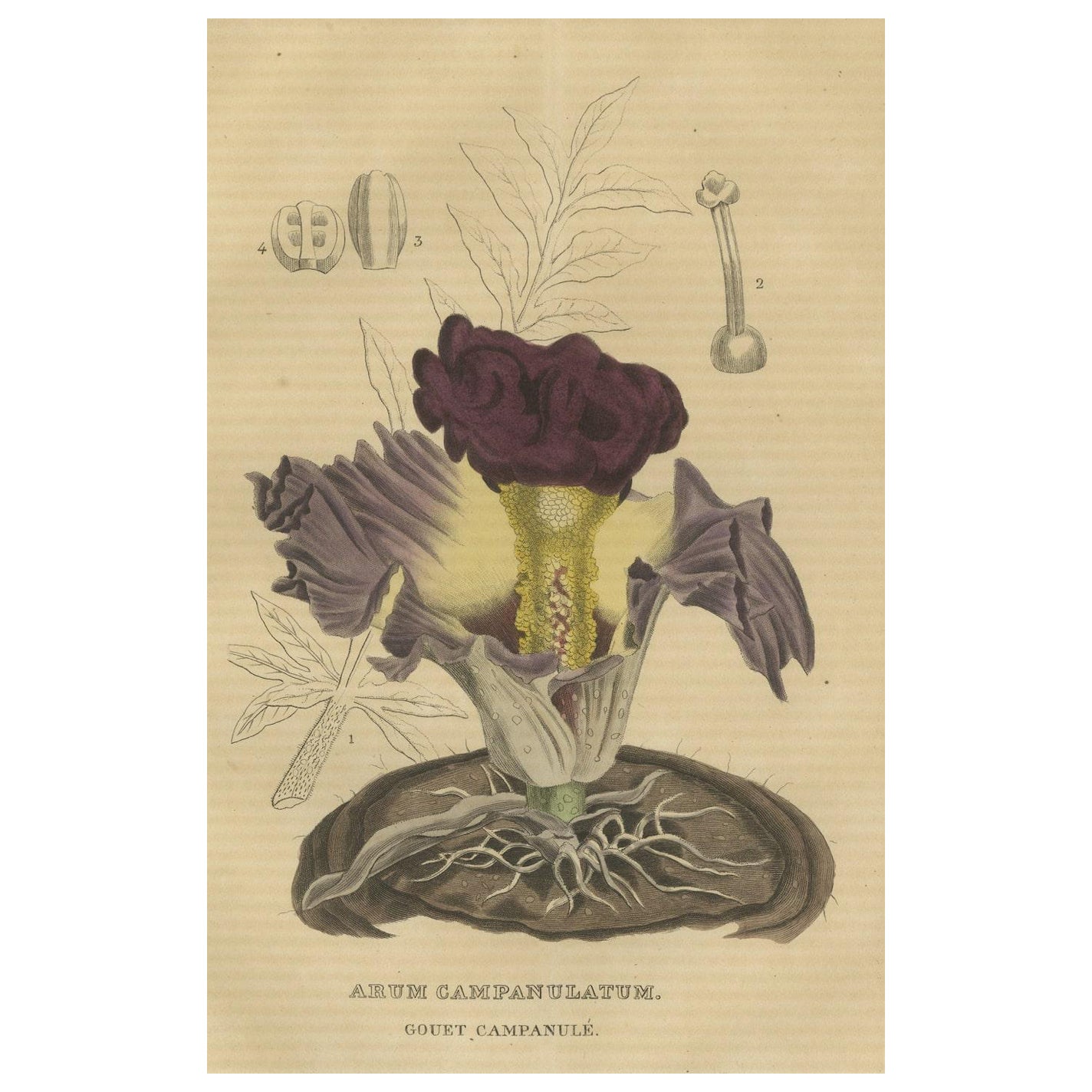
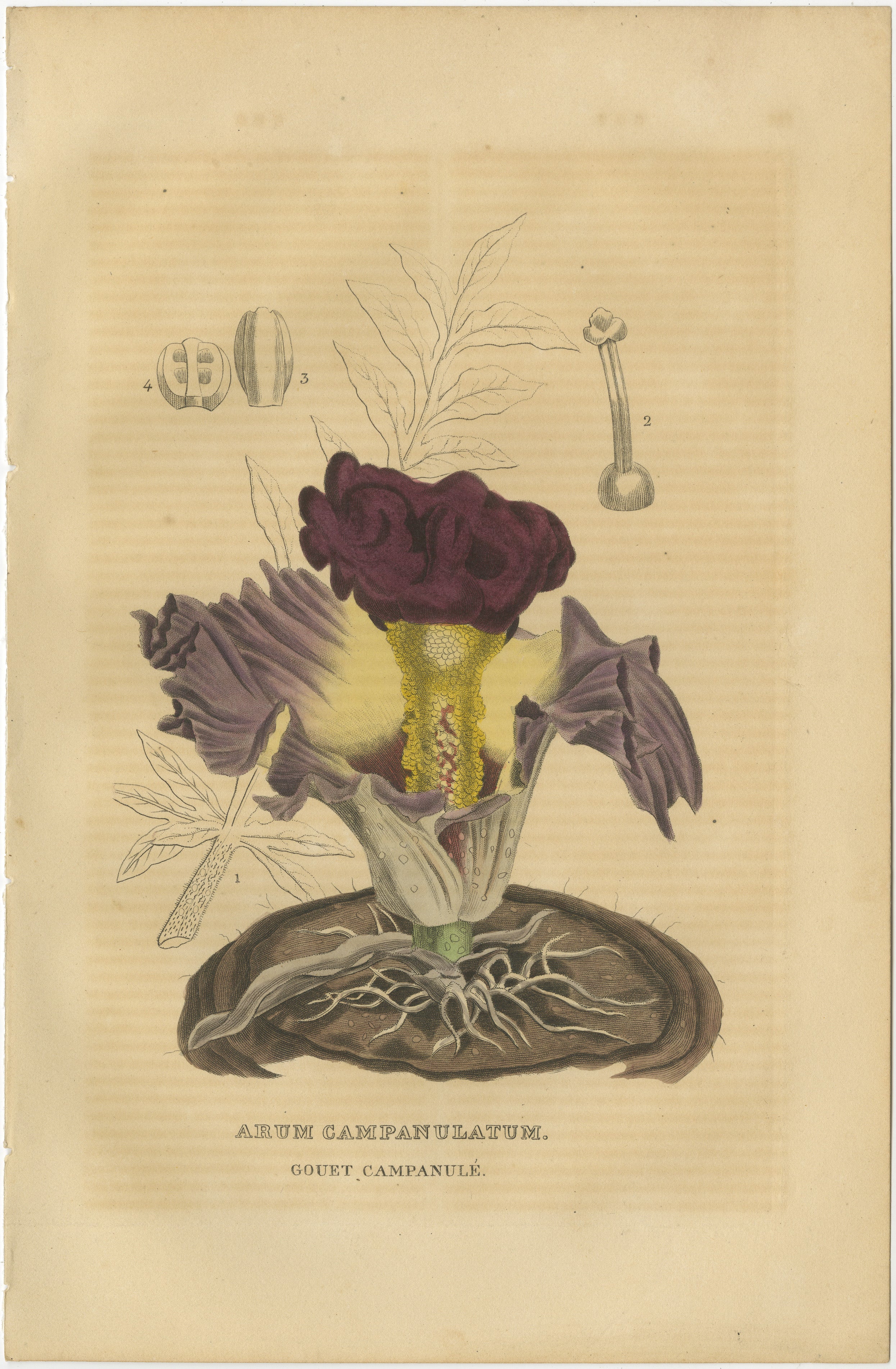
This original antique engraving depicts the Arum Campanulatum, also known as the bell-shaped arum or campanulate arum. This print is hand-colored over 200 years ago.
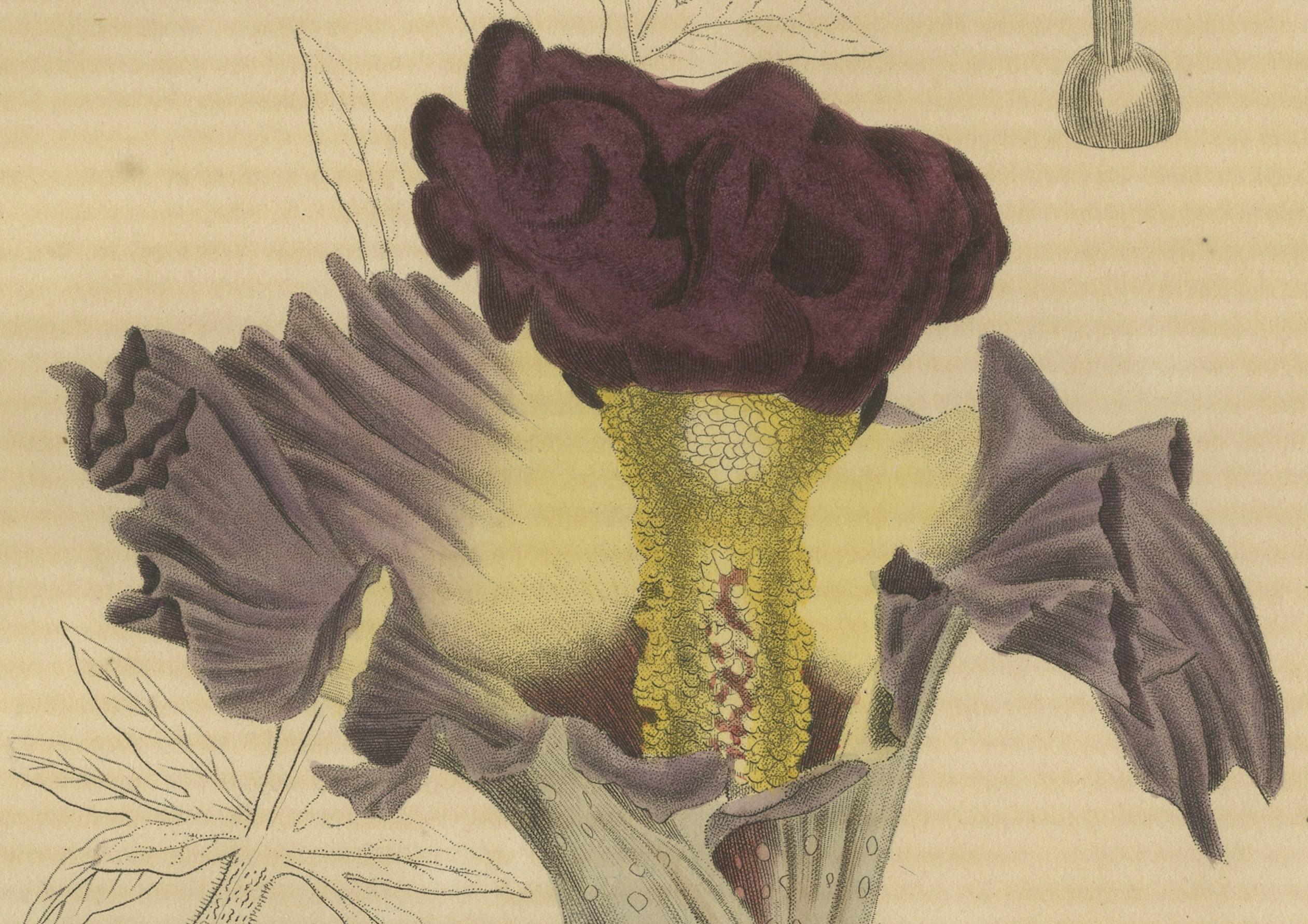
The plant is illustrated with a large, richly colored burgundy flower that dominates the image. The flower has a unique shape with a rolled, funnel-like spathe surrounding a tall, central spadix that is covered with tiny yellow florets at the top.
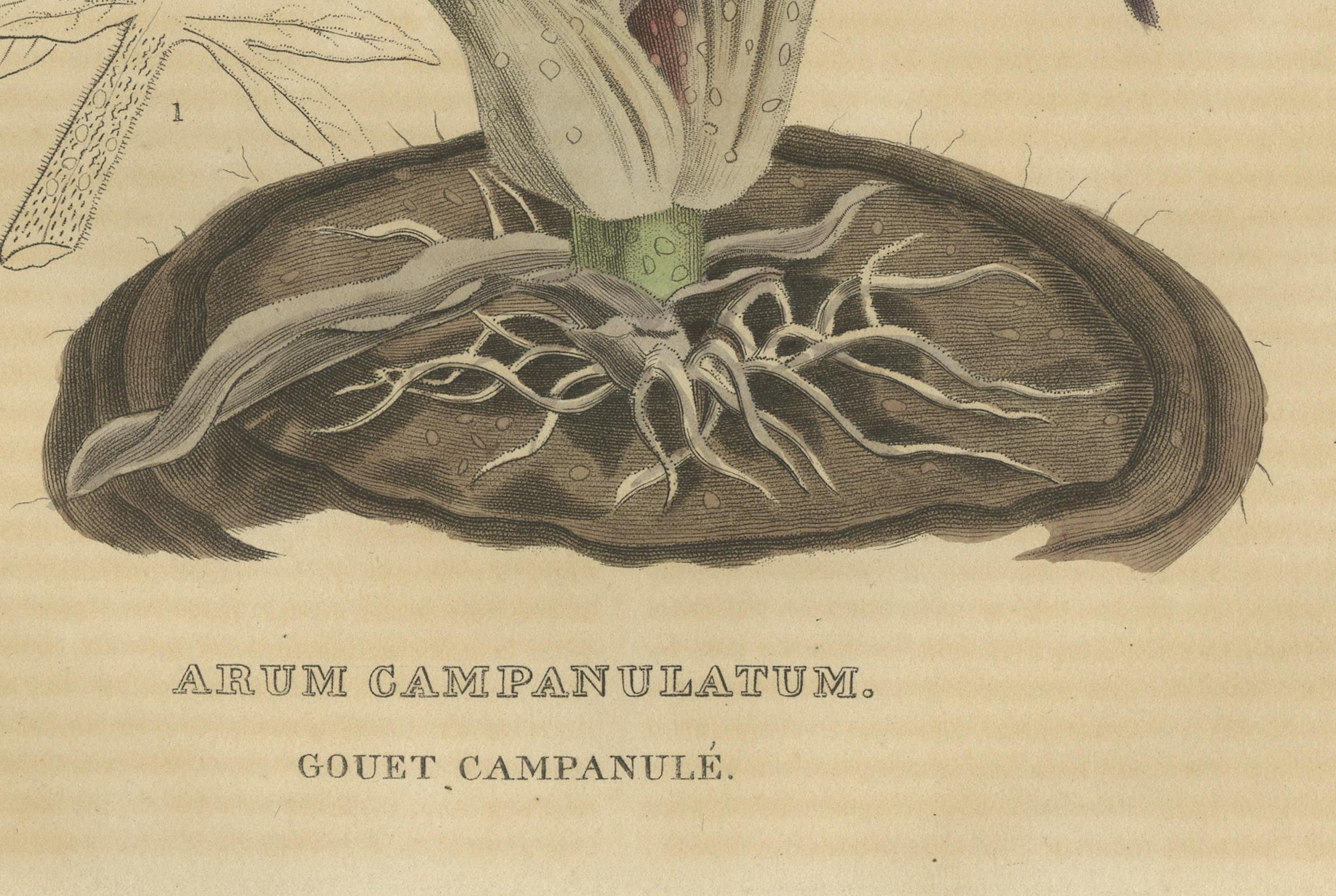
Below the flower, there's a cross-section of the plant showing its internal structures, including the spadix and the base where it connects to the stem. The leaves are illustrated with a high level of detail, displaying prominent veins and a realistic texture.
On the upper left side of the image, several smaller illustrations are present. Number '1' indicates a leaf with its intricate vein pattern. Number '2' seems to be a longitudinal section of the spadix, showing the flower's reproductive parts. Numbers '3' and '4' are likely parts of the plant's reproductive system as well, with '3' possibly being a cross-section of the spadix and '4' showing the seed pods or berries.
The Latin name "Arum Campanulatum" is indicated at the bottom, along with "Gouet Campanule," which is likely the French name for the plant. The style of the engraving, with its fine lines and careful shading, is was created during the 18th, a period known for detailed botanical illustrations. The illustration would have served both as an aesthetic piece and an important educational tool for the study of botany.
More info on the book in which it was published:
The 'Dictionnaire Classique des Sciences Naturelles' by Pierre Auguste Joseph Drapiez stands as a remarkable testament to 19th-century natural sciences. Published in Brussels in 1845, this work represents an expansive collation of knowledge, building upon the pioneering works of Buffon, Daubenton, Lacepede, Cuvier, de Jussieu, and other influential naturalists.
The prints within this compendium likely showcase a rich amalgamation of artistic precision and scientific accuracy. Drapiez, himself a Belgian naturalist, would have aimed for detailed representations of flora, fauna, and scientific phenomena, mirroring the illustrative styles prevalent during his time. Given the era's emphasis on illustration, these prints were likely engraved meticulously, possibly portraying intricate anatomical details or lifelike depictions of the natural world.
With Drapiez's background in natural history, the prints might bear testament to his commitment to scientific authenticity, aiming to educate and inspire scholars and enthusiasts alike. These engravings would have complemented the text, offering visual aids that elucidate the concepts and specimens discussed in the volume.
Overall, the prints of 'Dictionnaire Classique des Sciences Naturelles' likely serve as both artistic representations and invaluable scientific resources, encapsulating the essence of 19th-century natural history exploration and documentation.