About this sheet
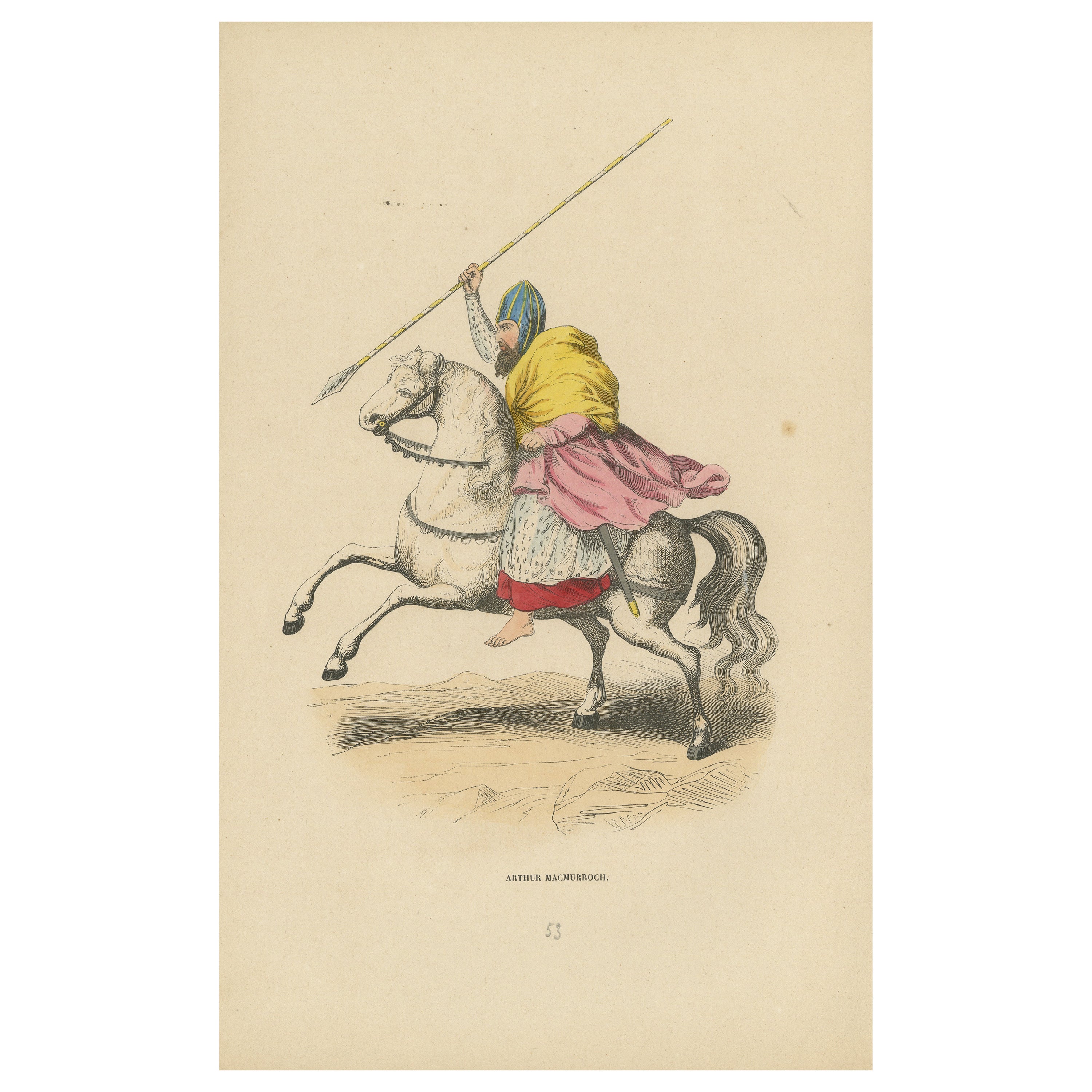
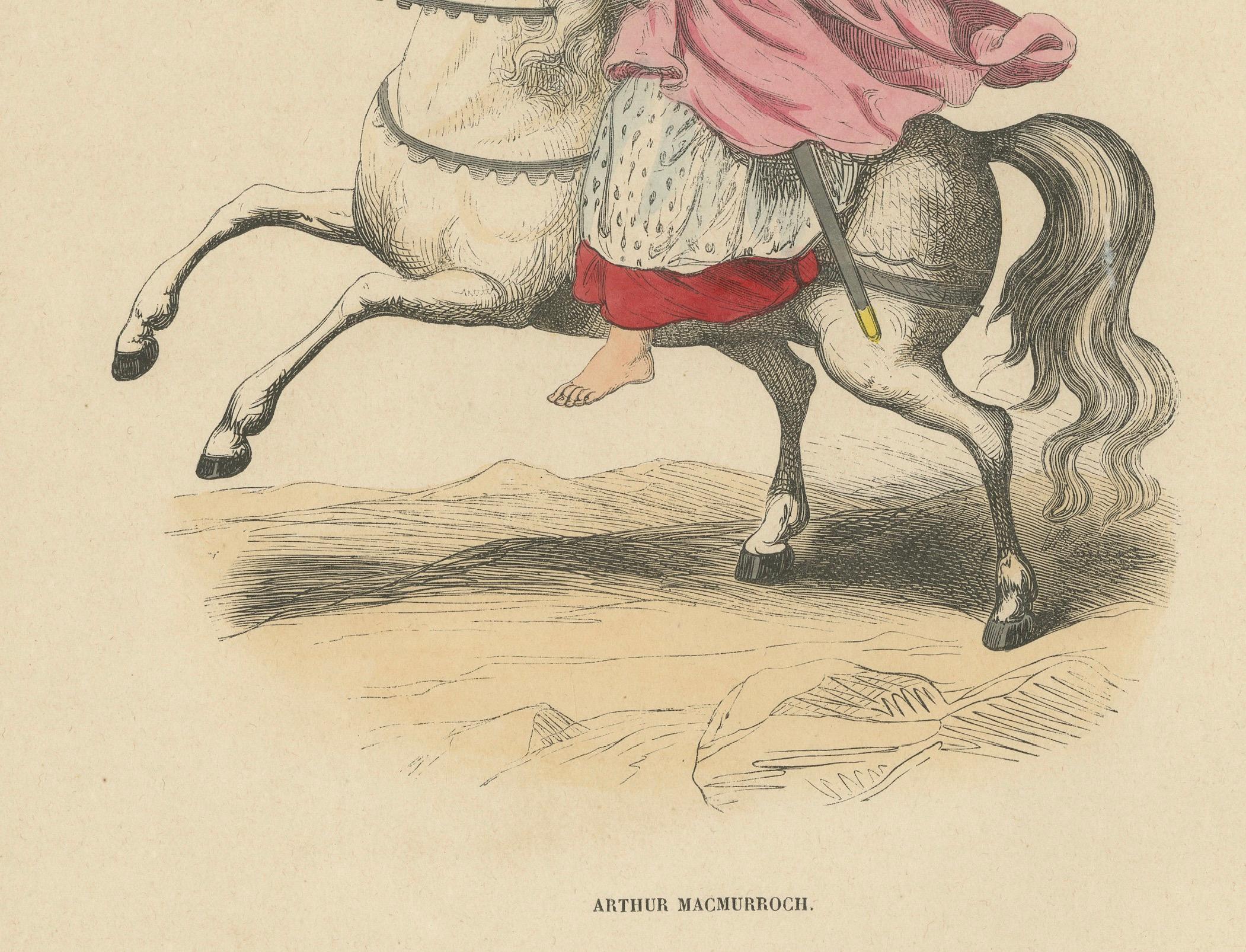
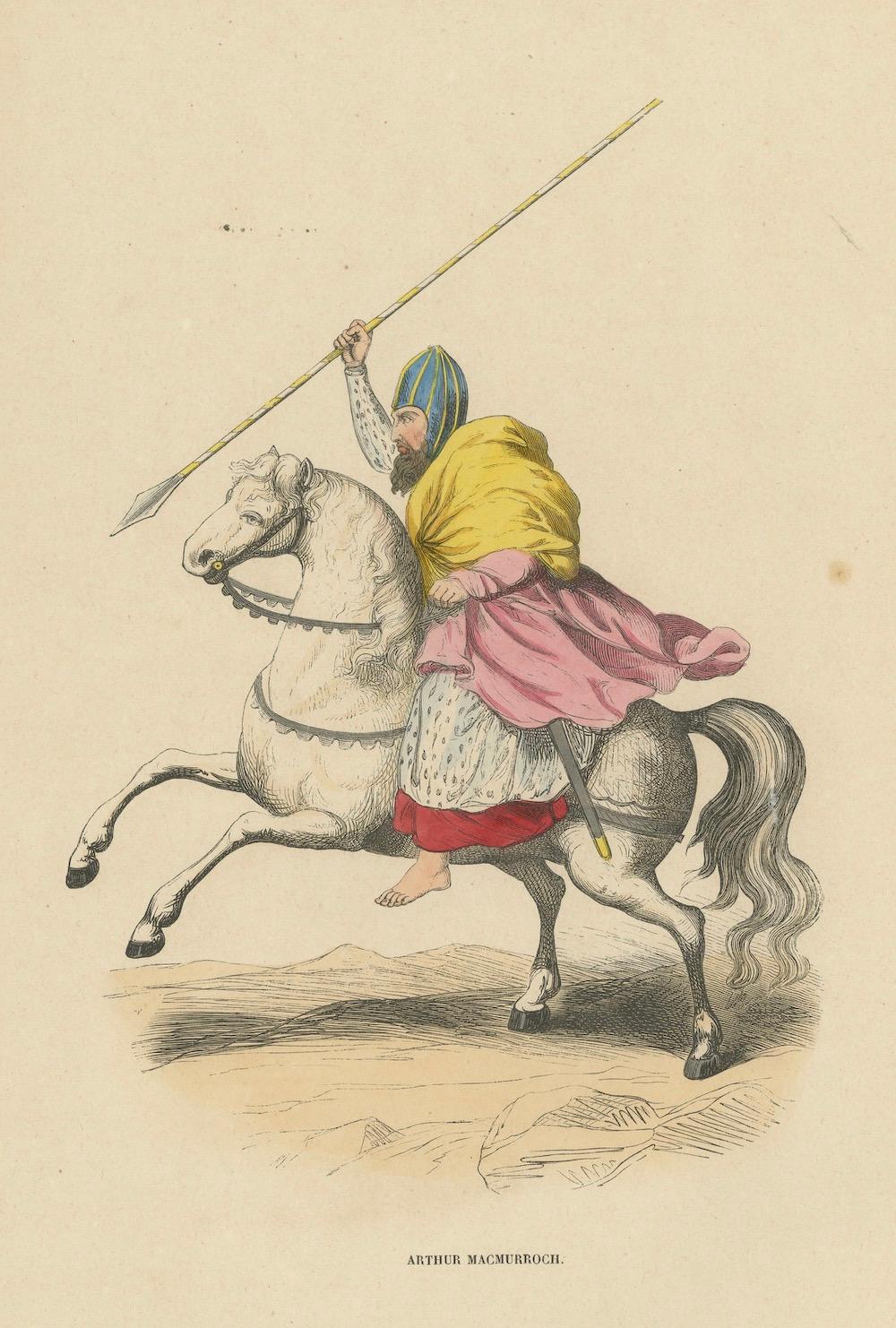
This print appears to portray a figure named Arthur MacMurrough, a historical or legendary figure associated with medieval Ireland. The warrior is mounted on a spirited white horse, which is captured in mid-gallop, its mane and tail flowing with the movement. The rider is attired in vibrant and contrasting colors, with a yellow cloak billowing behind him and a pink tunic covering a chainmail armor, which peeks through in areas, suggesting readiness for battle.
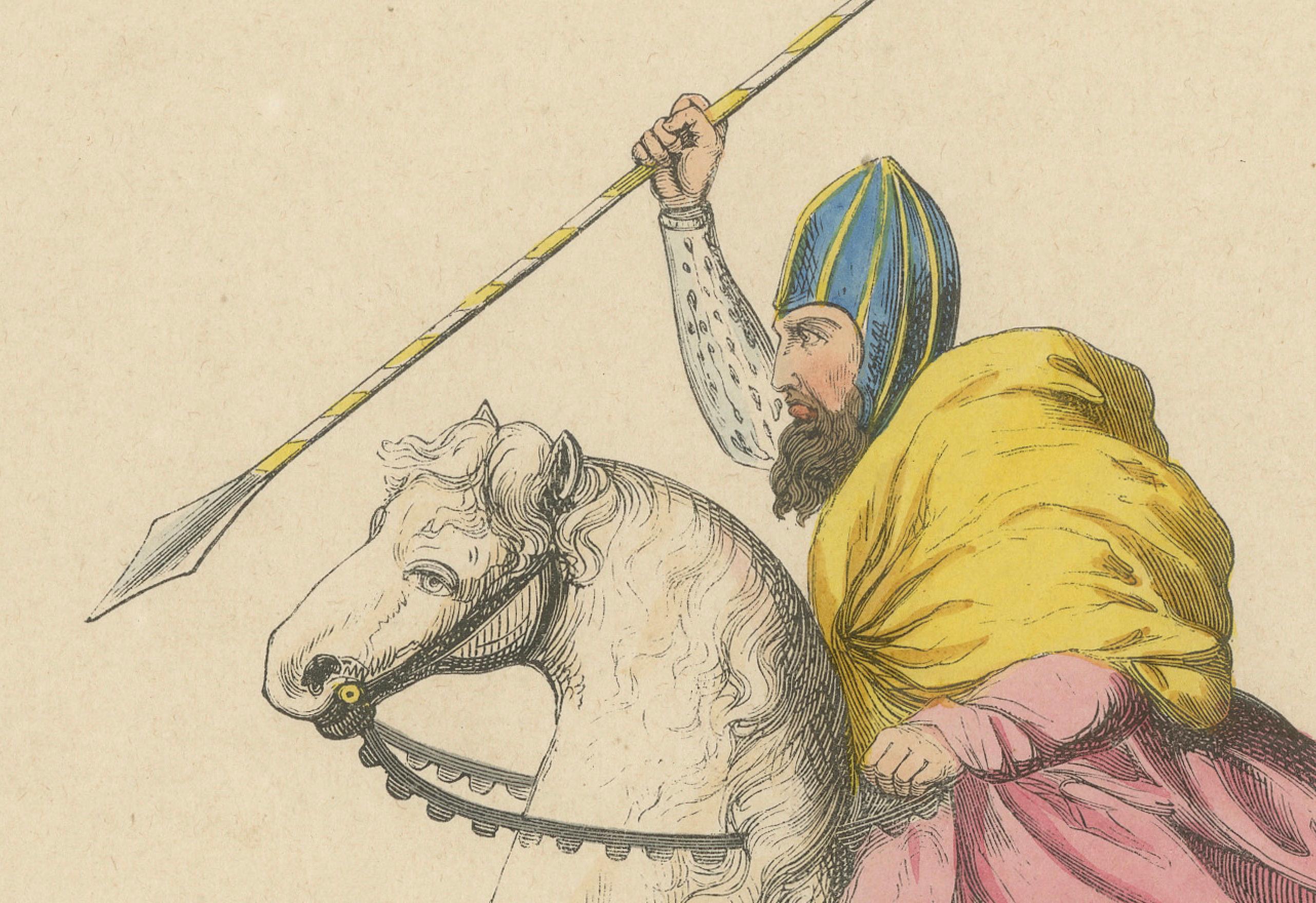
He wears a blue and yellow striped turban on his head, which gives him an exotic and noble appearance, perhaps indicating status or a role of leadership. The warrior holds a long spear in his right hand, raised high above his head in a gesture that could be interpreted as either a call to arms or a victorious salute.
The minimalistic landscape in the background, with its gentle dunes, emphasizes the figure’s prominence and the dramatic action of the scene. The image captures a moment of dynamism and seems to convey a narrative of leadership, bravery, and the martial spirit of the age.
More about the vivid colors of this original hand-colored antique print:
The colors have a nice glow over them. Historically, egg whites, known as glair, and sometimes egg yolk were indeed used in illumination and painting, particularly in manuscripts, to give colors a brighter appearance and to add a sheen or gloss to the work. This technique was quite common during the Middle Ages and into the Renaissance.
Egg whites can be applied as a varnish over pigments to enhance their brightness and to protect the colors. This application could make the colors appear more vivid and also add a slight glossy sheen to the surface of the image.
Egg yolk, on the other hand, was commonly used as a binding agent in paint. It forms the basis of tempera paint, a medium that was widely used before the advent of oil painting. Egg yolk helps to create a durable and long-lasting color that adheres well to various surfaces.
In the context of the print from 1847, it's less likely that egg whites or yolks were used directly on the print, as by that time, commercial printing processes would have been more advanced and less reliant on such manual methods. However, if this print is a representation of an earlier style or is meant to mimic the appearance of hand-painted manuscripts, the original artists might have employed techniques or materials that gave a similar effect to those achieved with egg-based binders and varnishes.