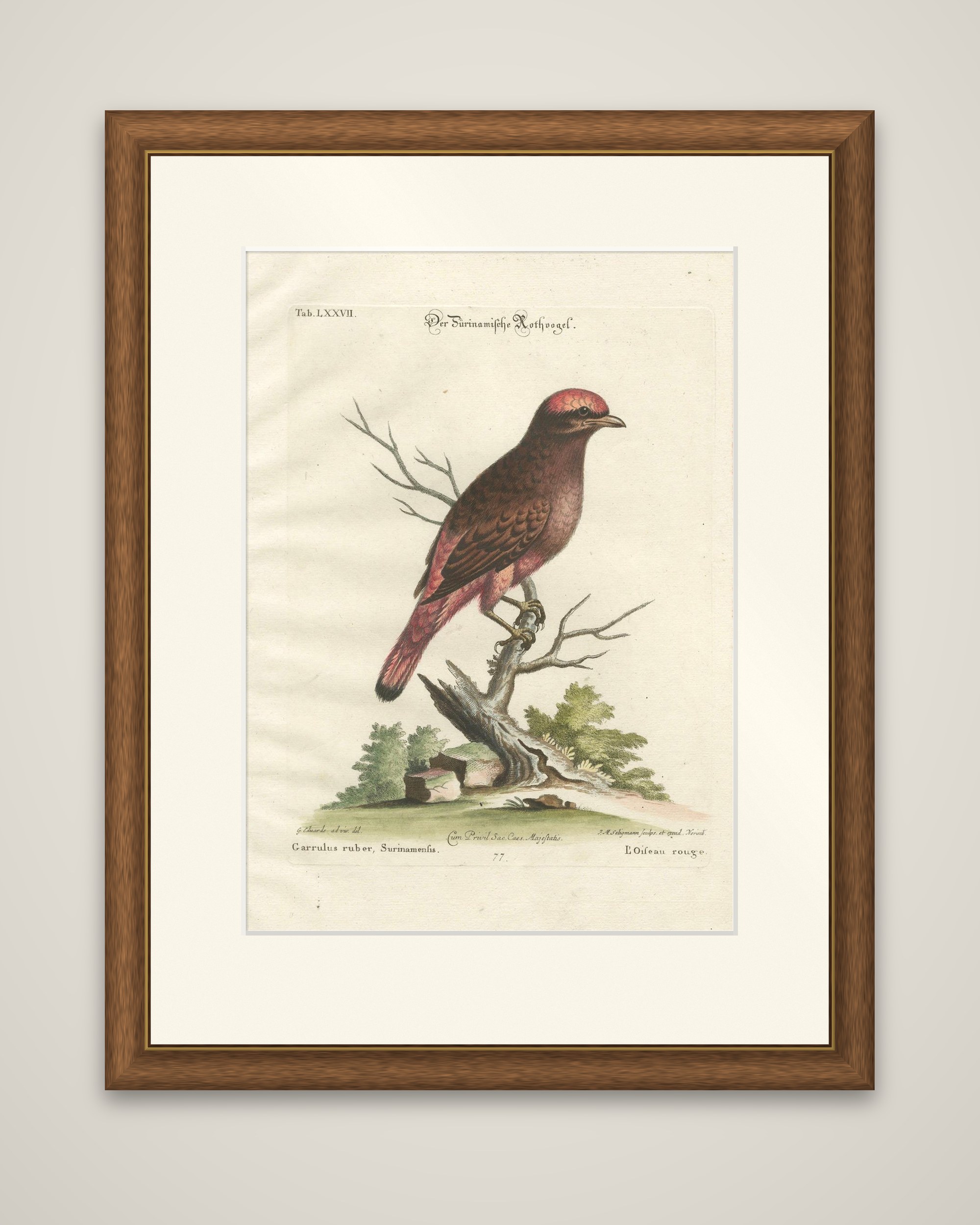
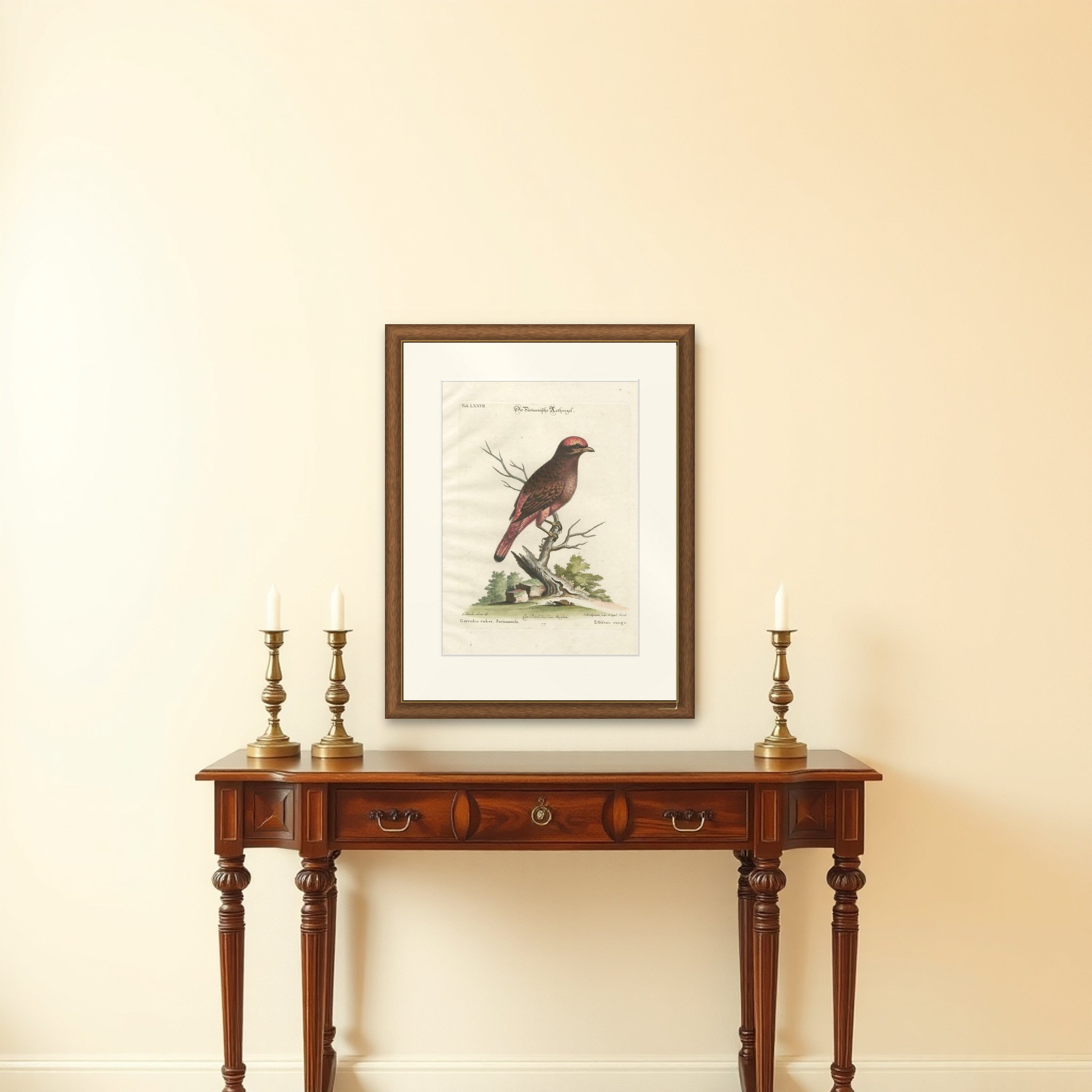
The Red Bird of Surinam by J.M. Seligmann, Hand-Colored Engraving, 18th Century
€ 580
Original antique · The actual sheet photographed · Certificate of authenticity on request · Sold unframed · Worldwide shipping from € 15 (rates)
Sheet size
37.3 × 24.3 cm (14.7 × 9.6 in)
Reference
BG-14005-5
What the condition grades mean
Excellent
Bright and clean, with no faults worth mentioning.
Very good
Only light signs of age, such as faint toning.
Good
Normal signs of age for a sheet of this period: toning, some foxing, small marks or neat old repairs.
Fair
Clear faults such as staining, tears or repairs, priced to match.
Every fault we see is written in the condition note, and the whole sheet is shown uncropped in the photos.
Condition
Good. Vibrant colors, minimal fading. Paper shows light toning and minor foxing. Left edge supported by tape, leaving enough margin for framing. Some minor handling marks, mostly outside plate-mark, not affecting image quality.
About this sheet
Garrulus ruber, Surinamensis, the red bird of Surinam, an original hand-colored copper engraving from Johann Michael Seligmann's Sammlung verschiedener auslaendischer und seltener Voegel, an eighteenth-century Nuremberg bird book. The plate is numbered "Tab. LXXVII" at the upper left and "77" at the foot, with the German title "Der Surinamische Rothvogel" at the top, the Latin name at the lower left and the French "L'Oiseau rouge" at the lower right.
The bird sits upright on a gnarled, bare branch rising from a stump, in profile to the right, with a short dark bill, a crimson cap, brown breast and back feathered like scales, and wings and a long tail washed in rose red. Low clumps of green foliage and a few stones fill the ground below. The lettering beneath the image credits G. Edwards as the draftsman and J. M. Seligmann as engraver and publisher at Nuremberg, and a privilege line stands at the center.
The design follows George Edwards's A Natural History of Uncommon Birds, whose plates Seligmann adapted for a German audience, and the sheet shows how a bird from the Guianas, known in Europe only from specimens, was drawn in the mid-eighteenth century.