About this sheet
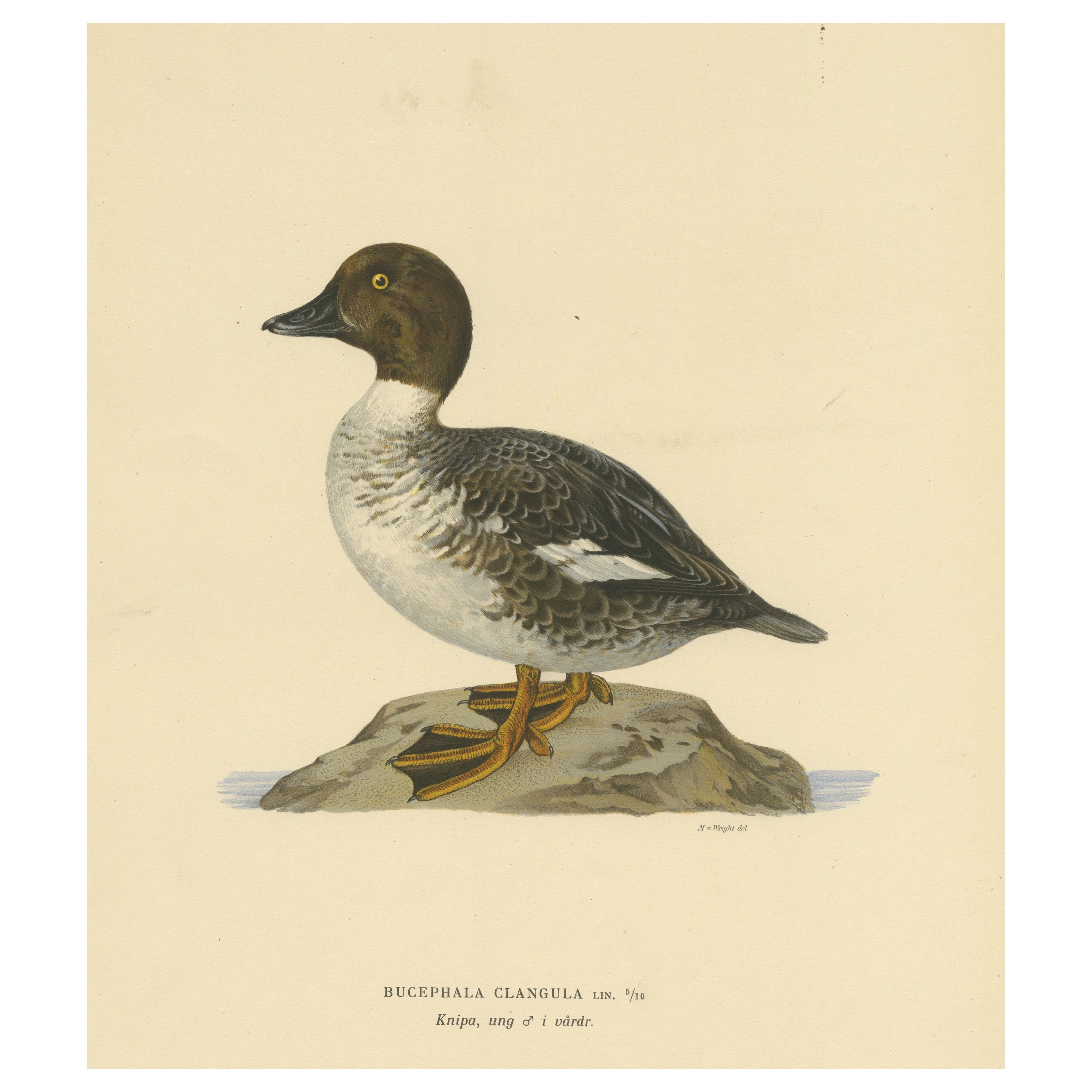
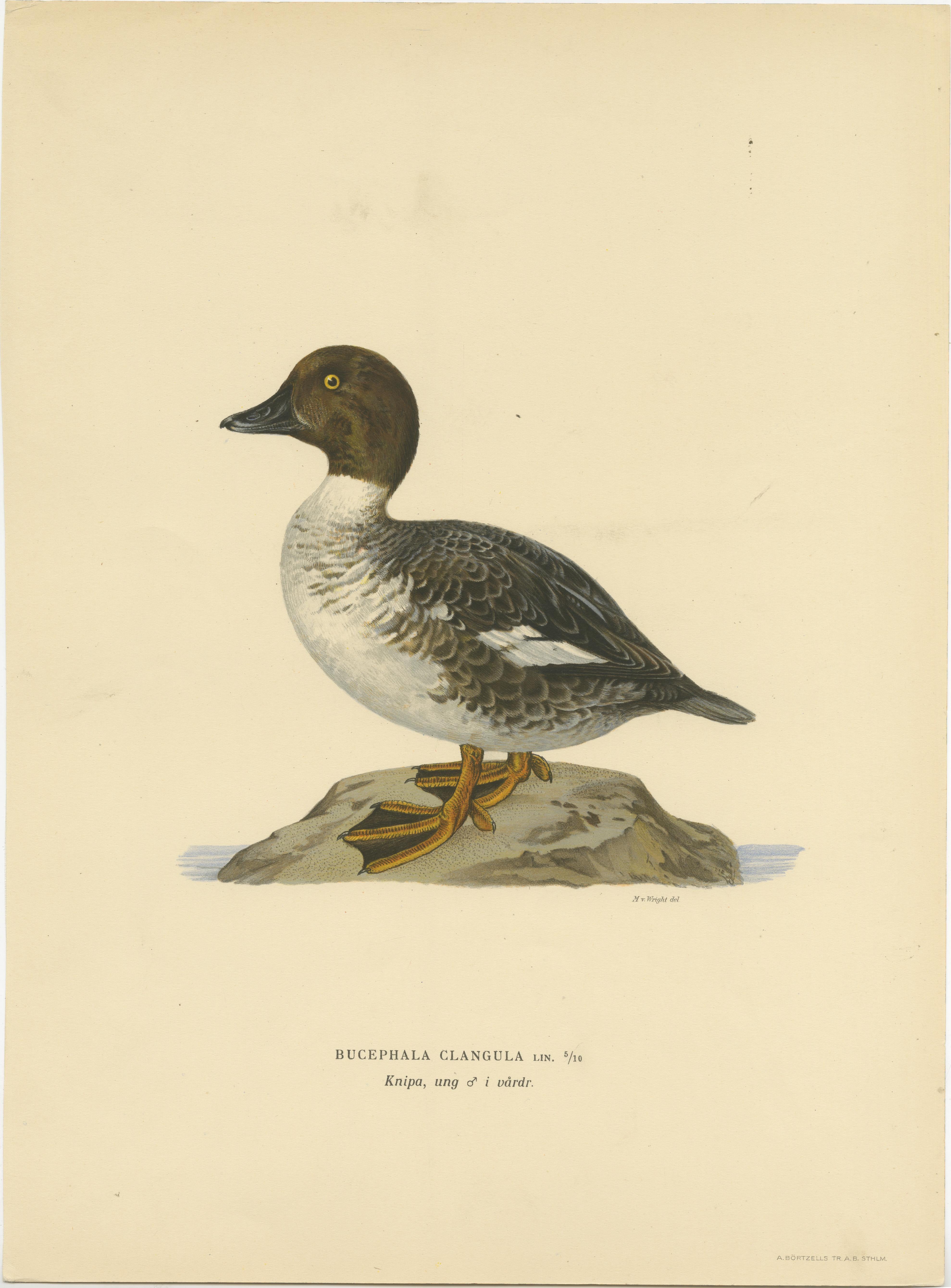
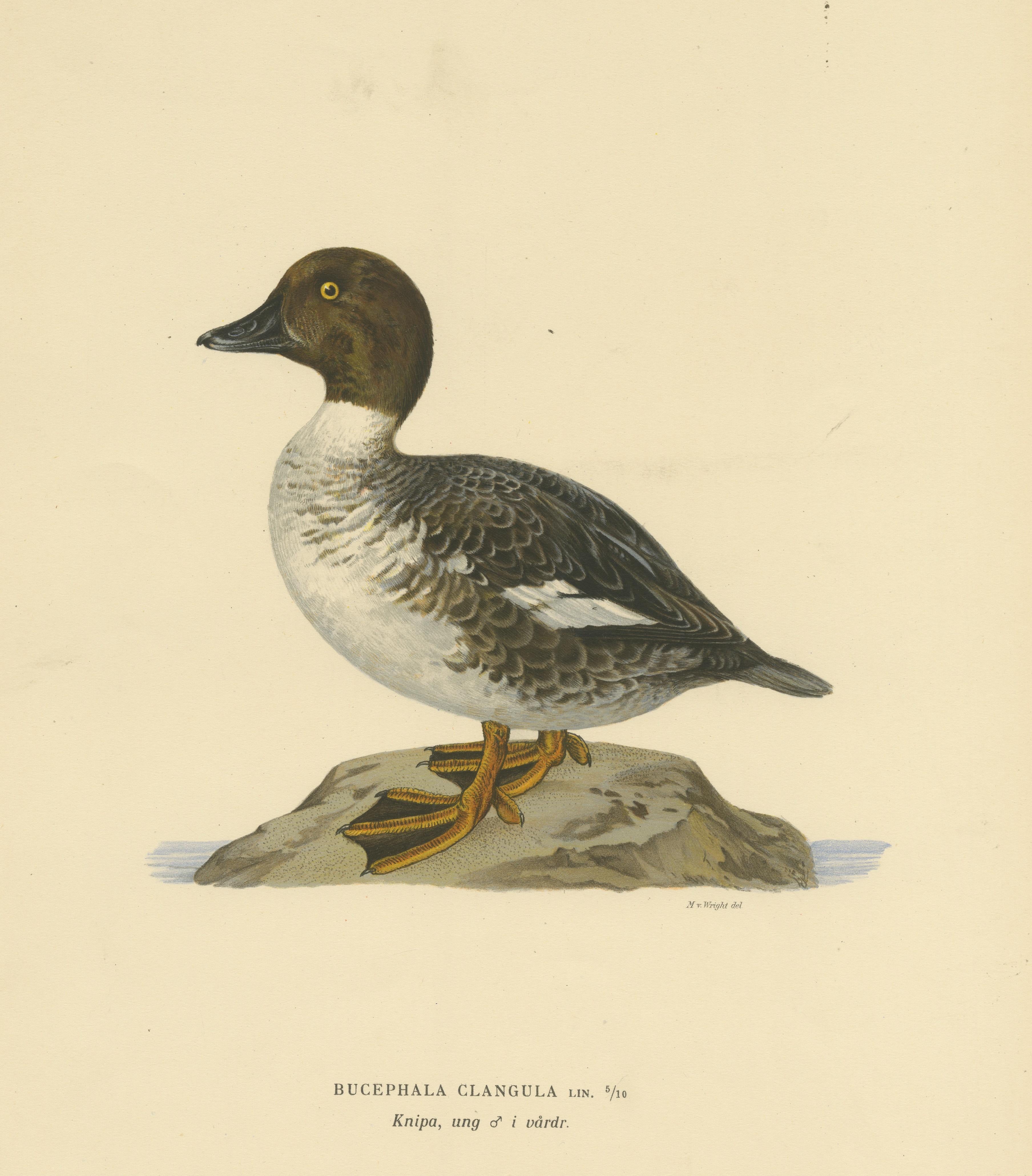
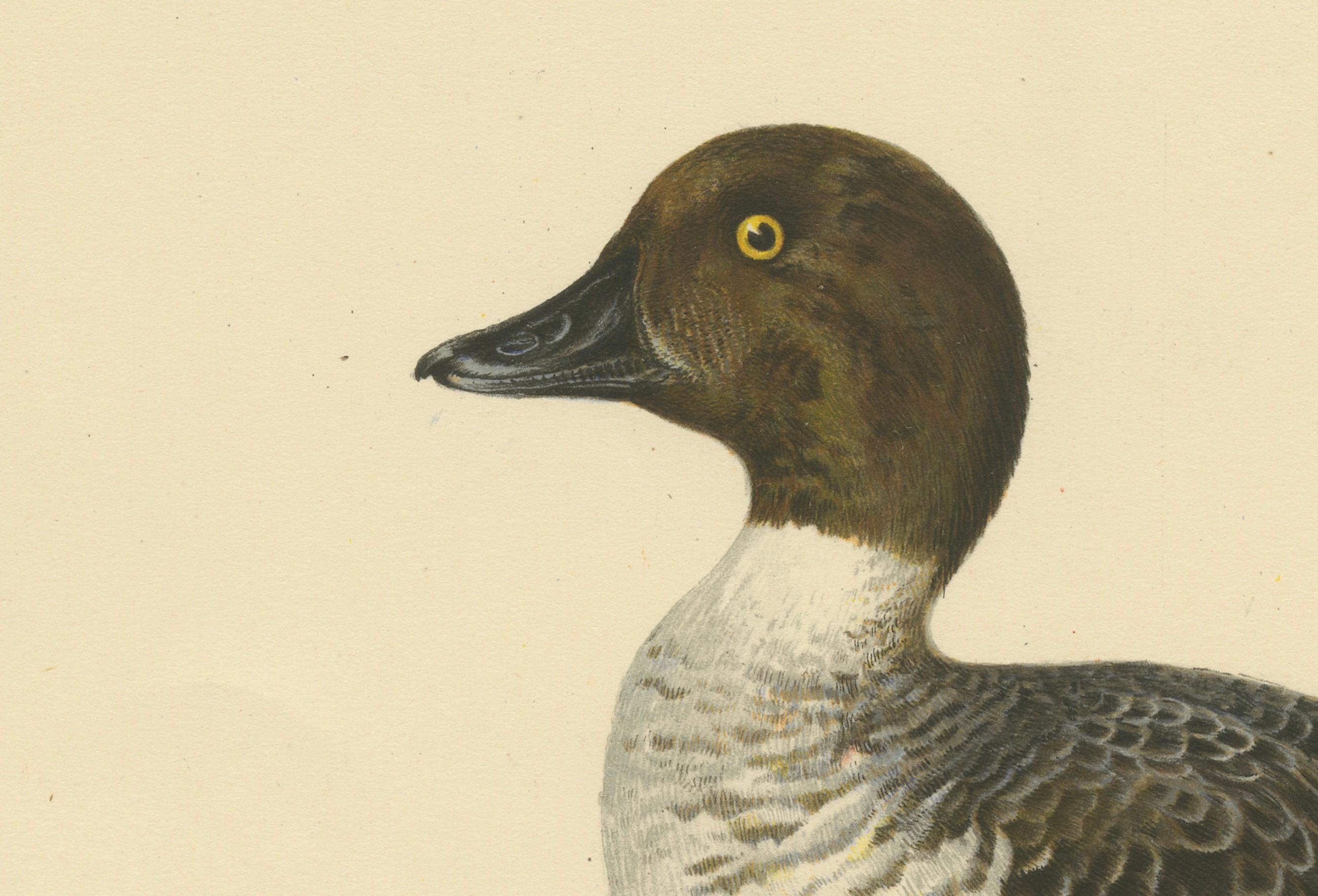
Antique bird print titled 'Bucephala Clangula'. Old bird print depicting a male common goldeneye. This print originates from 'Svenska Foglar Efter Naturen Och Pa Stenritade' by Magnus von Wright. Magnus von Wright (13 June 1805 – 5 July 1868) was a Swedish-Finnish painter and educator. In addition to bird illustrations, he was also known for his landscapes.
The print presents a male Common Goldeneye, scientifically known as *Bucephala clangula*. In this finely detailed illustration, the duck is shown in a side profile, allowing full view of its body markings and colors.
The Common Goldeneye is a medium-sized, sturdy duck with distinctive features that are captured in this print:
- **Head:** The bird's head is rounded with a steep forehead and is depicted in a rich brown color. In the sunlight, this dark head often shows iridescent green, which may not be fully captured in the print.
- **Eye:** True to its name, the golden eye is prominent and vividly represented, a striking feature against the dark head.
- **Bill:** The bill is black and seems slightly contrasting with the lighter feathers on the face just in front of it.
- **Body:** The body shows the typical white and black plumage of the male Goldeneye. The white breast and belly are set against the dark back with fine barring and mottling, which adds texture to the appearance.
- **Wings:** The wings are folded along its sides, showing the white patches on the otherwise dark upperwings which are visible when the bird is at rest.
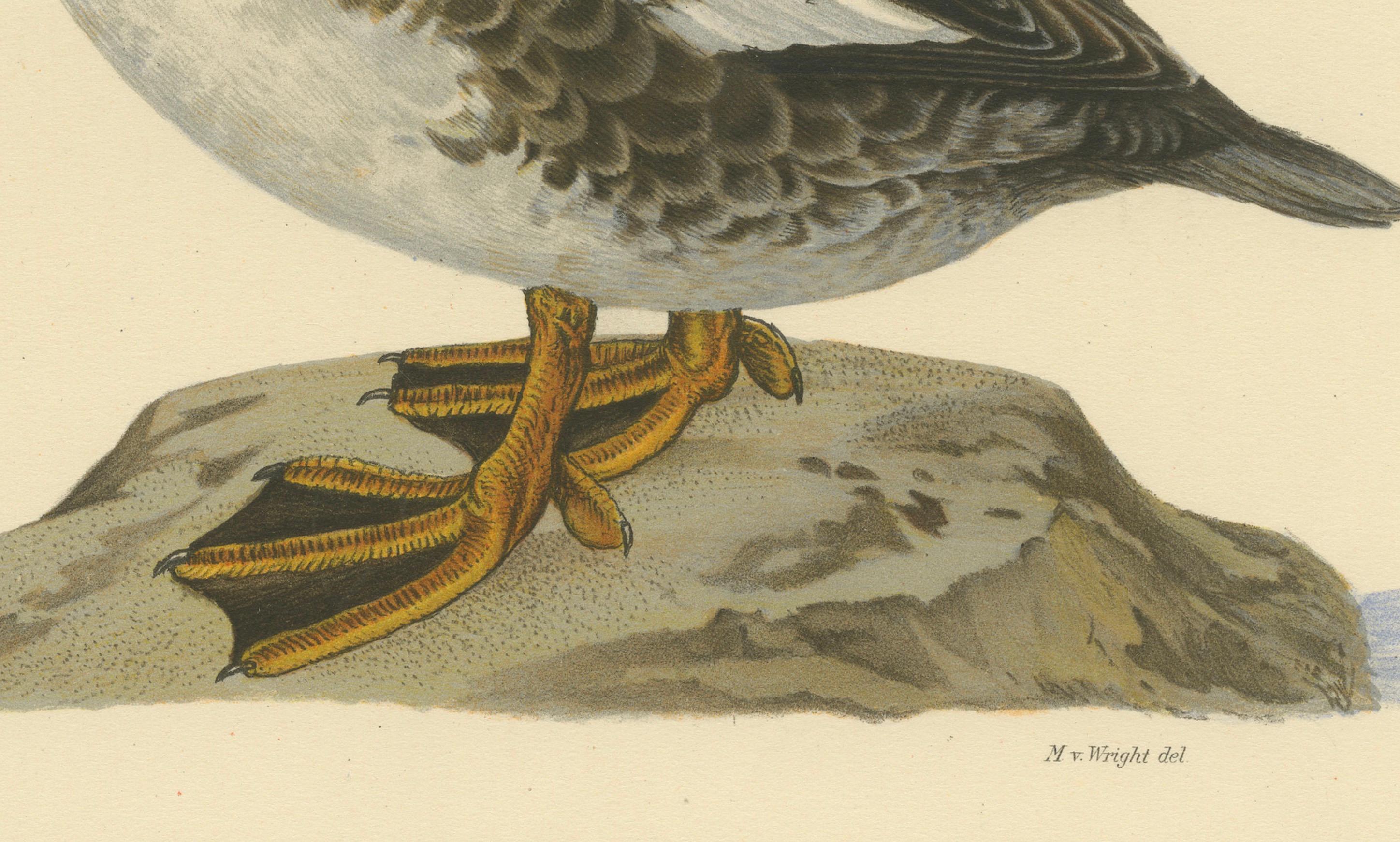
- **Feet:** The feet are large and positioned back on the body, an adaptation for diving, shown in a bright yellow-orange, contrasting with the neutral tones of the rock and the body feathers.
In the wild, Common Goldeneyes are known for their preference for the cold climates of the northern regions. They breed in the boreal forests and taiga of Canada and the northern United States, Scandinavia, and Russia, preferring forested lakes and rivers. In winter, they migrate to more temperate coastal waters.
Their behavior is particularly interesting during mating season, involving complex courtship displays with head throws, bill pointing, and vocalizations. They are excellent divers and feed on aquatic invertebrates, fish, and plant material.
As for Magnus von Wright, this print is a testament to his reputation for precision and scientific accuracy, combined with artistic skill. His work remains a valuable part of the historical record, contributing to the appreciation and knowledge of avian species in his homeland and beyond.
Magnus von Wright was not only a notable artist but also an important figure in the early documentation of Nordic natural history through his illustrations. Born in Sweden to a Finnish family, he grew up in Haminalahti, Finland, and spent much of his life there. His works often reflect the natural beauty and bird life of the region.
**Artistic and Scientific Contributions:**
- He was adept at illustrating the natural world, and he had a keen eye for capturing the details and behaviors of birds, which earned him a prominent place in natural history literature.
- His collaboration with his brother Wilhelm on "Svenska Foglar" (Swedish Birds) was considered one of the first significant works of ornithology in Scandinavia, combining both scientific detail and artistic merit.
**Multifaceted Talent:**
- Beyond ornithology, von Wright contributed to botanical illustrations and landscapes, revealing his versatile talent and deep appreciation for the natural world.
- His works reflect the early Victorian era’s fascination with nature, a period when both the sciences and the arts were heavily influenced by close observation and representation of the natural environment.
**Educational Influence:**
- Magnus von Wright's commitment to education is evident in his role as a drawing teacher at the University of Helsinki, where he influenced many students.
- His illustrations served as educational tools, allowing a broader audience to access the scientific understanding of the natural world.
**Cultural Impact:**
- The Wright brothers, including Magnus, are remembered as pioneers in Finnish art and science, and their legacy continues to be celebrated in exhibitions and collections, both in Finland and abroad.
- His contributions extend beyond his lifetime, as his work laid the groundwork for future naturalists and artists in Finland.
**Preservation of Legacy:**
- Today, Magnus von Wright's work is preserved in various Finnish museums and archives. His contributions to natural history continue to be recognized for their historical significance and as early representations of Finnish and Scandinavian wildlife.
Von Wright's life and work exemplify the 19th-century intersection of art and natural science, with each of his illustrations standing as a document of the natural heritage of his homeland. His artful portrayal of birds, like the Common Goldeneye, not only captures the attention of ornithologists but also...