About this sheet
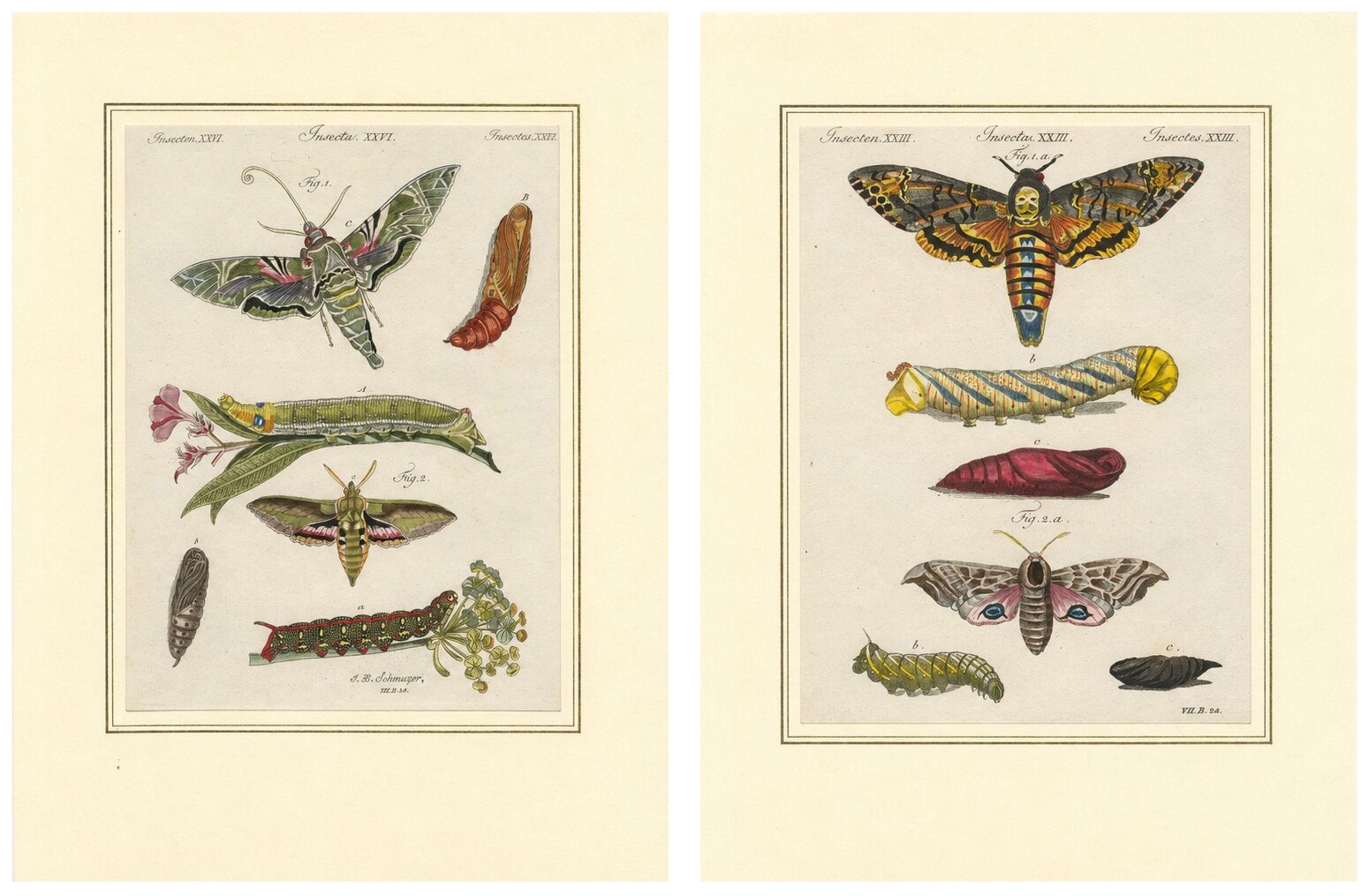
A striking set of two original antique hand-colored copper engravings depicting large hawk moths or sphinx moths together with their caterpillars and pupae, published in Friedrich Justin Bertuch’s celebrated “Bilderbuch für Kinder” around the turn of the 19th century.
The two companion plates, “Insecten XXVI / Insecta XXVI / Insectes XXVI” and “Insecten XXIII / Insecta XXIII / Insectes XXIII,” offer a fascinating early natural-history study of moth metamorphosis, showing the insects through different stages of their life cycles.
Offered together as a set of two original antique engravings.
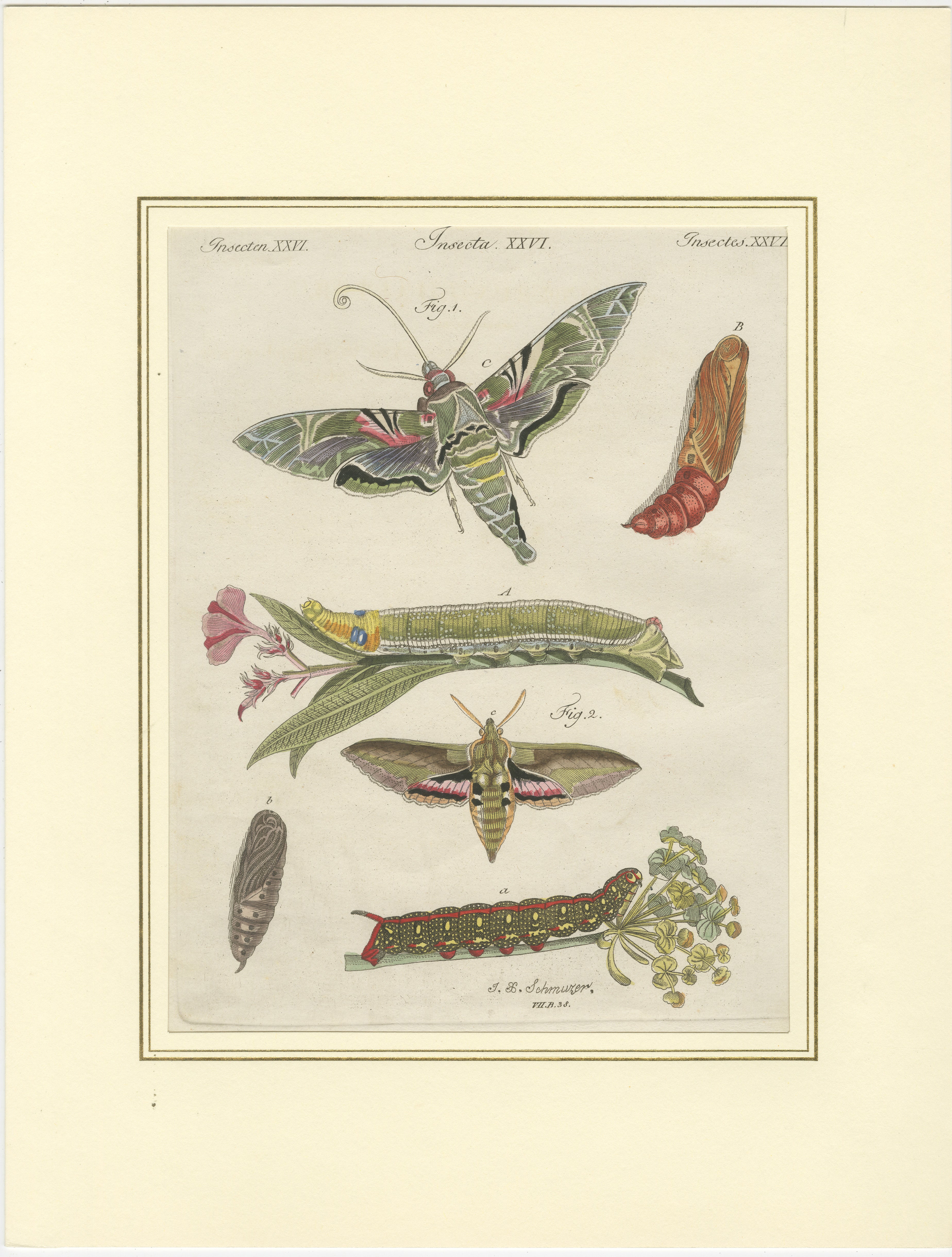
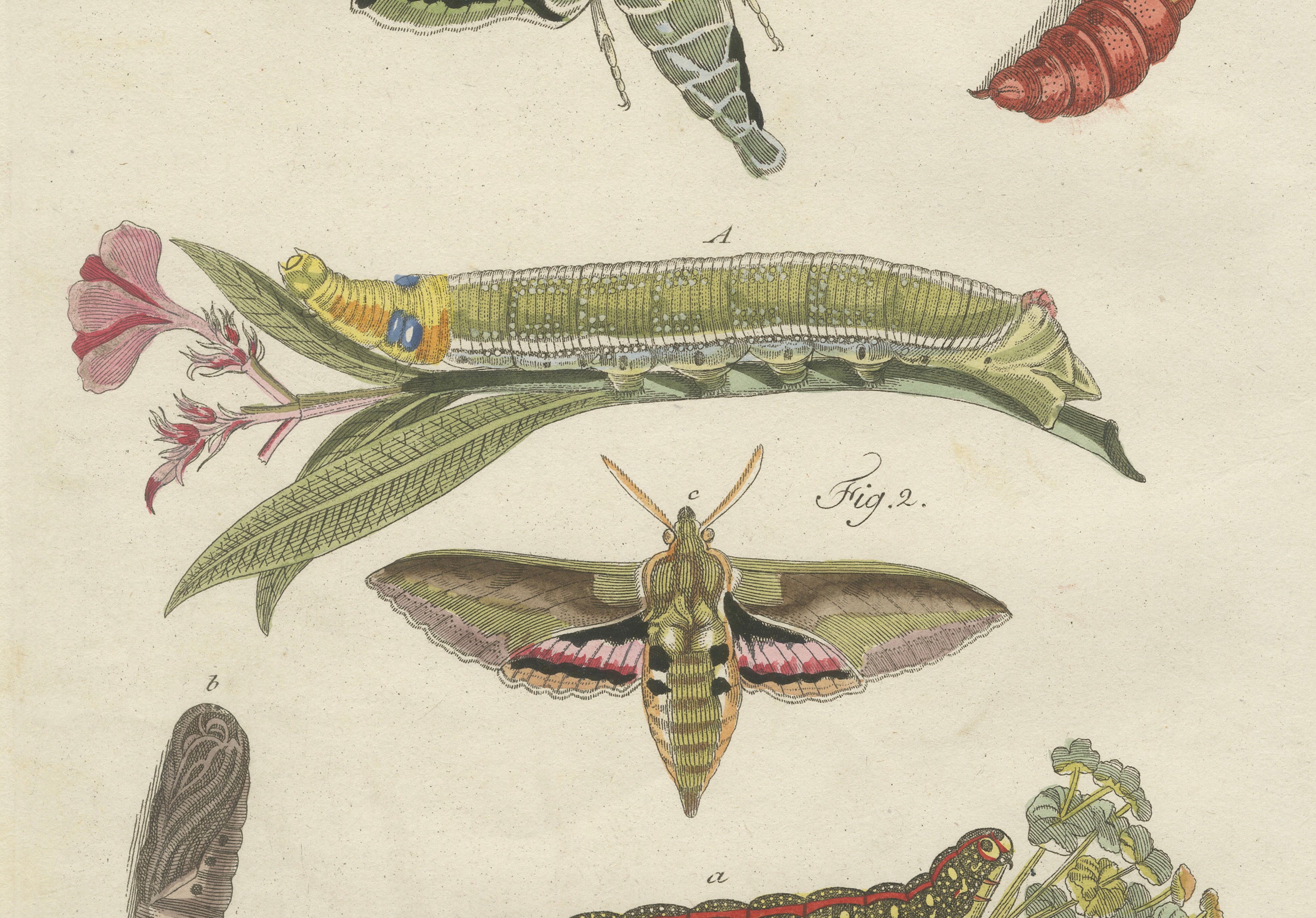
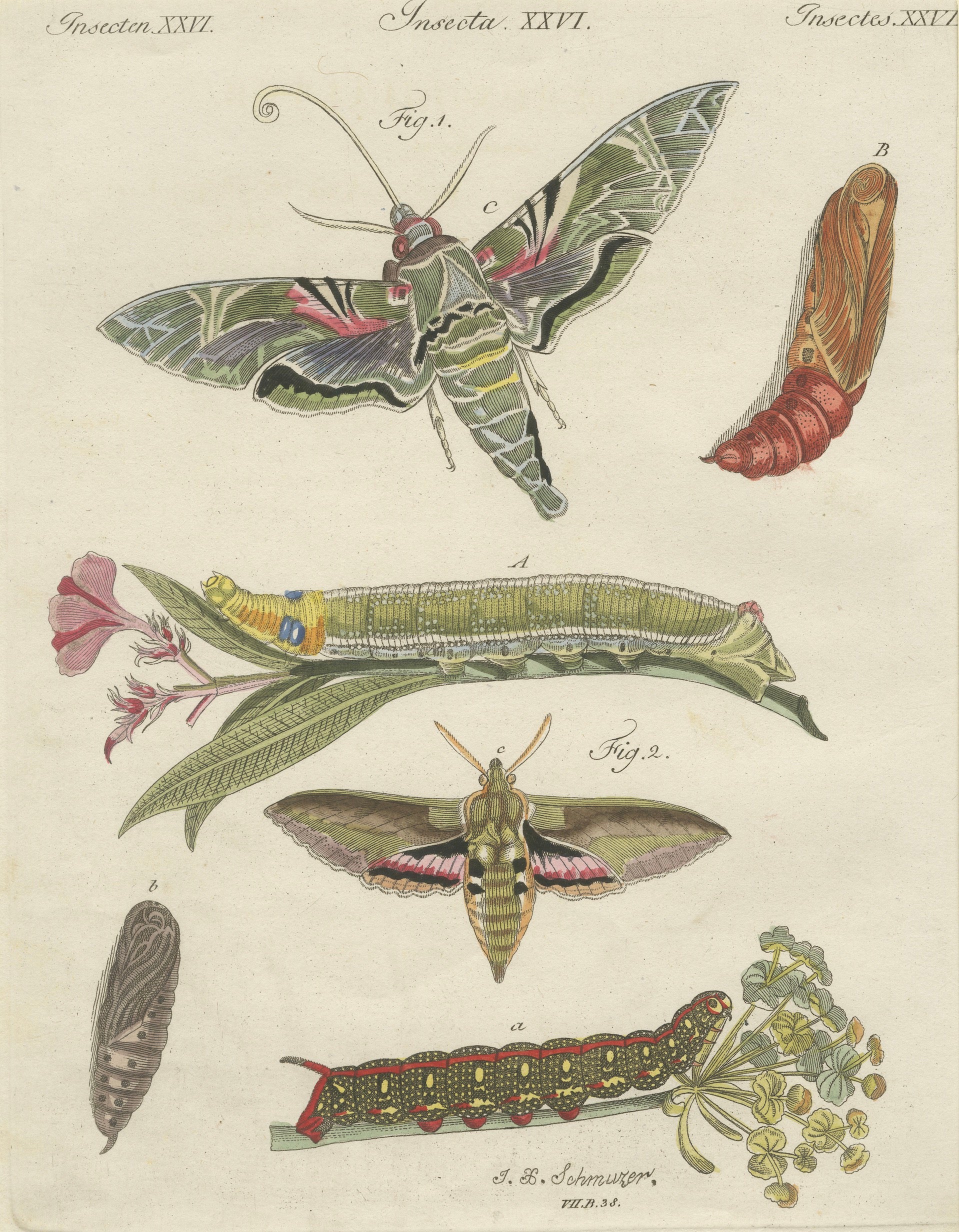
PLATE 1 – INSECTEN XXVI
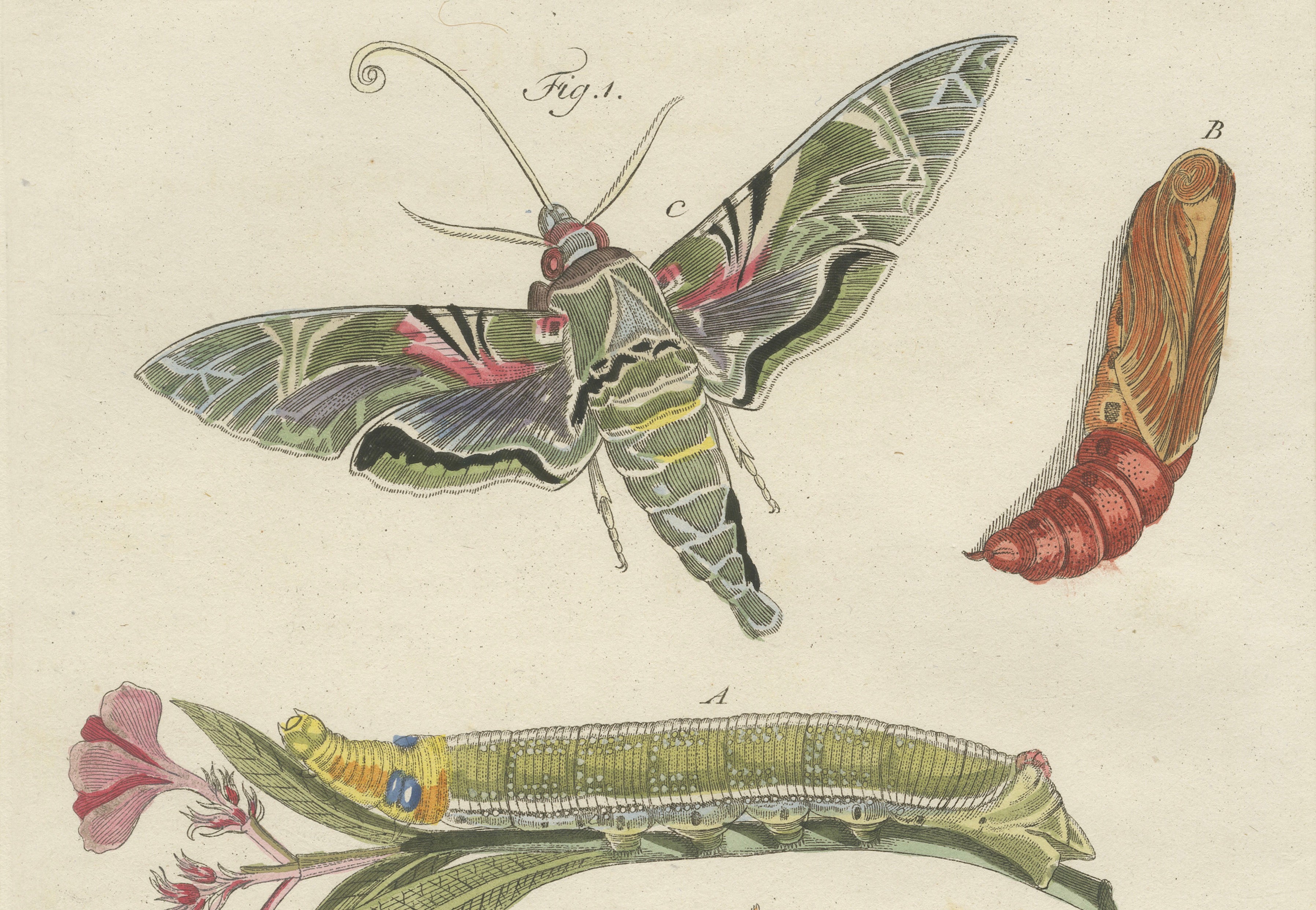
The first plate depicts two beautifully colored hawk or sphinx moths together with their caterpillars and pupae.
Fig. 1 – Large Green Hawk Moth / Sphinx Moth
A spectacular green, pink, black and cream moth is shown with its wings fully extended. The streamlined body, long forewings and powerful appearance are characteristic of the hawk moth family, Sphingidae.
Below the adult moth is its large green caterpillar feeding on a flowering plant, together with the reddish-brown pupa or chrysalis from which the adult moth eventually emerges.
Fig. 2 – Hawk Moth / Sphinx Moth
The second moth is depicted with long swept-back wings and delicate pink markings.
Its life cycle is again represented by a large, dramatically colored caterpillar and a separate dark pupa.
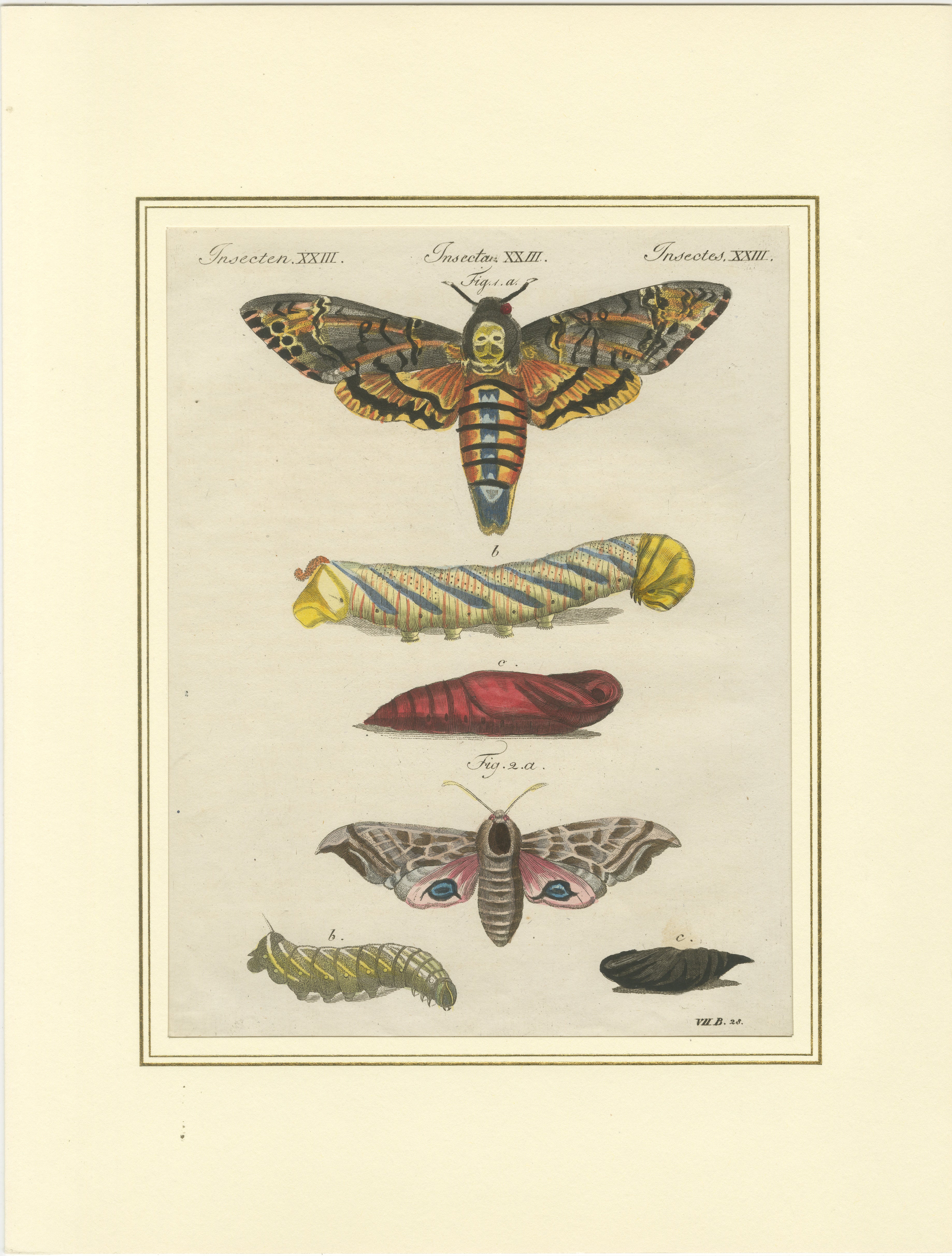
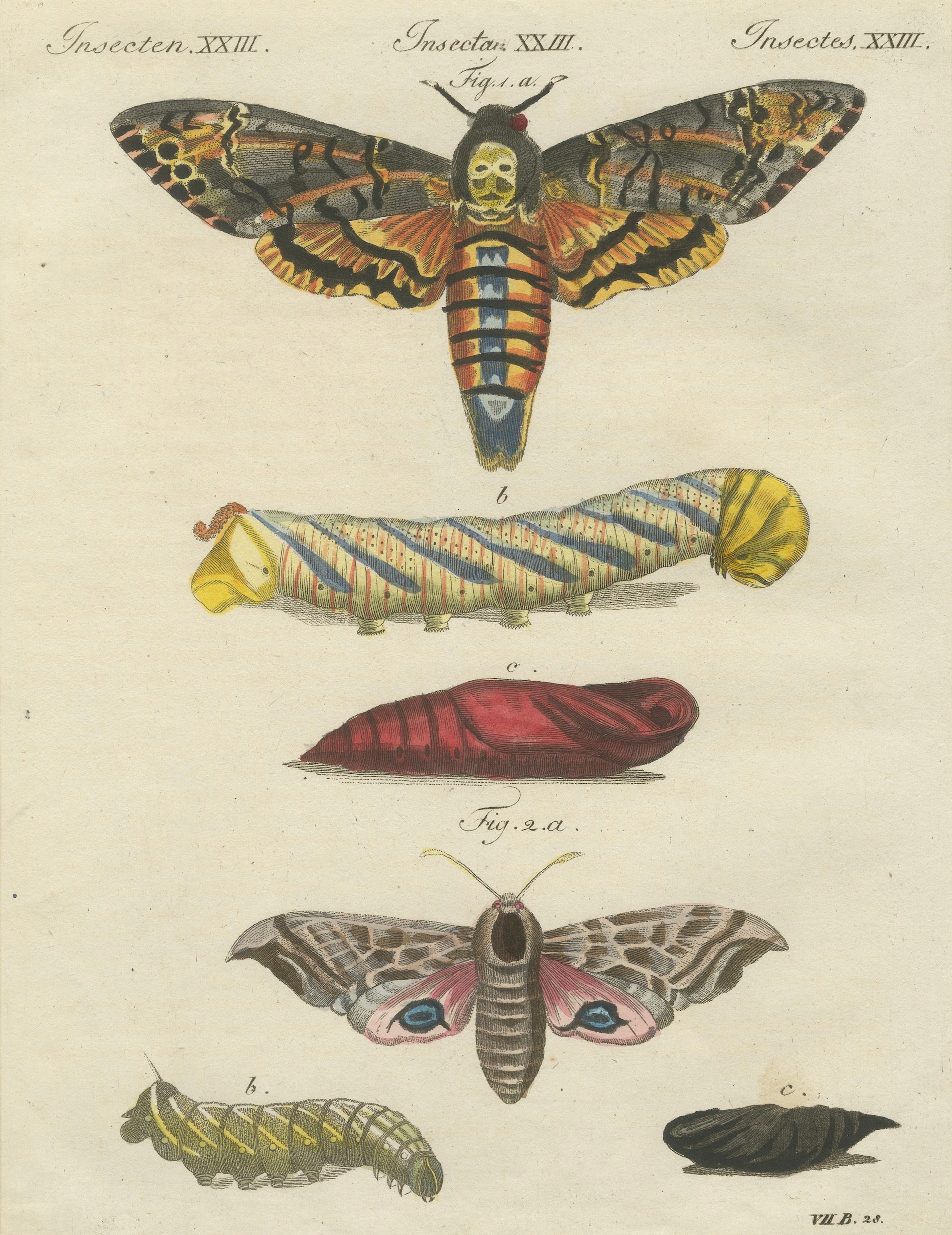
PLATE 2 – INSECTEN XXIII
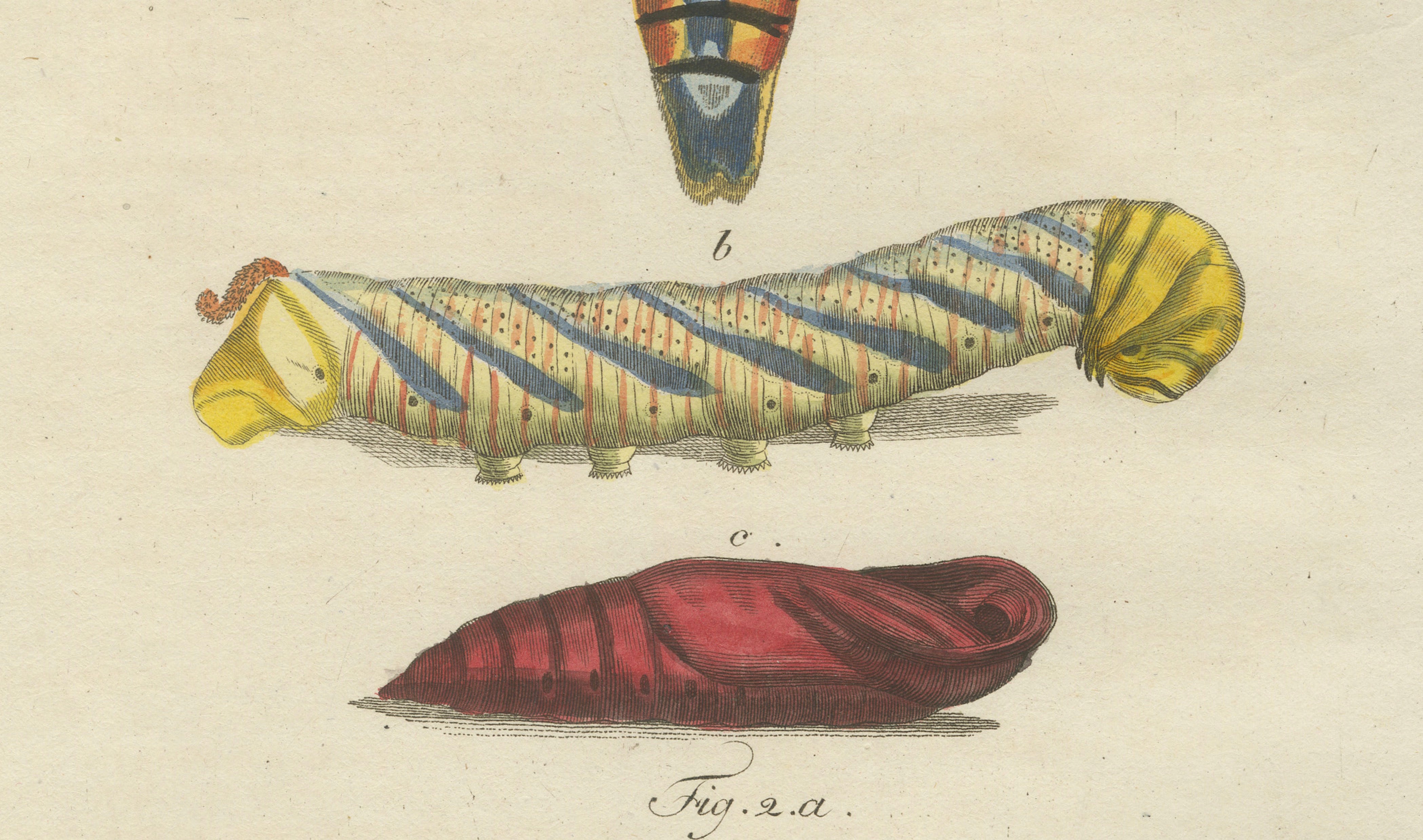
The companion engraving presents two further impressive hawk moths together with their caterpillars and pupae.
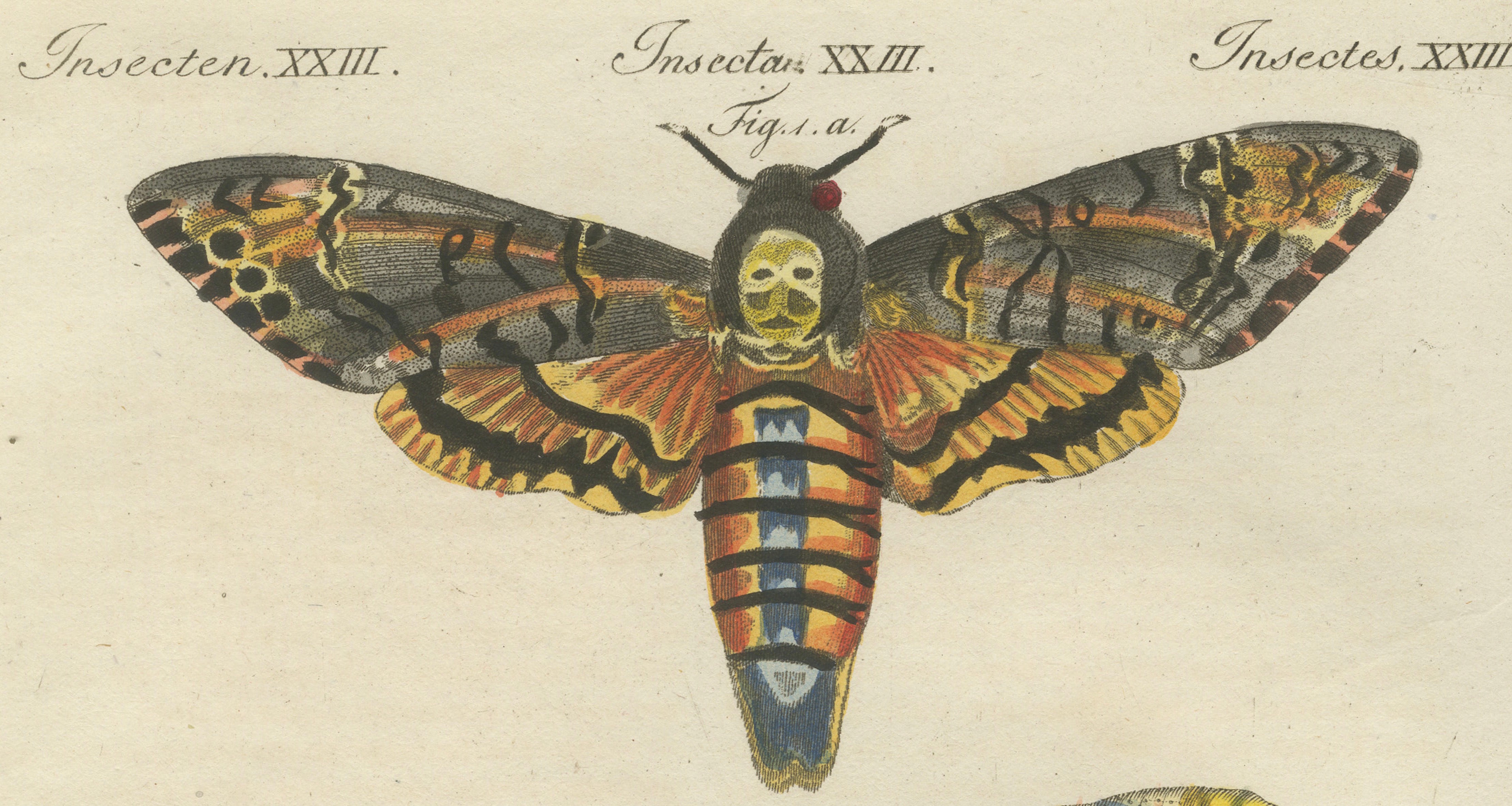
Fig. 1 – Death’s-Head Hawk Moth Type
The magnificent upper moth is immediately striking for the skull-like marking on its thorax.
This characteristic feature is famously associated with the Death’s-Head Hawk Moths of the genus Acherontia, among the most recognizable moths in European natural history.
The moth is shown with broad patterned wings in black, ochre, orange and yellow and a strongly banded abdomen.
Below it are the corresponding large caterpillar and deep reddish-brown pupa.
The Death’s-Head Hawk Moth became surrounded by folklore because the marking on its thorax resembles a human skull. Its unusual appearance made it a particularly memorable subject for early natural-history illustrators and collectors.
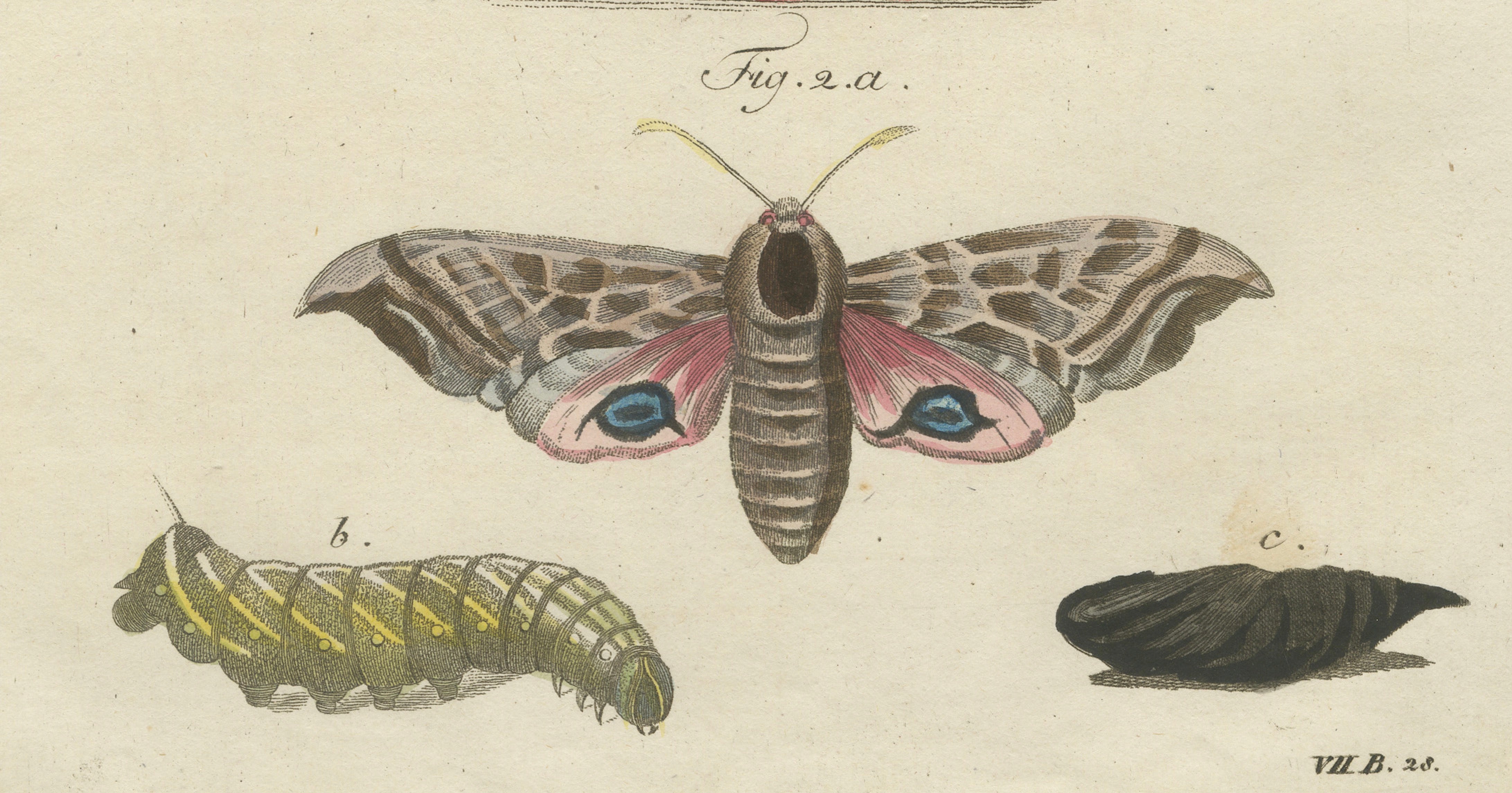
Fig. 2 – Eyed Hawk Moth Type
The lower moth displays spectacular blue-and-black eye-like markings against pink hindwings.
These false “eyes” can be suddenly revealed when the moth is disturbed and may help startle or confuse potential predators.
Its green caterpillar and dark pupa are illustrated separately below the adult.
HAWK MOTHS / SPHINX MOTHS
Hawk moths belong to the family Sphingidae and are among the most impressive moths in the world.
They are known for their powerful bodies, narrow aerodynamic wings and exceptionally fast flight. Many species hover in front of flowers while feeding on nectar with a long proboscis, giving them an almost hummingbird-like appearance.
Their caterpillars are equally distinctive. Many possess a characteristic horn or projection at the rear of the body, which gave rise to the traditional name “hornworm.”
THE LIFE CYCLE
These plates are particularly interesting because Bertuch does not simply illustrate the adult moths.
The caterpillar, pupa and adult stages are shown together, allowing the viewer to understand the extraordinary process of complete metamorphosis.
The caterpillar feeds and grows before transforming into a pupa. Inside this apparently inactive structure, the insect undergoes a remarkable transformation before emerging as the fully winged adult moth.
For readers around 1800, illustrations such as these provided an accessible introduction to one of the most fascinating processes in natural history.
FRIEDRICH JUSTIN BERTUCH
Friedrich Justin Bertuch (1747–1822) was a German publisher, writer and patron of the arts. His monumental “Bilderbuch für Kinder” (Picture Book for Children), first published in Weimar in 1790, became one of the great illustrated educational encyclopedias of the late 18th and early 19th centuries.
Its hundreds of engraved and hand-colored plates introduced readers to animals, birds, insects, plants, marine life, geography, science, technology, antiquity and cultures from around the world.
One of the plates bears the engraved signature “J. B. Schmuzer.”
THE SET
These two engravings work particularly well as a pair.
Both use the same educational format of adult moth, caterpillar and pupa, while their strong original colors complement one another beautifully. Greens and pinks dominate one plate, while the companion print introduces dramatic orange, yellow, red, blue and black.
Together they form an unusually decorative and scientifically interesting pair of early entomological prints.
Technique: Original hand-colored copper engravings
Publisher: Friedrich Justin Bertuch / Industrie-Comptoir
Publication: Bilderbuch für...