About this sheet
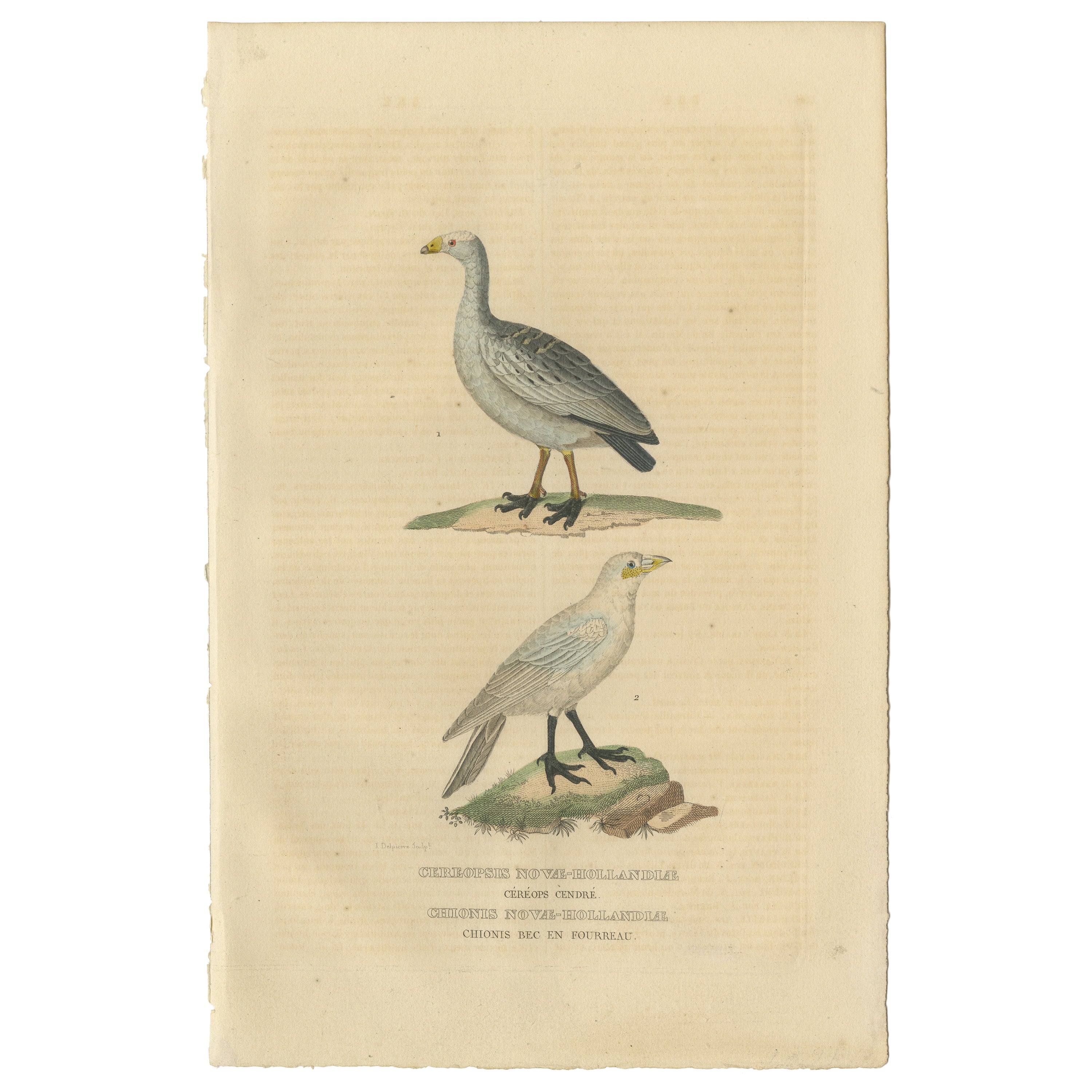
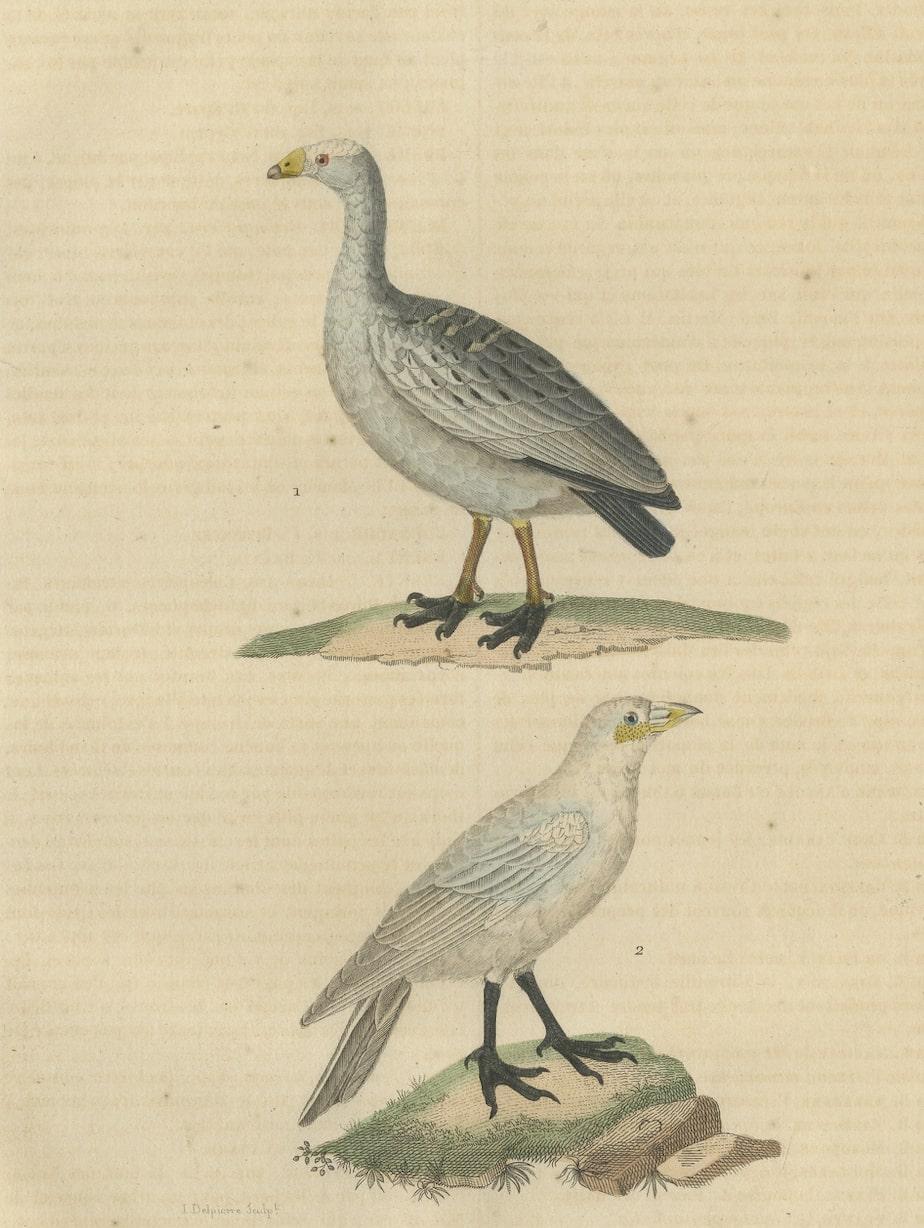
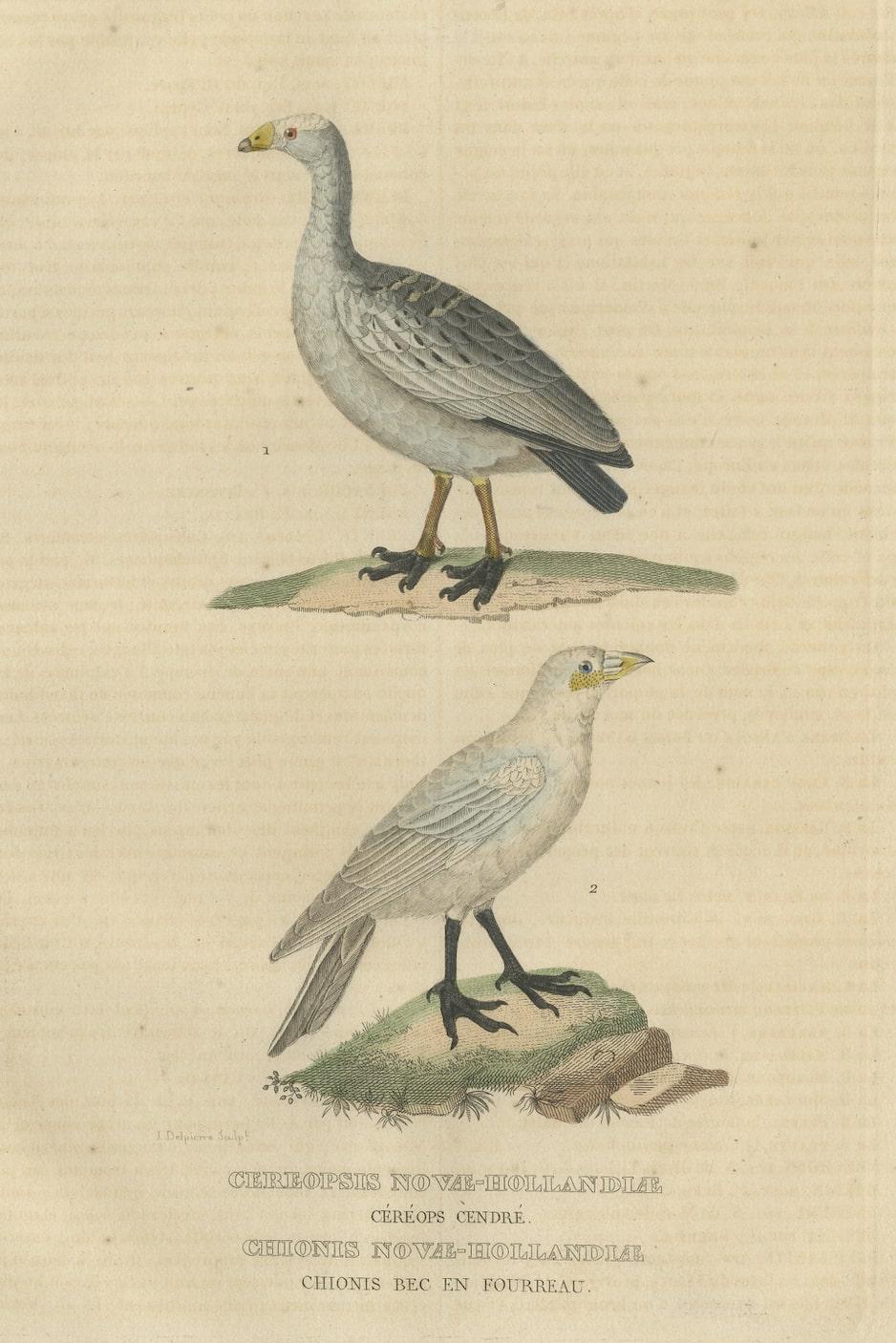
Cape Barren goose, Cereopsis novaehollandiae, and Snowy Sheathbill, Chionis albus. Handcoloured copperplate stipple engraving from Dumont de Sainte-Croix's "Dictionary of Natural Science: Ornithology, " Paris, France, 1816-1830. Illustration by J. G. Pretre, engraved by Massard, directed by Pierre Jean-Francois Turpin, and published by F.G. Levrault. Jean Gabriel Pretre (1780~1845) was painter of natural history at Empress Josephine's zoo and later became artist to the Museum of Natural History. Turpin (1775-1840) is considered one of the greatest French botanical illustrators of the 19th century.
"Cereopsis novaehollandiae" refers to the Cape Barren Goose, a species of goose native to southern Australia, particularly the islands surrounding Tasmania and parts of mainland Australia. These geese are known for their distinct appearance, featuring pale plumage with dark markings and a bright greenish-yellow cere (fleshy area at the base of the bill). The Cape Barren Goose is recognized for its striking appearance and is considered an iconic bird in the regions where it is found.
The Snowy Sheathbill (Chionis alba) is a unique and distinctive bird found in Antarctica and the surrounding islands. It's one of the only bird species that resides exclusively in Antarctica throughout the year. This bird has white plumage, a stout body, and a characteristic pinkish bill with a distinct sheath covering its base. Despite its appearance resembling a gull, the Snowy Sheathbill is not related to gulls and belongs to its own unique family, the Chionidae. It's often found scavenging for food along the icy coastlines and is considered an integral part of the Antarctic ecosystem.
Made by F.J. Desmares after Pierre Auguste Joseph Drapiez (1778-1856).
Engraving with original hand colouring, heightened with arabic gum on wove (vellin) paper.
More info on the book in which it was published:
The 'Dictionnaire Classique des Sciences Naturelles' by Pierre Auguste Joseph Drapiez stands as a remarkable testament to 19th-century natural sciences. Published in Brussels in 1845, this work represents an expansive collation of knowledge, building upon the pioneering works of Buffon, Daubenton, Lacepede, Cuvier, de Jussieu, and other influential naturalists.
The prints within this compendium likely showcase a rich amalgamation of artistic precision and scientific accuracy. Drapiez, himself a Belgian naturalist, would have aimed for detailed representations of flora, fauna, and scientific phenomena, mirroring the illustrative styles prevalent during his time. Given the era's emphasis on illustration, these prints were likely engraved meticulously, possibly portraying intricate anatomical details or lifelike depictions of the natural world.
With Drapiez's background in natural history, the prints might bear testament to his commitment to scientific authenticity, aiming to educate and inspire scholars and enthusiasts alike. These engravings would have complemented the text, offering visual aids that elucidate the concepts and specimens discussed in the volume.
Overall, the prints of 'Dictionnaire Classique des Sciences Naturelles' likely serve as both artistic representations and invaluable scientific resources, encapsulating the essence of 19th-century natural history exploration and documentation.