About this sheet
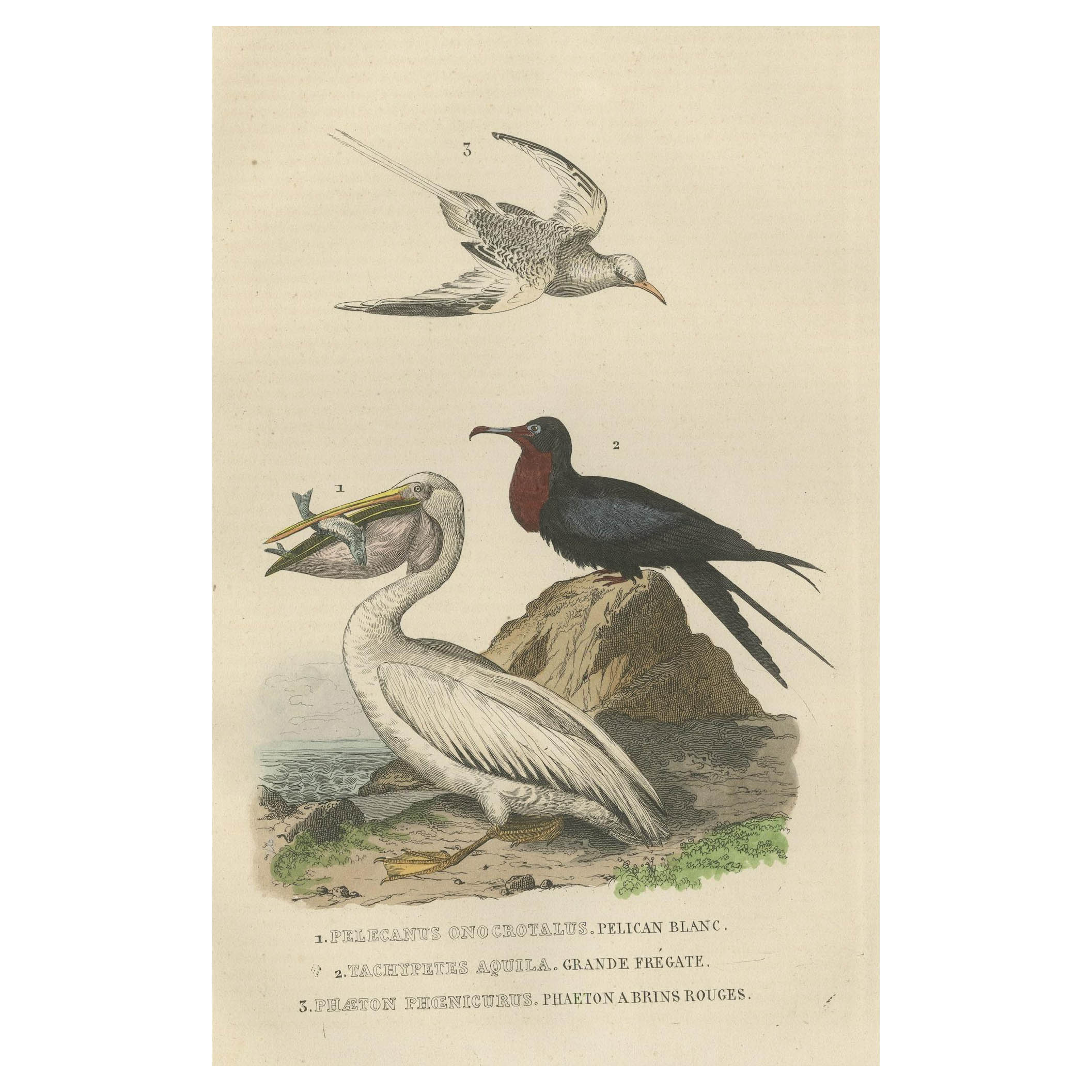
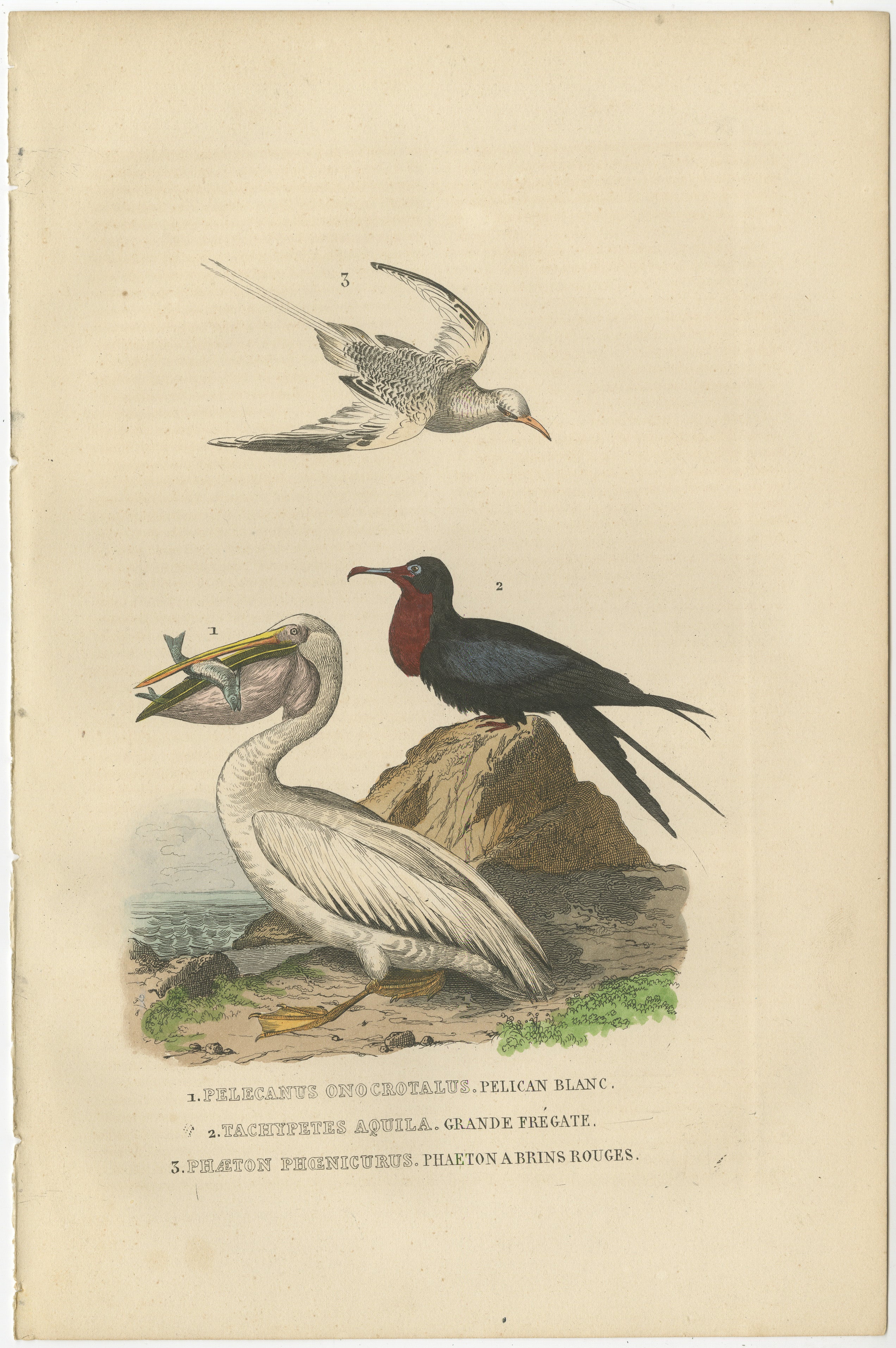
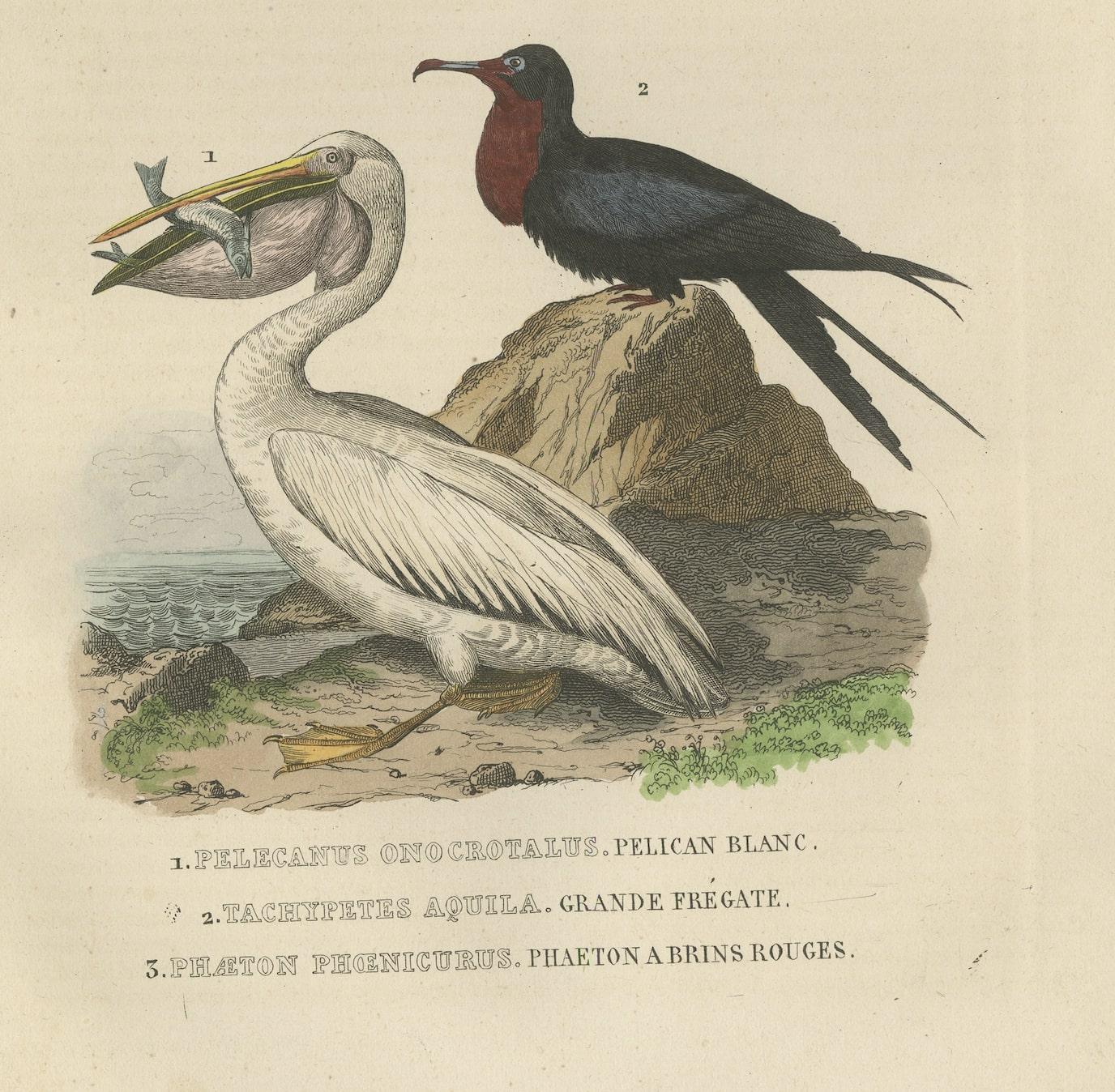
1. PELECANUS ONOCROTALUS – PELICAN BLANC, 2. TACHYPETES AQUILA – GRANDE FREGATE, 3. PHAETON PHOENICURUS – PHEATON A BRINS ROUGES.
Translated: – 1. Great White Pelican, Eastern White Pelican, White Pelican, 2. Great Frigate Bird, 3. Red-Tailed Tropicbird.
The Great White Pelican, also known as the Eastern White Pelican, or simply the White Pelican, commands attention with its massive wingspan and conspicuous, snow-white plumage. This majestic bird, a symbol of grace, employs its impressive pouch to scoop fish from the water in synchronized fishing formations. Often found in large colonies, their communal behavior during feeding and nesting is a sight to behold.
The Great Frigate Bird, a master of aerial maneuvers, boasts a sleek silhouette and expansive wings, dominating the skies with effortless gliding and precise dives. Its striking black plumage contrasts with a vibrant red gular sac, inflated during courtship displays, adding drama to its courtship rituals.
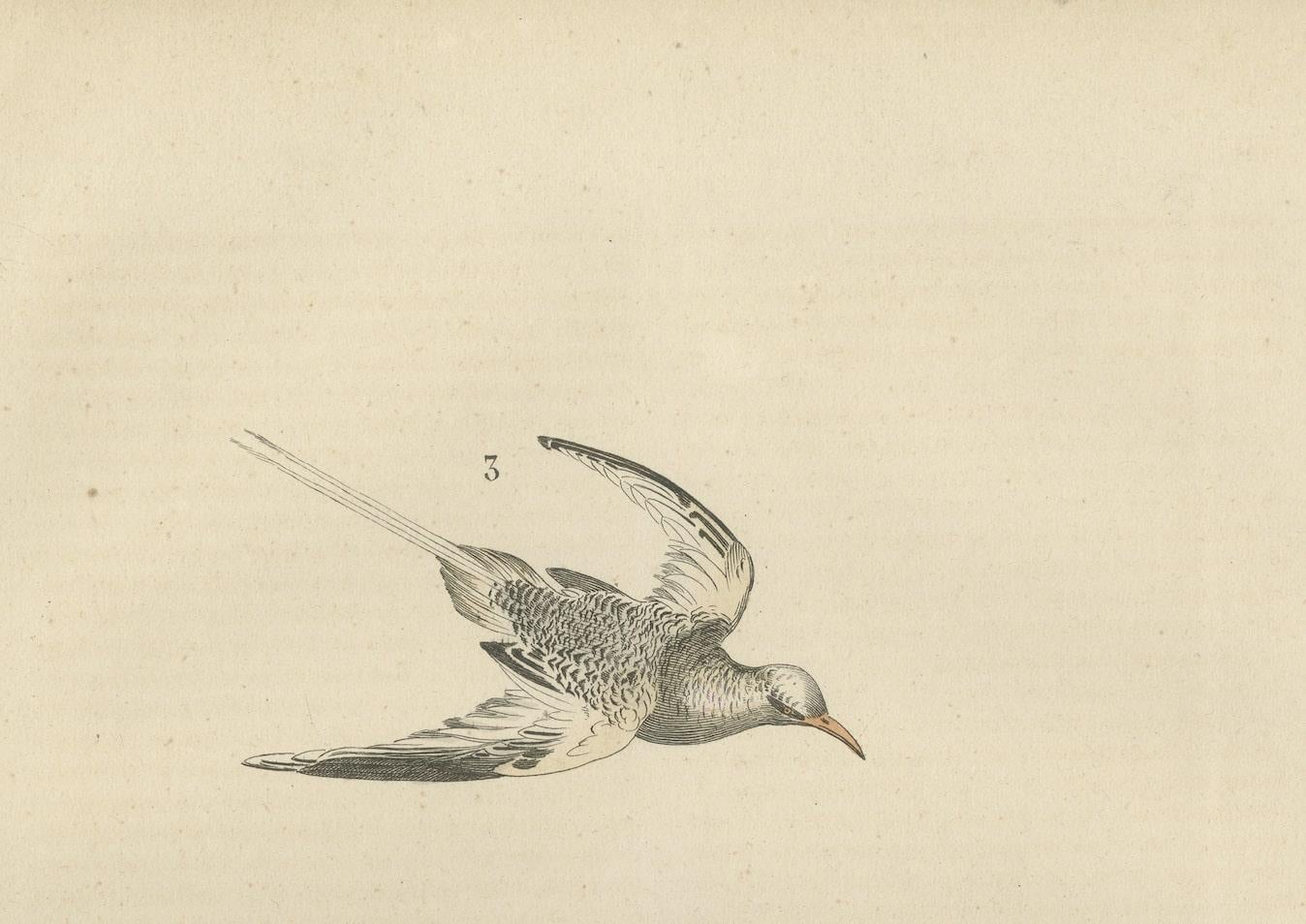
The Red-Tailed Tropicbird, an emblem of tropical skies, exhibits resplendent white plumage and elongated tail feathers, culminating in fiery crimson hues. Its aerial agility and enchanting flight patterns evoke a sense of ethereal beauty, gracefully cruising above azure waters in search of prey.
More info on the book in which it was published:
The 'Dictionnaire Classique des Sciences Naturelles' by Pierre Auguste Joseph Drapiez stands as a remarkable testament to 19th-century natural sciences. Published in Brussels in 1845, this work represents an expansive collation of knowledge, building upon the pioneering works of Buffon, Daubenton, Lacepede, Cuvier, de Jussieu, and other influential naturalists.
The prints within this compendium likely showcase a rich amalgamation of artistic precision and scientific accuracy. Drapiez, himself a Belgian naturalist, would have aimed for detailed representations of flora, fauna, and scientific phenomena, mirroring the illustrative styles prevalent during his time. Given the era's emphasis on illustration, these prints were likely engraved meticulously, possibly portraying intricate anatomical details or lifelike depictions of the natural world.
With Drapiez's background in natural history, the prints might bear testament to his commitment to scientific authenticity, aiming to educate and inspire scholars and enthusiasts alike. These engravings would have complemented the text, offering visual aids that elucidate the concepts and specimens discussed in the volume.
Overall, the prints of 'Dictionnaire Classique des Sciences Naturelles' likely serve as both artistic representations and invaluable scientific resources, encapsulating the essence of 19th-century natural history exploration and documentation.