About this sheet
Mirlo, Mirlo Pintado, Mirlo Blanco – Antique Bird Engraving, c. 1860
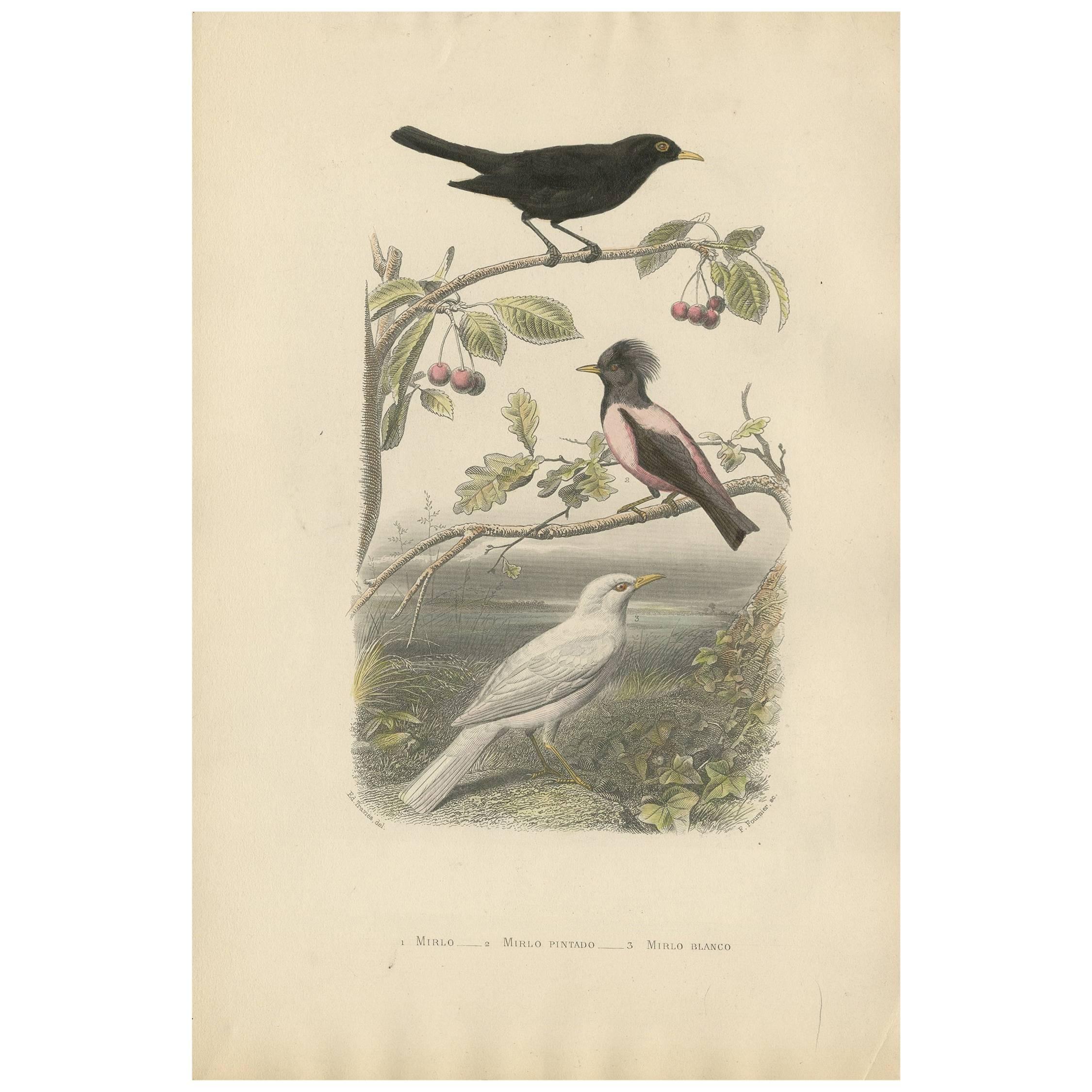
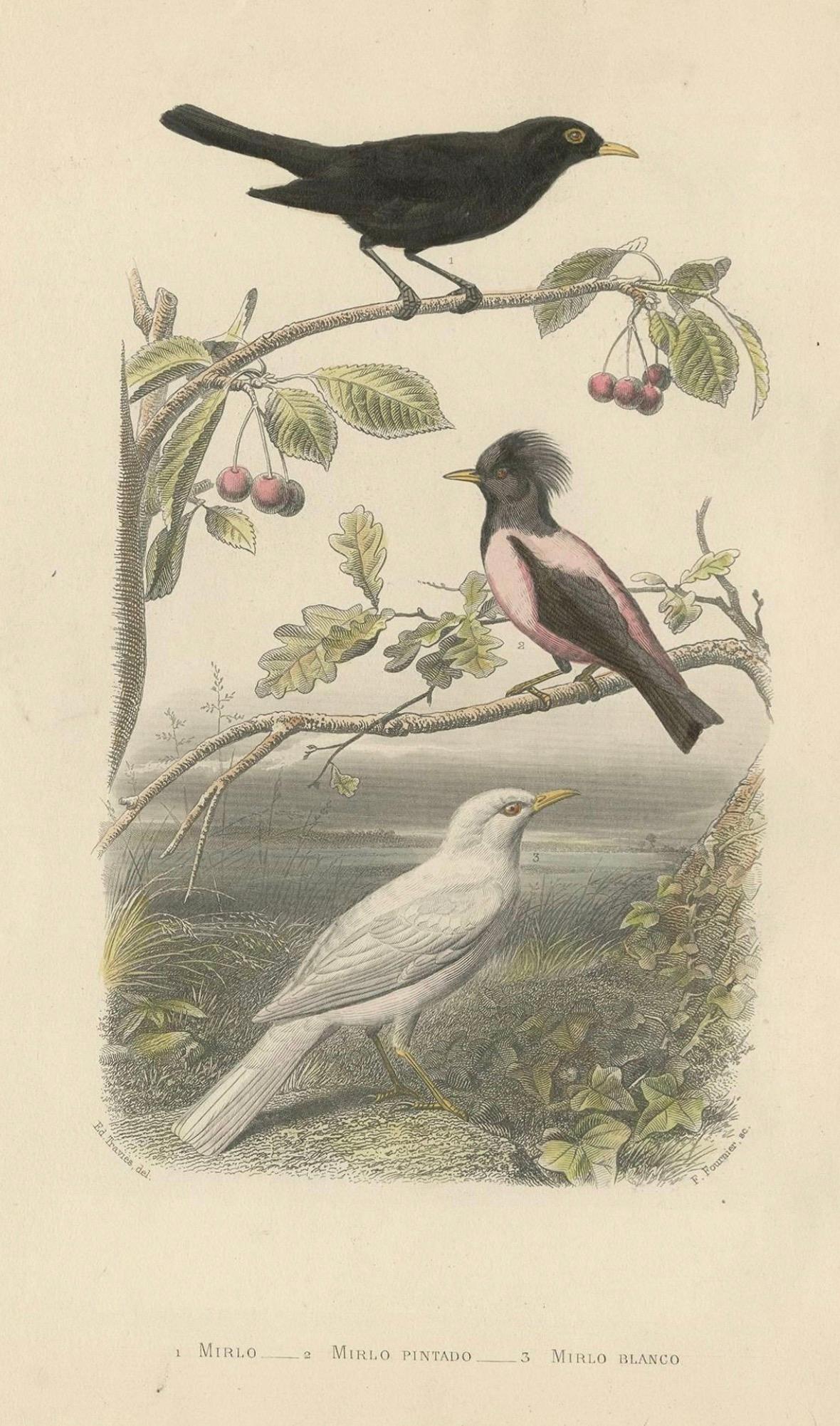
This attractive 19th-century bird engraving depicts three variations of thrush-like birds arranged in a vertical, decorative composition within a natural landscape. The plate is titled “1. Mirlo, 2. Mirlo Pintado, 3. Mirlo Blanco” and presents a comparative study that combines natural history observation with strong visual appeal.
At the top is the Common Blackbird (Mirlo), shown perched on a fruiting branch, identifiable by its deep black plumage and yellow bill. The central bird is the Rosy Starling (Mirlo Pintado), distinguished by its contrasting dark head and wings with pale rosy body, depicted resting calmly among foliage. At the bottom stands the Albino Blackbird (Mirlo Blanco), rendered in pale tones with subtle shading that emphasizes its unusual coloration while maintaining anatomical clarity. Together, the three birds illustrate natural variation within related species, a subject that fascinated 19th-century naturalists and illustrators alike.
The engraving was executed by F. Fournier, whose name appears in the plate. Fournier’s engraving technique is precise and delicate, with fine line work that captures feather texture, foliage, and landscape depth. The image was likely produced for an educational or zoological publication intended to both inform and delight, reflecting the period’s growing interest in ornithology and visual taxonomy.
The hand-applied coloring is soft and well-balanced, enhancing the birds without overpowering the composition. The surrounding vegetation and distant background provide a gentle sense of place, while the ample margins and centered image give the print an elegant, refined presence. This engraving works beautifully as a standalone decorative piece and also lends itself well to pairing with other 19th-century natural history prints.
Condition:
Good condition. Light age-related toning to the paper, consistent with mid-19th-century prints. Minor scattered spots and faint handling marks, mainly in the margins. The image remains fresh and clear, with well-preserved color. No major tears or losses observed.
Framing tips:
This print is well suited to a classic presentation with a warm wood or dark walnut frame and an off-white or light ivory mat to highlight the softness of the colors. For a more contemporary interior, a slim black frame with a neutral mat will create contrast and allow the birds to stand out while maintaining a refined, gallery-style look.
Technique: Engraving with original hand color
Maker: Engraved by F. Fournier, France, circa 1860