About this sheet
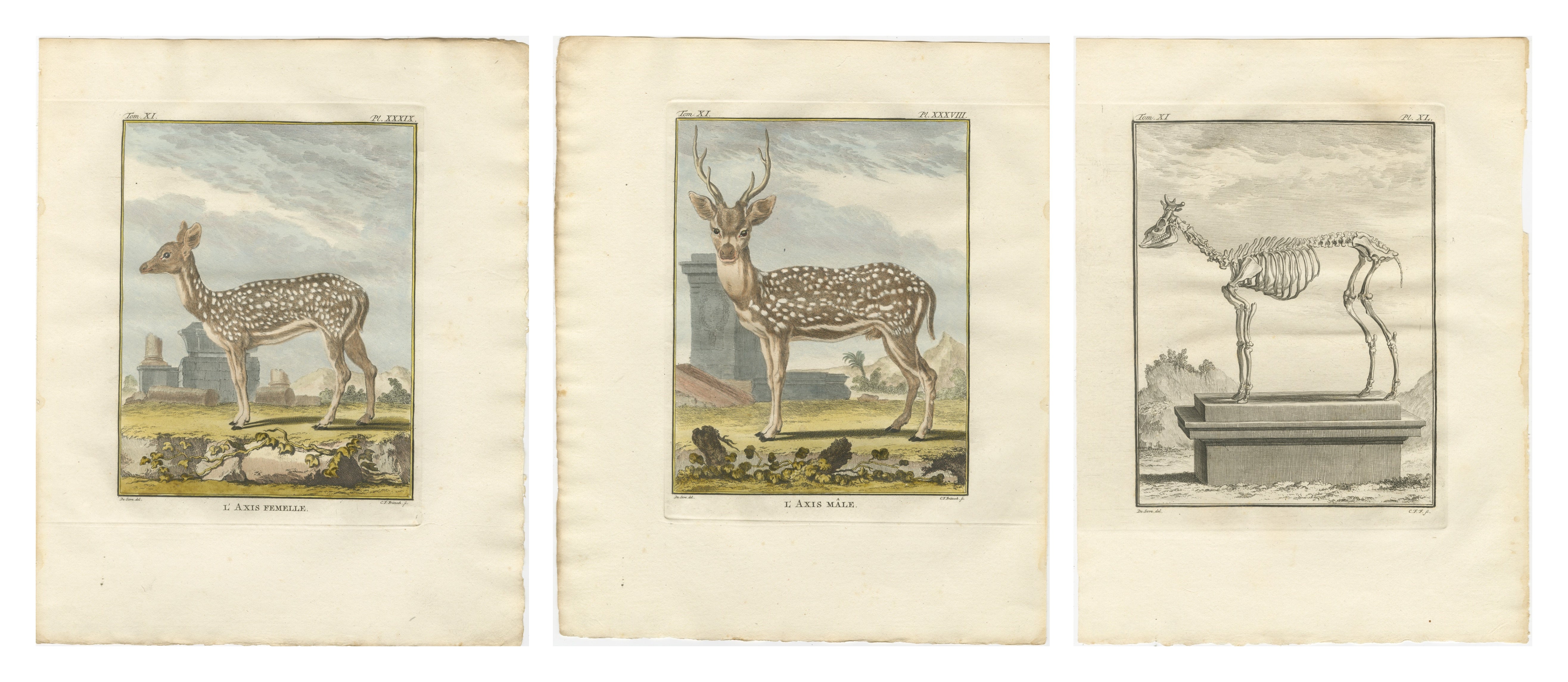
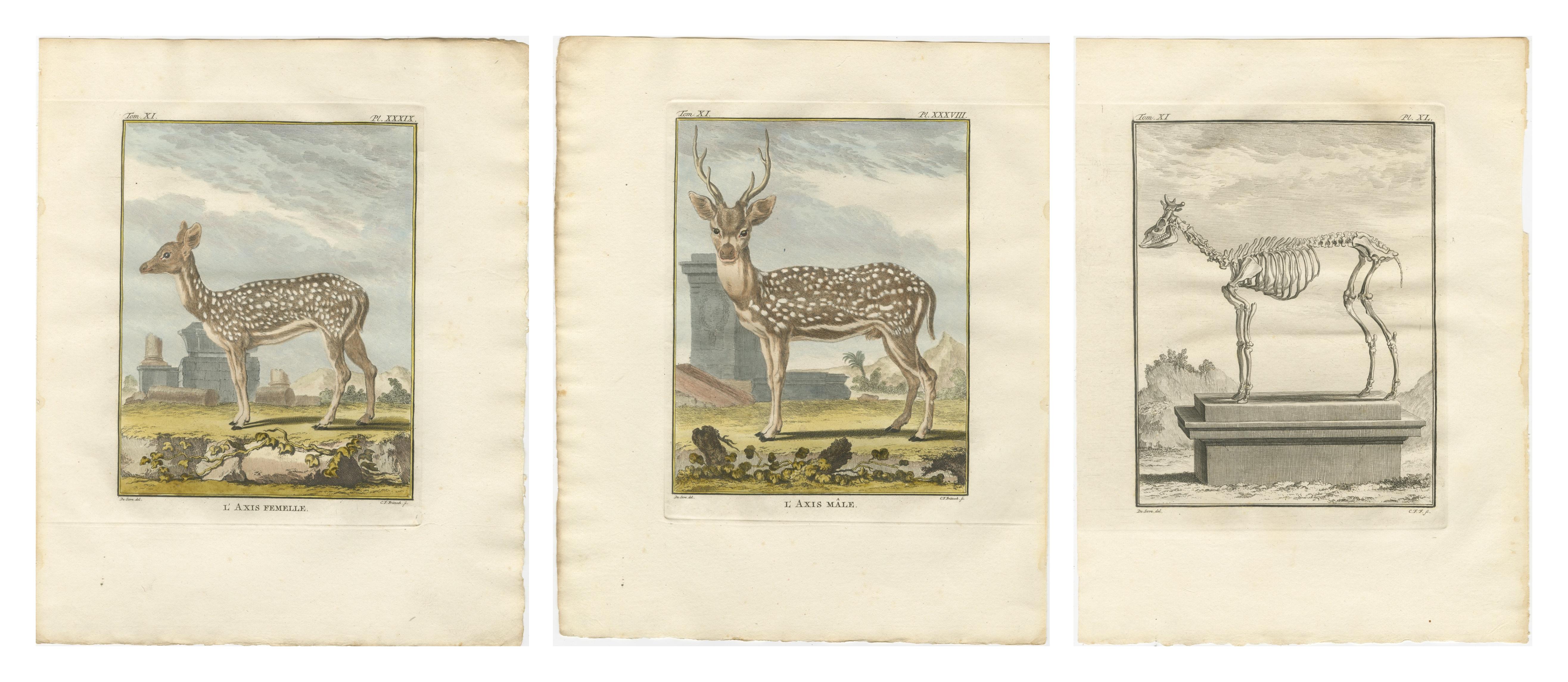
Buffon Axis Deer Prints Set of 3 – Male Female & Skeleton, 1775
A striking set of three eighteenth-century natural history engravings depicting the Axis Deer (Chital), including the male, female, and a detailed anatomical skeleton. The prints originate from the Dutch edition of the monumental scientific work Histoire Naturelle by the French naturalist Georges-Louis Leclerc, Comte de Buffon, published in Amsterdam by J.H. Schneider around 1775.
Buffon’s Histoire Naturelle was one of the most ambitious scientific publishing projects of the Enlightenment. First issued in Paris beginning in 1749, the series sought to describe and classify the entire natural world. The work became famous not only for its scientific importance but also for its exceptional illustrations, which combined careful observation with elegant artistic composition. Buffon believed that accurate images were essential for understanding animals and insisted on the highest standards for the plates that accompanied the text.
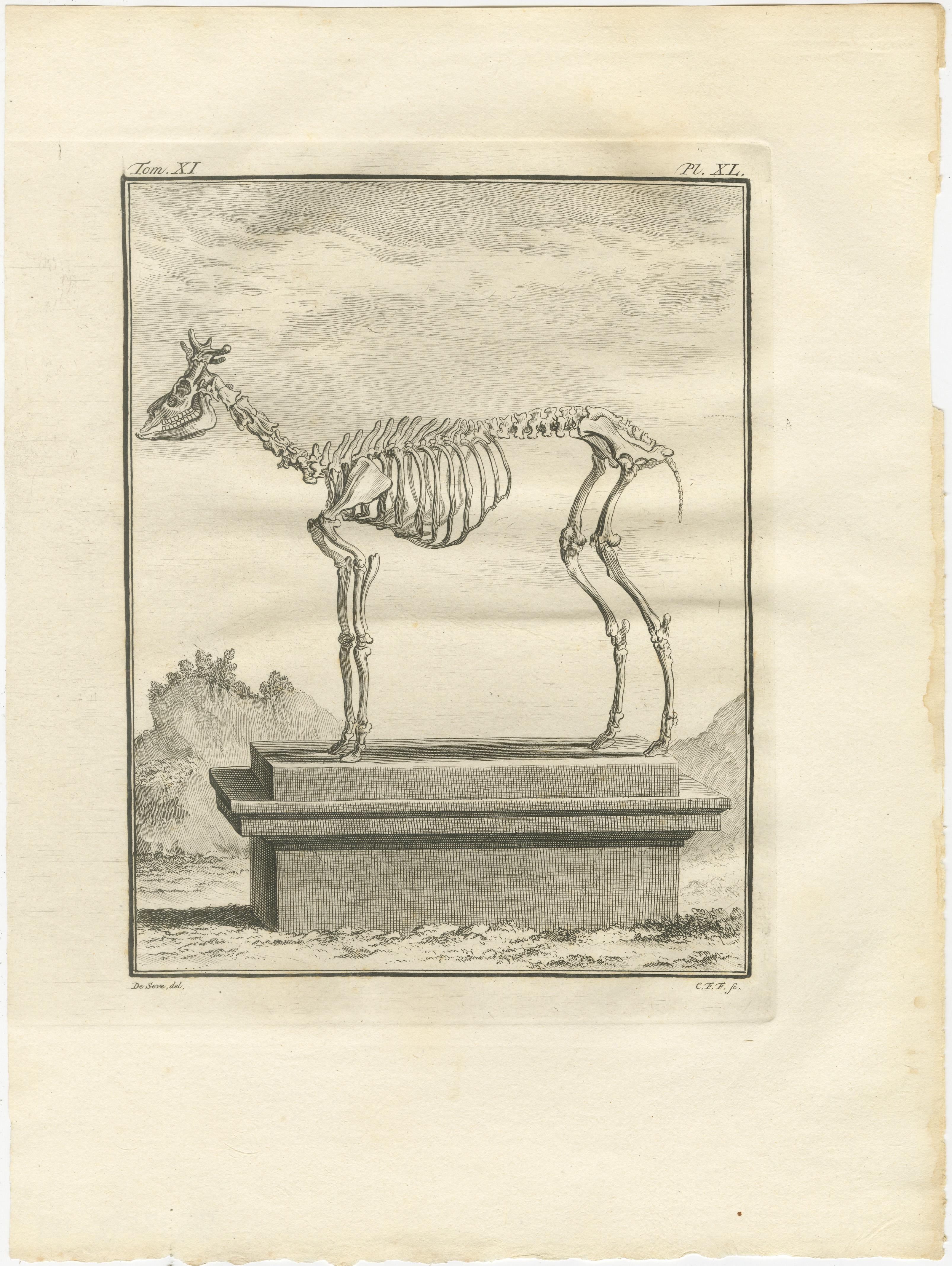
These engravings were drawn by the noted French illustrator Jacques de Sève, whose signature appears on the plates as “De Seve del.” The abbreviation del. derives from the Latin delineavit, meaning “he drew it,” identifying him as the artist responsible for the original design. De Sève was one of Buffon’s principal illustrators and produced many of the most recognizable zoological images of the eighteenth century.
The plates were engraved by Christian Friedrich Fritzsch, a German-born engraver whose name appears as “C.F. Fritzsch sc.” or fecit. These Latin abbreviations indicate that he transferred the artist’s drawing to a copper plate for printing. Fritzsch’s involvement is characteristic of the Amsterdam edition of Buffon’s work, distinguishing these impressions from the earlier Paris printings, which were engraved by French craftsmen.
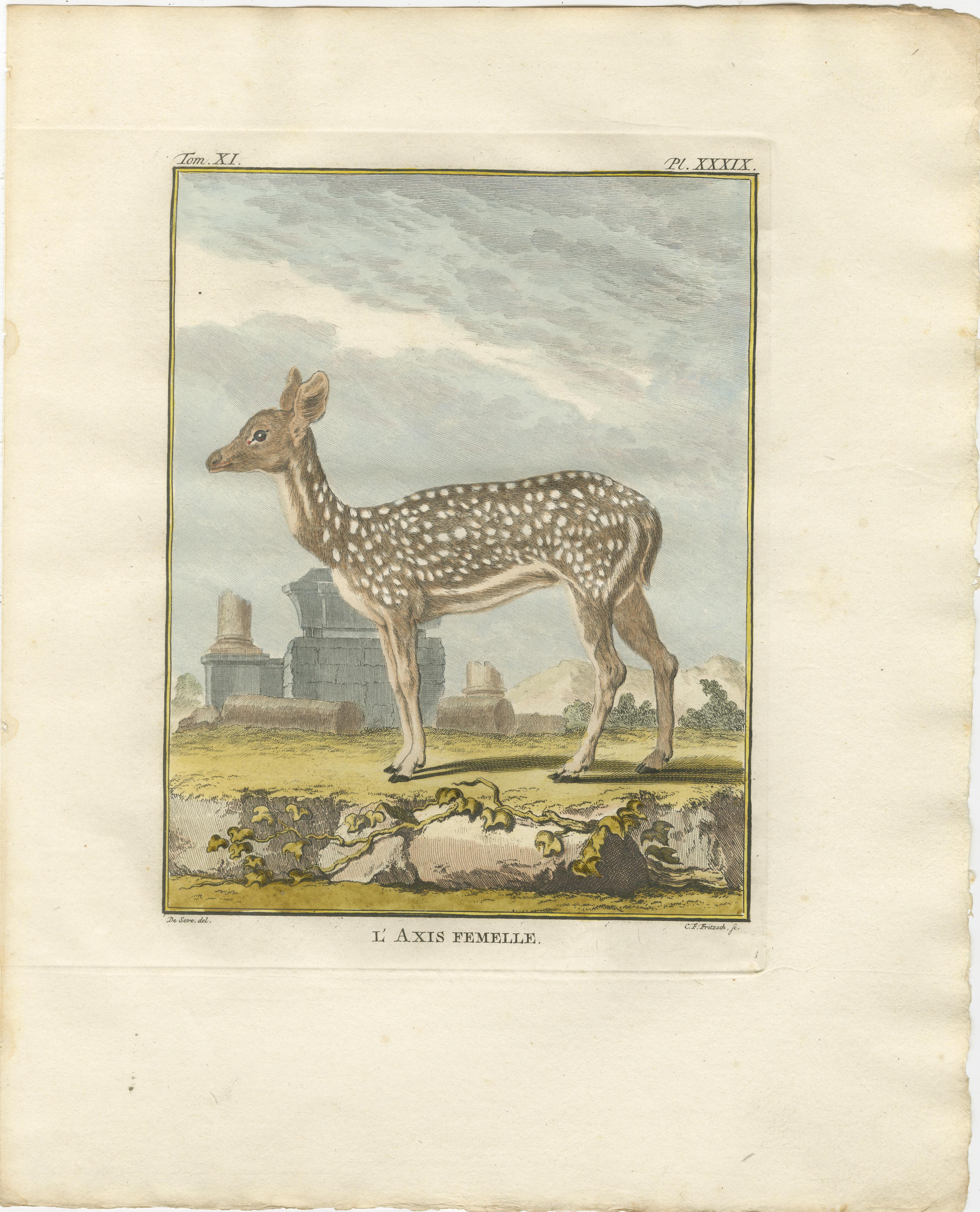
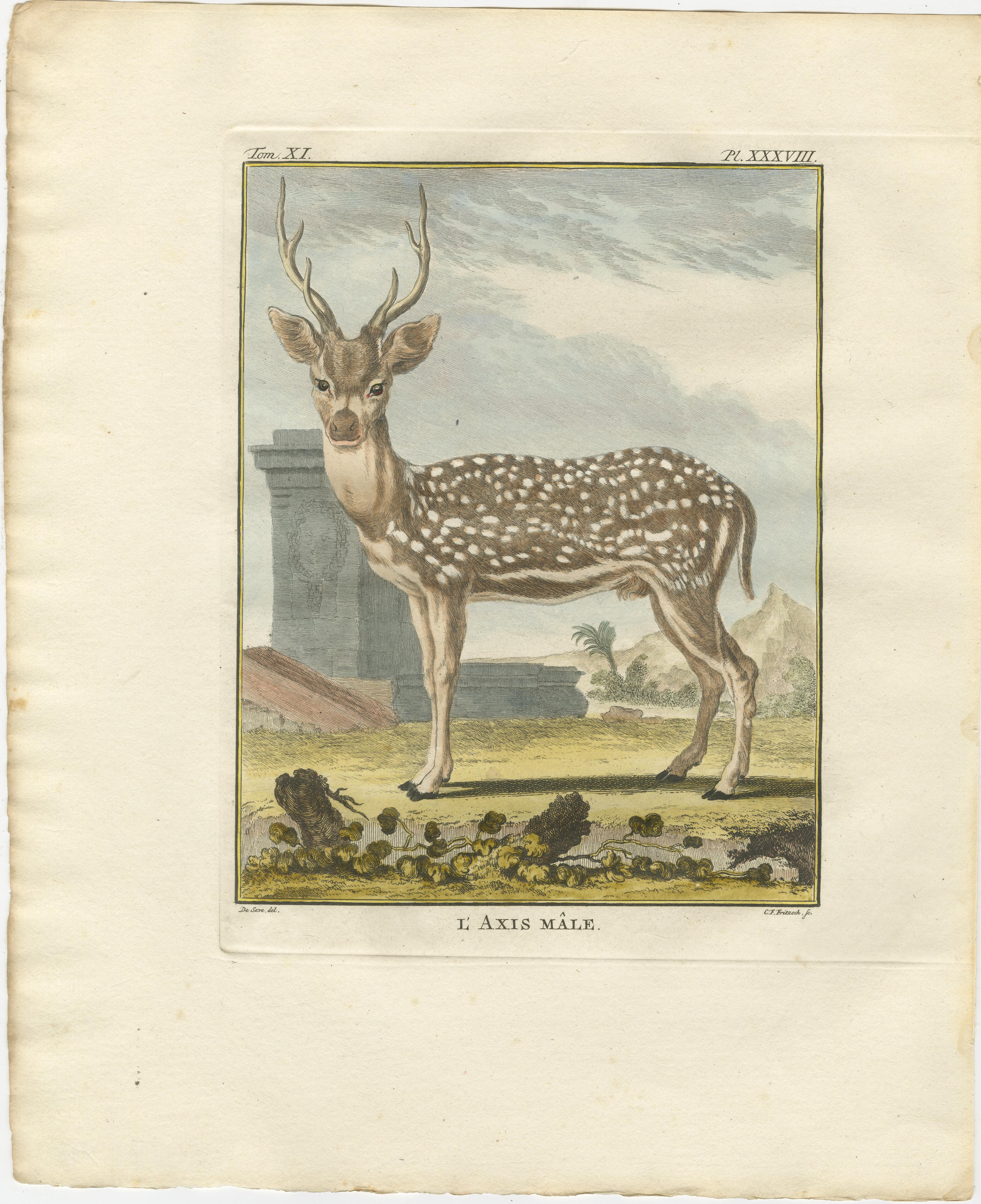
Two of the plates depict the Axis Deer itself: the female (L’Axis Femelle) and the male (L’Axis Mâle). The species, native to the Indian subcontinent, is known for its elegant proportions and distinctive white-spotted coat. In keeping with the visual language of eighteenth-century natural history illustration, the animals are presented within softly rendered landscapes featuring classical ruins and distant scenery.
The third plate illustrates the skeletal structure of the animal, presented as a scientific study on a pedestal. Such anatomical plates were an essential component of Enlightenment natural history, reflecting the period’s fascination with comparative anatomy and the systematic classification of species.
Together the three engravings form a compelling narrative set, combining naturalistic portraiture with scientific investigation. Displayed as a group, they present the animal in life and in structure, making the set both visually elegant and intellectually engaging. Buffon plates remain among the most admired natural history engravings of the eighteenth century and are highly sought after by collectors, designers, and scholars of early scientific illustration.
Condition:
Good antique condition with age-appropriate toning and occasional light spotting to the margins. Minor edge wear consistent with eighteenth-century paper. Plate impressions visible. The two zoological plates retain attractive original hand coloring. The skeletal plate is printed in black ink as issued.
Framing tips:
This set displays beautifully as a horizontal trio. Dark walnut or ebonized frames combined with generous ivory or museum-white mats create a refined gallery presentation and highlight the delicate engraving and original hand coloring.
Technique: Copperplate engraving with original hand coloring
Maker: Jacques de Sève (designer) and Christian Friedrich Fritzsch (engraver), Amsterdam / Paris, circa 1775