About this sheet
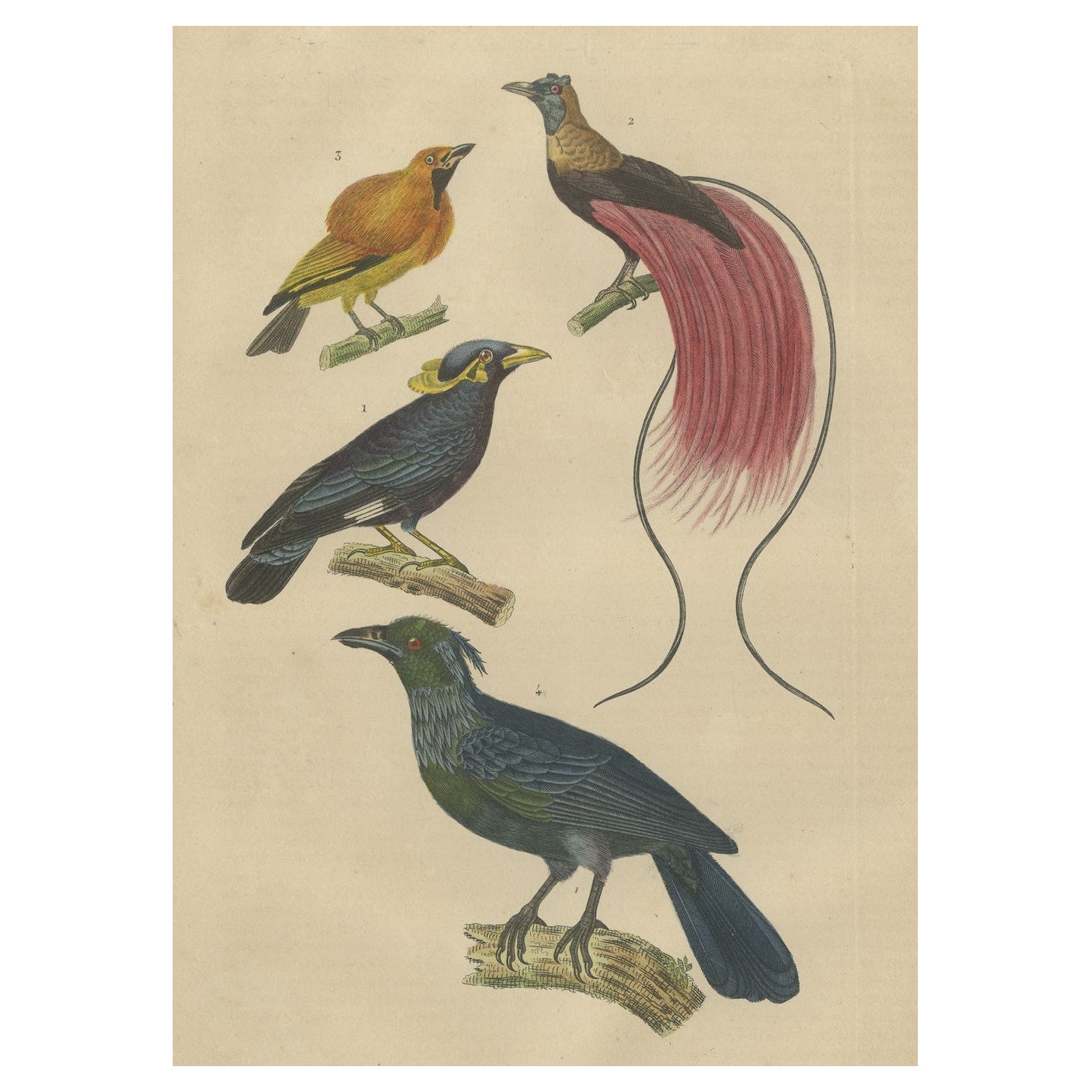
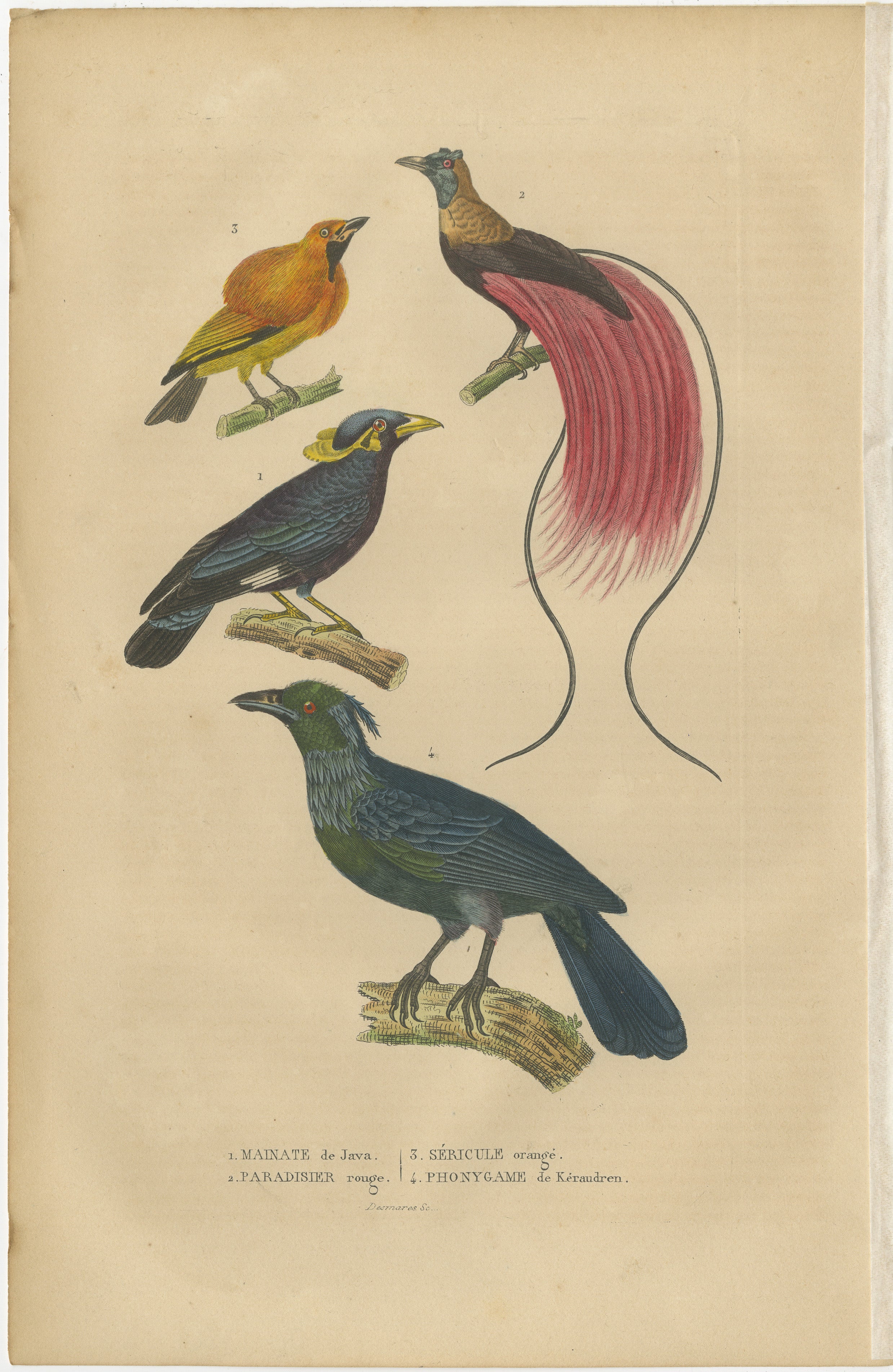
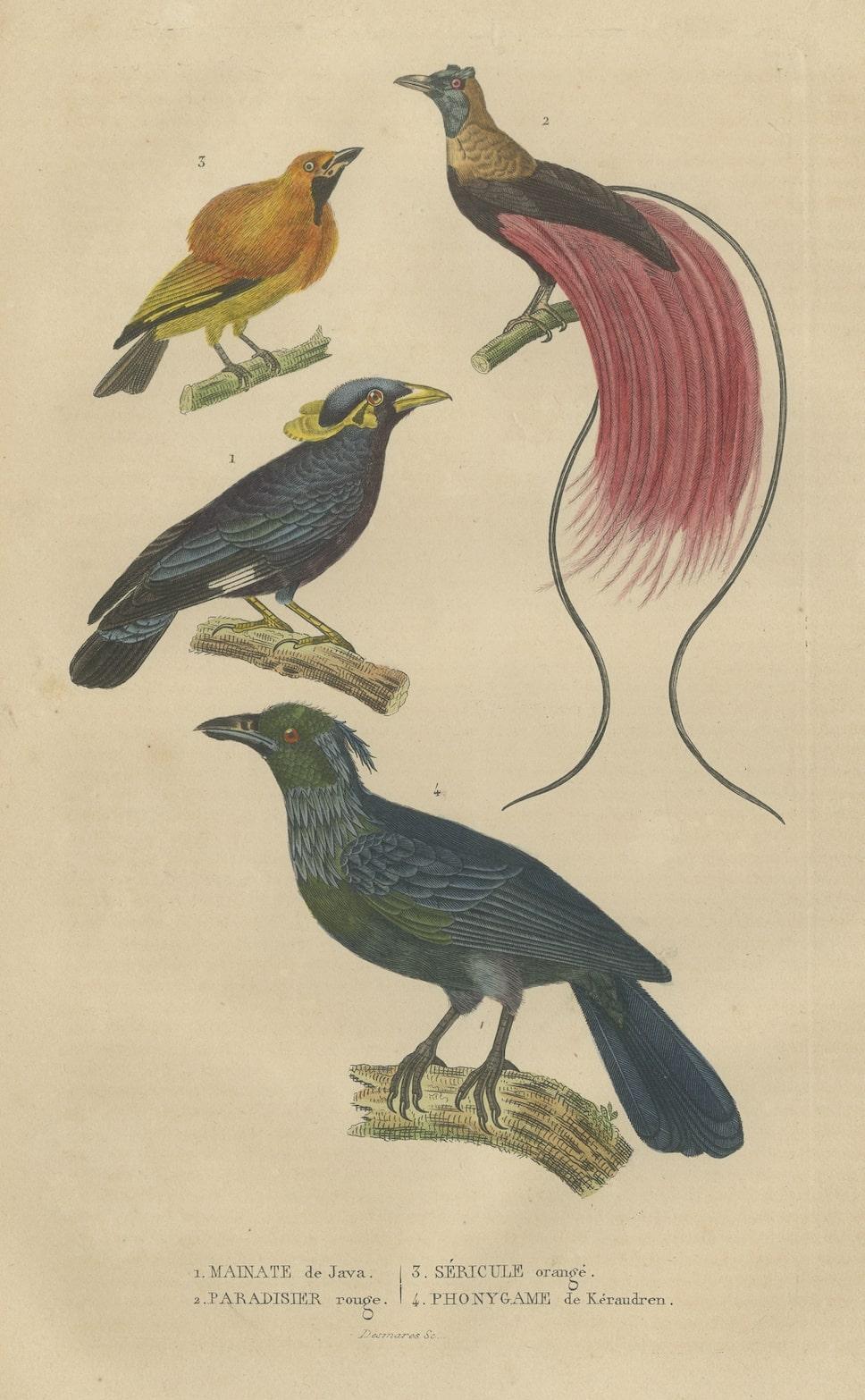
Beautiful print showing for birds of Asia, including the famous Bird of Paradise
Title: ‘1. MAINATE DE JAVA, 2. PARADISIER ROUGE, 3. SERICULE ORANGE, 4. PHONYGAME DE KERAUDREN.’, 2. STEATORNIS CARIPENSIS – GUACHARO DE CARIPE.’
"Mainate de Java" translates to "Javan Myna" in English. The Javan Myna is a bird species native to Southeast Asia, specifically found in countries like Indonesia, Malaysia, and Singapore. It's known for its adaptability to urban environments and its ability to mimic various sounds.
The Paradisier Rouge translates to "Red Bird-of-Paradise" in English. This species, Paradisaea rubra, is a bird-of-paradise found in the forests of New Guinea. The male Red Bird-of-Paradise is known for its vibrant red plumage and intricate courtship displays, showcasing its colorful feathers to attract mates.
"Sericule orange" translates to "Orange-breasted Trogon" in English. The Orange-breasted Trogon is a bird species found in parts of Africa, known for its distinctive orange-colored breast plumage and its presence in forested habitats.
"Phonygammus keraudrenii" or 'Trompetparadijskraai' refers to Keraudren's Phonygamm, a species of bird found in New Guinea. This bird is known for its striking appearance, characterized by its colorful plumage and unique features. Glossy black large songbird with a red eye, long rounded tail, and small shaggy plumes on back of neck. Prefers the middle to upper canopy of rainforest, where it often perches prominently. Compare Spangled Drongo (forked tail), Metallic Starling (much smaller, pointed tail), and male Pacific Koel (larger, with pale bill). Gives a loud, piercing contact call.
More info on the book in which it was published:
The 'Dictionnaire Classique des Sciences Naturelles' by Pierre Auguste Joseph Drapiez stands as a remarkable testament to 19th-century natural sciences. Published in Brussels in 1845, this work represents an expansive collation of knowledge, building upon the pioneering works of Buffon, Daubenton, Lacepede, Cuvier, de Jussieu, and other influential naturalists.
The prints within this compendium likely showcase a rich amalgamation of artistic precision and scientific accuracy. Drapiez, himself a Belgian naturalist, would have aimed for detailed representations of flora, fauna, and scientific phenomena, mirroring the illustrative styles prevalent during his time. Given the era's emphasis on illustration, these prints were likely engraved meticulously, possibly portraying intricate anatomical details or lifelike depictions of the natural world.
With Drapiez's background in natural history, the prints might bear testament to his commitment to scientific authenticity, aiming to educate and inspire scholars and enthusiasts alike. These engravings would have complemented the text, offering visual aids that elucidate the concepts and specimens discussed in the volume.
Overall, the prints of 'Dictionnaire Classique des Sciences Naturelles' likely serve as both artistic representations and invaluable scientific resources, encapsulating the essence of 19th-century natural history exploration and documentation.